Danny Boyle’s 2008 Oscar-winner, Slumdog Millionaire. It’s a drama about a kid winning a game show. But visually, this film was a prototype for modern hybrid filmmaking. It traded resolution for energy and proved that “cinematic” doesn’t necessarily mean “pristine.” I remember watching this and realizing that the technical imperfections the noise, the shutter angles, the mixed formats were actually the secret sauce. Here is my breakdown of how they pulled it off.
About the Cinematographer
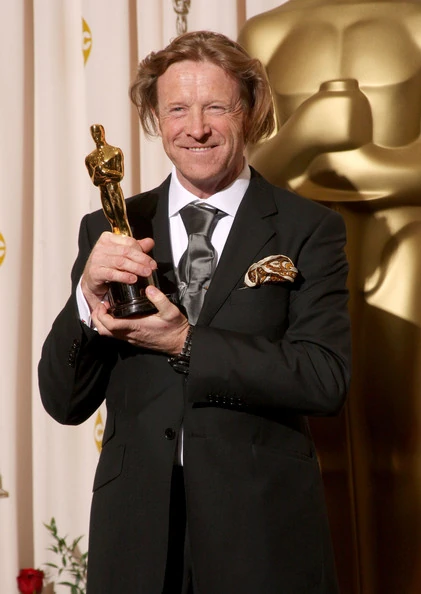
The visual architect behind Slumdog Millionaire is Anthony Dod Mantle. If you follow his work (he also shot 28 Days Later), you know he is a pioneer of the “run and gun” digital aesthetic. He isn’t interested in traditional Hollywood glamour; he comes from the Dogme 95 school of thought, where the emotion of the moment supersedes technical perfection.
For Slumdog, Mantle was the only logical choice. Shooting in the dense slums of Mumbai with massive 35mm cinema cameras would have been a logistical nightmare. Boyle needed someone who could move fast, blend into the crowd, and treat the camera like a documentary tool. Mantle’s willingness to use what were essentially prototype digital cameras allowed the crew to capture an energy that a traditional cinematographer would have missed while setting up lights.
Inspiration Behind the Cinematography
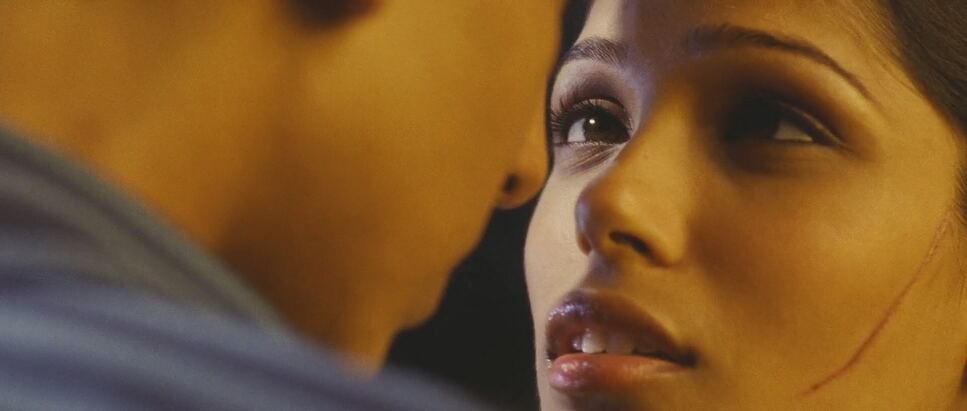
Mumbai acts less like a backdrop in this film and more like an antagonist. It creates obstacles, it separates lovers, and it physically beats the characters down. The visual inspiration seems to stem from this friction between the “destined” nature of Jamal’s victory and the gritty reality of his environment.
The film visually articulates the tension between India’s rapid globalization and its deep-rooted struggles. We see a blend of hyper-realism almost documentary-style coverage of the slums clashing with the magical realism of the “It is Written” theme. Visually, this required a style that could pivot from the brutal reality of the riots to the glossy, artificial high of the game show studio without giving the audience whiplash. It’s an ambitious tightrope walk, balancing despair and a “Bollywood” payoff in the same visual language.
Camera Movements
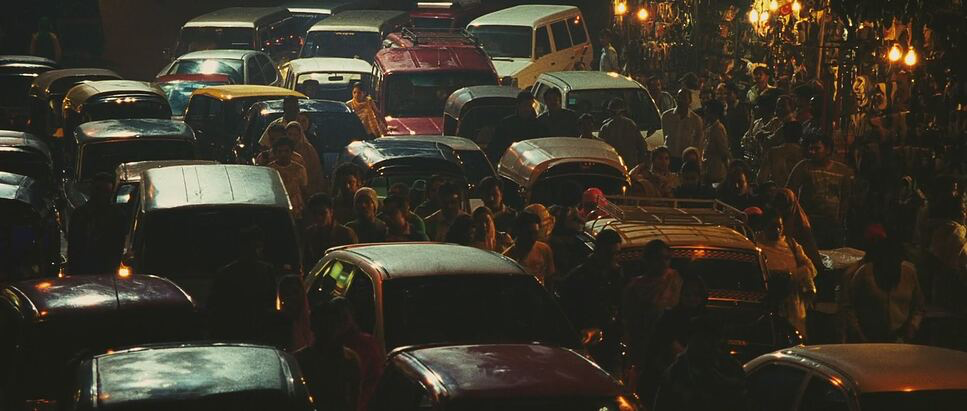
If there’s one defining characteristic here, it’s the lack of stability. Handheld is king, particularly in the Dharavi slum sequences and the chase scenes. But this isn’t just “shaky cam” for the sake of action; it puts us inside Jamal’s subjective experience. The camera jostles because Jamal is being jostled.
Boyle and Mantle also lean heavily into the Dutch angle (tilted horizon). While film students are often told to avoid this, here it serves a purpose: it amplifies the imbalance of Jamal’s world. His life is precarious, so the frame is precarious. When the story shifts to the Who Wants to Be a Millionaire studio, notice how the camera settles down. It becomes smoother, more mechanical (using jibs and cranes), contrasting the organic chaos of the streets with the controlled, manufactured tension of the game show.
Compositional Choices
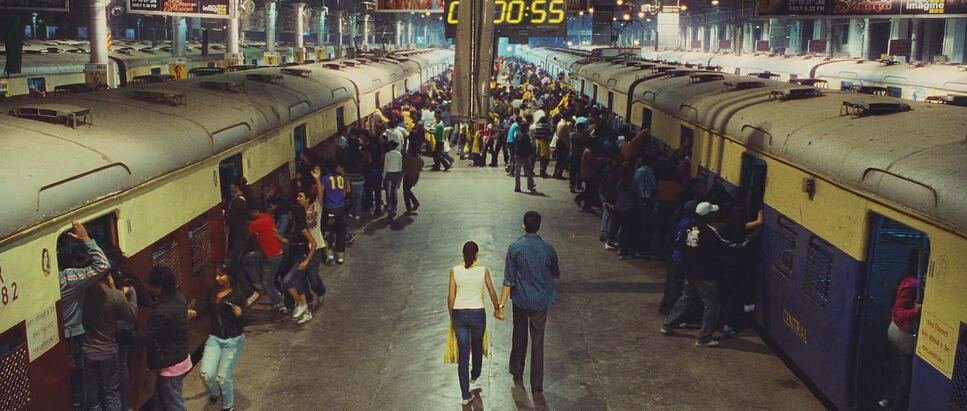
Mantle’s compositions are incredibly smart about space. In the slums, he uses wide-angle lenses to pack the frame with information. There is rarely a clean single shot; the frame is usually cluttered with people, architecture, and movement. This density conveys the overwhelming nature of the ecosystem Jamal lives in privacy is a luxury he doesn’t have.
Conversely, in moments of isolation, Mantle creates frames that feel claustrophobic. The interrogation scenes are a great example: the camera is tight, often uncomfortably close to the lens, mirroring the pressure Jamal is under. But look at the scenes with Latika at the train station suddenly, we get negative space. The composition breathes, hinting at the possibility of freedom. It’s a subtle shift, but it unconsciously guides how we interpret the character’s headspace.
Lighting Style
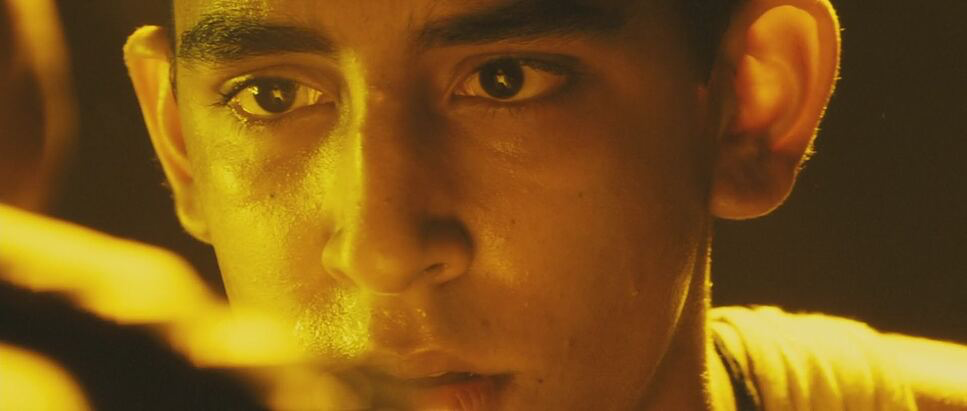
The lighting in Slumdog is a masterclass in mixed sources. In the location work, Mantle isn’t trying to overpower the Indian sun with HMI lights; he’s shaping what’s already there. We see a lot of hard, top-down sunlight which creates deep eye sockets and harsh shadows a look many DPs avoid, but one that feels authentic to the harsh environment here.
In the night scenes, he embraces the available street lamps and fluorescents, allowing the “ugly” green and orange spikes in the spectrum to exist rather than correcting them out. This grounds the film in reality. Then, you have the game show set. The lighting there is high-key, glossy, and perfectly separated. It feels fake because it is fake—it’s a stage where Jamal is being judged. The contrast between the gritty, mixed-light slums and the perfectly calibrated studio lighting does half the storytelling work for us.
Lensing and Blocking
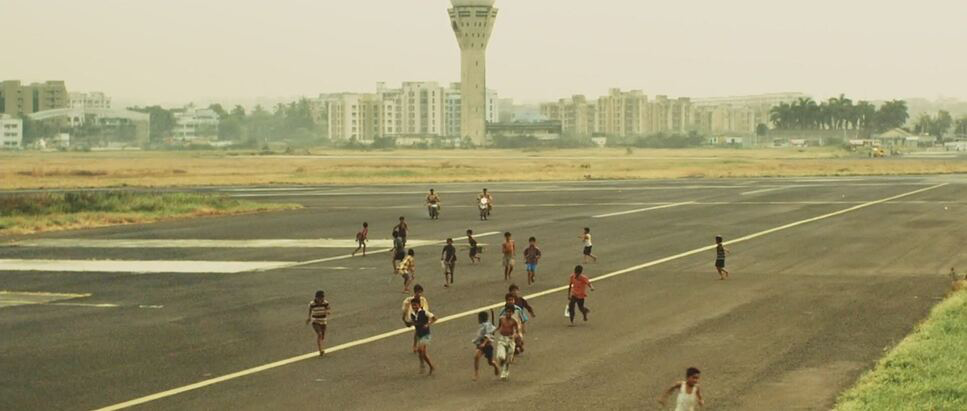
Mantle predominantly favored wide-angle zooms (like the Angenieux Optimos) for the handheld work. Wide lenses on the smaller sensor cameras they were using allowed for a massive depth of field. This means that even when running through a crowd, the background remains relatively sharp, keeping the context of the slum constantly visible.
Blocking this film must have been a nightmare. The “chase” scenes often involved running through actual crowds who didn’t know a movie was being filmed. The blocking is dynamic characters are constantly moving toward or away from the lens, rarely moving across the plane. This Z-axis movement creates a 3D feel, dragging the audience into the screen rather than letting us observe from a distance.
Color Grading Approach
As a colorist, this is where the film gets interesting for me. The grade was handled by the legendary Jean-Clément Soret. What fascinates me is how he managed to match footage from 35mm film with early, noisy digital sensors.
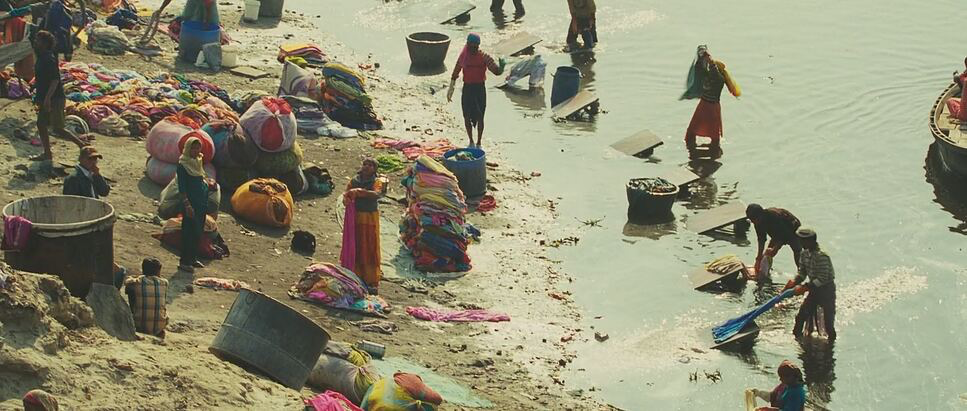
The look is defined by aggressive contrast and a “bleach bypass” feel in the highlights, particularly in the childhood sequences. The blacks are often crushed, sacrificing shadow detail to increase perceived sharpness and grit. Color-wise, Soret pushes the separation: the warm, saffron yellows and oranges of the Indian landscape are exaggerated against cooler cyans in the shadows. This isn’t a naturalistic grade; it’s a psychological one.
As the film progresses towards the climax, the grade cleans up. The “digital noise” of the slums gives way to the cleaner, richer tones of the studio and the final dance number. The saturation remains high throughoutthis is India, after all but the tonal curve softens, reflecting the “happy ending” resolution.
Technical Aspects & Tools
Slumdog Millionaire
Technical Specifications & Production Data
| Genre | Drama, Romance, Gambling, Coming-of-Age |
|---|---|
| Director | Danny Boyle, Loveleen Tandan |
| Cinematographer | Anthony Dod Mantle |
| Production Designer | Mark Digby |
| Costume Designer | Suttirat Anne Larlarb |
| Editor | Chris Dickens |
| Colorist | Jean-Clement Soret |
| Time Period | 2000s |
| Color Palette | Warm, Saturated, Orange, Yellow |
| Aspect Ratio | 2.35 – Super 35, 3 perf |
| Format | Film – 35mm |
| Lighting | Soft light, Low contrast, Top light |
| Lighting Type | Daylight |
| Story Location | Asia > India |
| Filming Location | Asia > India |
| Camera | Arricam LT, Arricam ST, Arriflex 235, Arriflex BL4, Canon EOS 1DX, Silicon Imaging SI-2k |
| Lens | Angenieux Optimo Zooms, Century Angenieux 23-460mm, Zeiss Ultra Prime |
| Film Stock / Resolution | 8543/8643 Vivid 160T, 8563/8663 Eterna 250D, 8573/8673 Eterna 500T, 8522/8622 F-64D, 8592/8692 Reala 500D |
This film is famous for its camera package. While they carried Arricam LT and ST film cameras, the real hero was the Silicon Imaging SI-2K.
This was a tiny distinctive digital camera where the recording unit was separated from the sensor head, allowing Mantle to hold just a small lens block in his hand while the recorder was in a backpack. This form factor allowed for angles and proximity that a standard cinema camera simply couldn’t achieve. They also famously utilized the Canon EOS-1D Mark III (a DSLR) using its burst photo mode to capture high-speed sequences, which gave the motion a choppy, staccato feel that became part of the film’s visual signature.
From a post-production standpoint, the challenge would have been matching the color science of Silicon Imaging, Canon stills, and Kodak film stock. The fact that the final image feels cohesive is a testament to the heavy lifting done in the DI (Digital Intermediate) suite.
- Also read: THE MARTIAN (2015) – CINEMATOGRAPHY ANALYSIS
- Also read: DEADPOOL (2016) – CINEMATOGRAPHY ANALYSIS
Browse Our Cinematography Analysis Glossary
Explore directors, cinematographers, cameras, lenses, lighting styles, genres, and the visual techniques that shape iconic films.
Explore Glossary →