When I sit down to analyze Tumbbad (2018), I can’t help but perform a surgical examination of the frame. Frankly, few films have gripped my professional curiosity quite like Tumbbad.This isn’t just another horror flick; it’s a mythical odyssey steeped in a uniquely Indian aesthetic. One reviewer called it “a tale of retribution and how greed consumes,” and they’re spot on. It pulls you into a rain-soaked, mud-caked world that whispers ancient curses. The visual storytelling here isn’t just “good” it’s masterful. It defines the film’s identity as much as the narrative of Hastar and Vinayak’s relentless pursuit of gold. For me, it’s the benchmark of what Indian cinema can achieve when craft meets vision.
About the Cinematographer
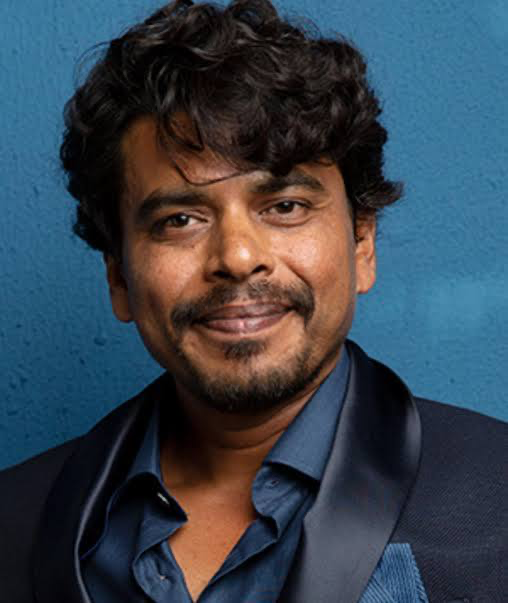
The man behind the lens is Pankaj Kumar. I’ve been following his work for a while, and there’s a distinct thoughtfulness to his approach. He’s not someone who just “points and shoots.” There is a profound understanding of how light, shadow, and composition serve the emotional truth of a moment.
He worked previously on Ship of Theseus, which showed his eye for philosophical depth, but Tumbbad was a whole different beast. It demanded a blend of raw, grounded realism for the poverty-stricken village and a painterly, almost fever-dream quality for the mythological elements. Kumar navigated this tightrope with grace, creating a visual language that feels both ancient and contemporary. He understands that a cinematographer’s role isn’t just technical execution it’s about translating a script’s soul into visual poetry.
Inspiration Behind the Cinematography
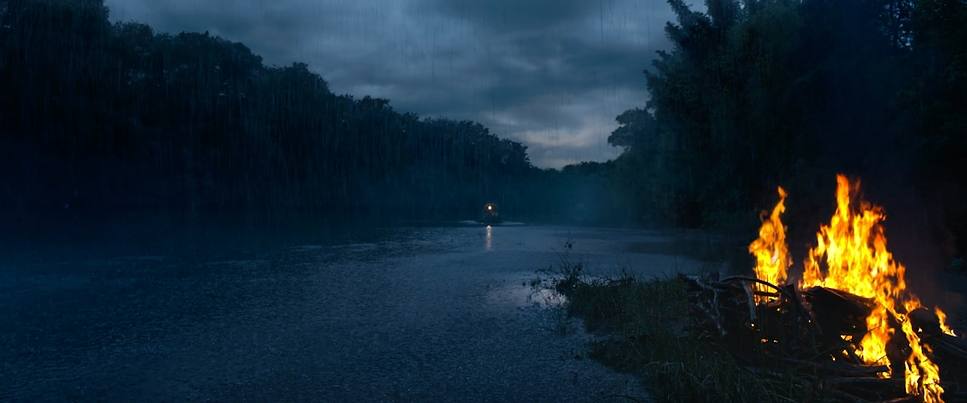
The core of Tumbbad’s visual language is duality. The constant, oppressive rain isn’t just weather; it’s a character. This unending downpour sets a desaturated, heavy tone that implies decay. But amidst that grim reality, there’s the allure of gold a gleaming, impossible promise.
The challenge was making a fantastical horror film rooted in local folklore feel authentic rather than “stagey.” They balanced the mythic scale of Hastar’s legend with the intimate, squalid lives of the characters. People often mention how “rich” the film looks, but it’s not a gaudy richness. It’s a richness of texture, deep shadows, and meticulously crafted production design. Every frame feels steeped in the history of the curse, blending cultural authenticity with a global visual grammar.
Camera Movements
Pankaj Kumar’s camera choices are incredibly deliberate. In the rain-swept exteriors, there’s a sense of slow, creeping dread. He uses wide, observational establishing shots to underscore the isolation of the village. The camera often glides like an unseen presence through the dilapidated mansion, making Vinayak’s quest feel voyeuristic and forbidden.
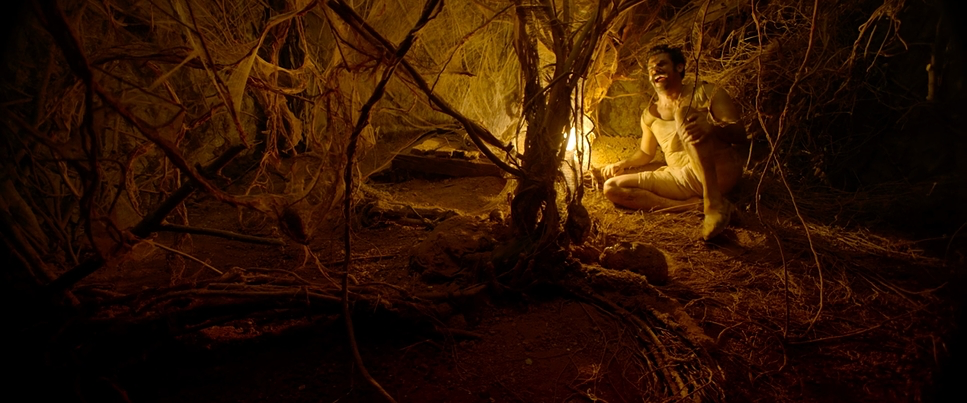
The real magic, though, happens in the goddess’s womb. The camera becomes an extension of Vinayak’s paranoia. We see a lot of motivated movement tracing his nervous glances or creeping low to emphasize the claustrophobia. When Hastar appears, the camera mirrors his erratic movements, becoming dynamic and unsettling. Those scenes with the “yelling and crawling on the walls” demand a camera that can keep pace with a monster, often employing subtle handheld work to inject a raw quality. Then, suddenly, Kumar will hit you with a powerful static shot, forcing you to absorb a grotesque discovery without the mercy of a cut.
Compositional Choices
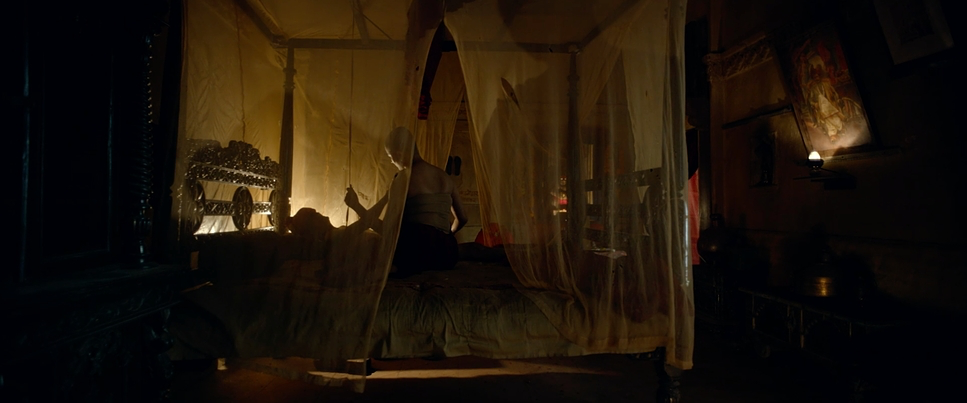
This film is a masterclass in telling a story through the frame with minimal dialogue. Kumar consistently uses deep-focus compositions, especially in the mansion. This allows multiple layers of information to exist at once, reinforcing the secrets hidden within the walls.
The use of negative space is what really struck me. When Vinayak is in the vast interiors or descending the well, he’s a tiny figure against an encroaching darkness. It highlights his vulnerability against forces he can’t control. Look at how they frame the great-grandmother in that dark room; you rarely get a clear look at her. She’s glimpsed in fragments and shrouded in shadow. As Vinayak himself transforms, the compositions morph to reflect his degradation, using distorted perspectives to highlight his new reality.
Lighting Style
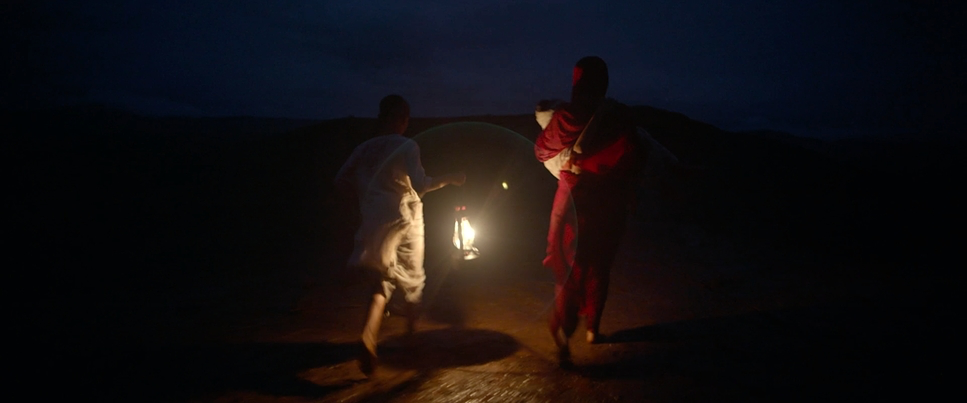
The lighting is arguably the film’s most defining characteristic. It’s as much about what you don’t see as what you do. A low-key approach dominates, reflecting the “never-ending rain.” Exteriors are drenched in soft, diffused light—or more accurately, a lack of direct light which grounds the fantasy in a gritty reality.
Indoors, especially in the mansion, Kumar uses motivated lighting. Flickering oil lamps and sparse natural light filtering through grimy windows create a heavy chiaroscuro effect. The shadows aren’t just black; they are inky and rich. When Vinayak descends into the womb, the lighting becomes sparse and otherworldly. Torchlight cuts through absolute darkness, highlighting the grotesque textures of the environment. The “pulsating” feel of those flesh-like walls would have been impossible to sell without this level of precision.
Lensing and Blocking
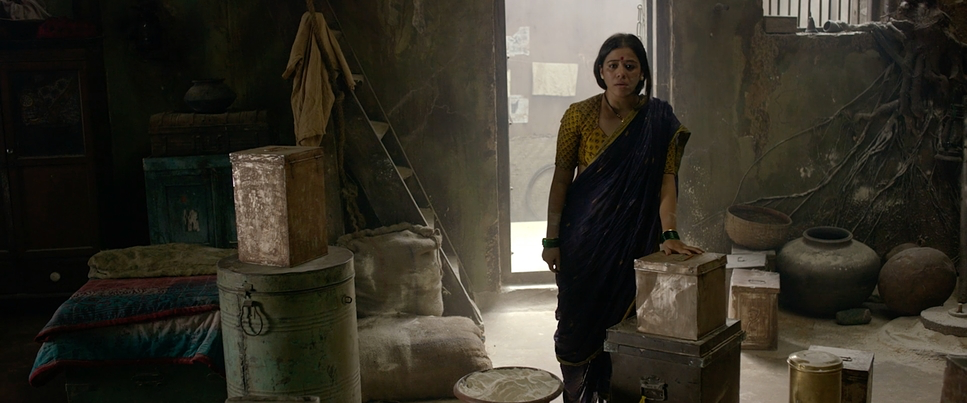
As a colorist, I notice when filmmakers choose glass with a purpose. For the wide shots of the village, I’d bet they leaned toward 24mm or 35mm primes. These focal lengths give a sense of scale without excessive distortion, capturing the sprawling decay of the ancestral home.
But in the intimate, terrifying moments, the lens choices shift. They move to tighter glass likely 50mm or 85mm primes to isolate characters and magnify their fear. When Hastar emerges, I noticed wider, slightly distorted lenses used from low angles to make the creature feel larger and more suffocating.
Blocking is the subtle masterstroke here. It’s never just about where an actor stands. Think of Vinayak in the early scenes cramped and small. Later, as he gains wealth, the blocking places him centrally, dominating the frame. I did something similar on a small indie drama recently; we used blocking to make the protagonist physically shrink within the frame as his anxiety grew. In Tumbbad, Vinayak’s journey from a confident stride to a hesitant creep as he enters the womb tells you everything you need to know about his internal battle between greed and terror.
Color Grading Approach
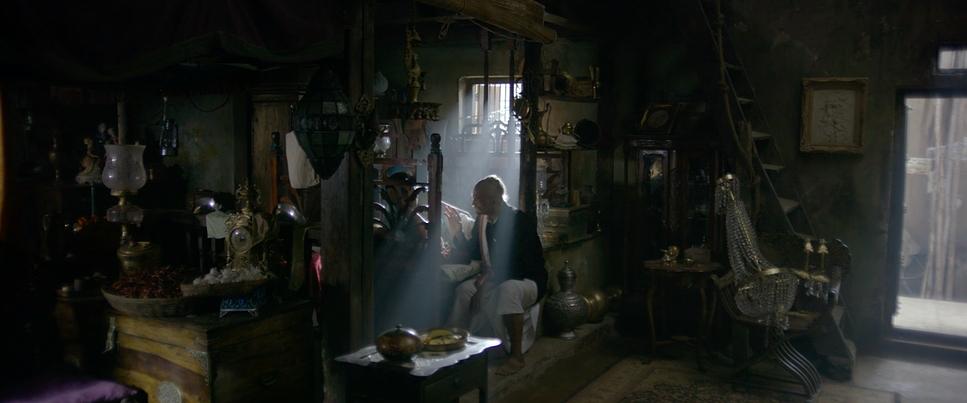
This is where I really connect with the film. Tumbbad’s grade is the soul of its narrative. This isn’t a vibrant, saturated “Bollywood” look. The palette is dominated by earthy browns, deep greens, and a melancholic blue-grey.
Within this restrained palette, the colorist (Tushar Jadhav) performed surgical hue separation. The reds—the blood or the warmth in Vinayak’s human moments really pop against the muted backdrop. And then, there’s the gold. It’s often the single brightest and warmest element in a cool frame, an almost sickly yellow-orange that screams avarice.
The tonal sculpting is incredible. The shadows are deep but hold information without feeling “crushed.” The highlights have a beautiful, filmic roll-off they never feel “blown out” or digital. There’s a subtle grit added that prevents the image from ever looking too clean or sterile, which perfectly serves the theme of moral rot.
Technical Aspects & Tools
Tumbbad: Technical Specifications
| Genre | Fantasy, Horror, Monster, Occult |
| Director | Rahi Anil Barve |
| Cinematographer | Pankaj Kumar |
| Production Designer | Rakesh Yadav, Nitin Zihani Choudhary |
| Costume Designer | Sachin Lovalekar, Smriti Chauhan |
| Editor | Sanyukta Kaza |
| Colorist | Tushar Jadhav |
| Time Period | 1910s |
| Color | Cool, Saturated, Blue |
| Aspect Ratio | 2.39 – Anamorphic |
| Format | Digital |
| Lighting | Soft light, Low contrast |
| Lighting Type | Daylight, Overcast, Artificial light, Mixed light |
| Story Location | Maharashtra > Tumbbad |
| Filming Location | Maharashtra > Tumbbad |
The technical execution here is top-tier. While I don’t have the call sheet in front of me, the image quality suggests a high-end digital cinema camera with serious dynamic range likely an ARRI Alexa given that classic skin-tone rendition.
The VFX work is commendable because of how it integrates with the lighting. To make a creature like Hastar look “Hollywood” on an Indian budget requires excellent on-set supervision and a seamless marriage of CGI and practical effects. The “pulsating scene” in the womb is a testament to the art direction. The production clearly understood which technical elements would yield the greatest emotional return. They didn’t just spend money; they spent it where it mattered.
- Also read: DIABOLIQUE (1955) – CINEMATOGRAPHY ANALYSIS
- Also read: THE BEST YEARS OF OUR LIVES (1946) – CINEMATOGRAPHY ANALYSIS
Browse Our Cinematography Analysis Glossary
Explore directors, cinematographers, cameras, lenses, lighting styles, genres, and the visual techniques that shape iconic films.
Explore Glossary →