I’m Salik Waquas. As a filmmaker and colorist running Color Culture, I’m constantly hunting for films that don’t just use technology, but disappear behind it. Top Gun: Maverick is exactly that beast. It isn’t just a legacy sequel; it’s a masterclass in hybrid filmmaking—blending old-school practical stunts with the absolute bleeding edge of digital capture. After years of delays, the visceral impact of this film left me buzzing. It’s a stark reminder of what the big screen is actually for, and honestly, it sets a standard for visual fidelity that the rest of our industry needs to be chasing.
About the Cinematographer
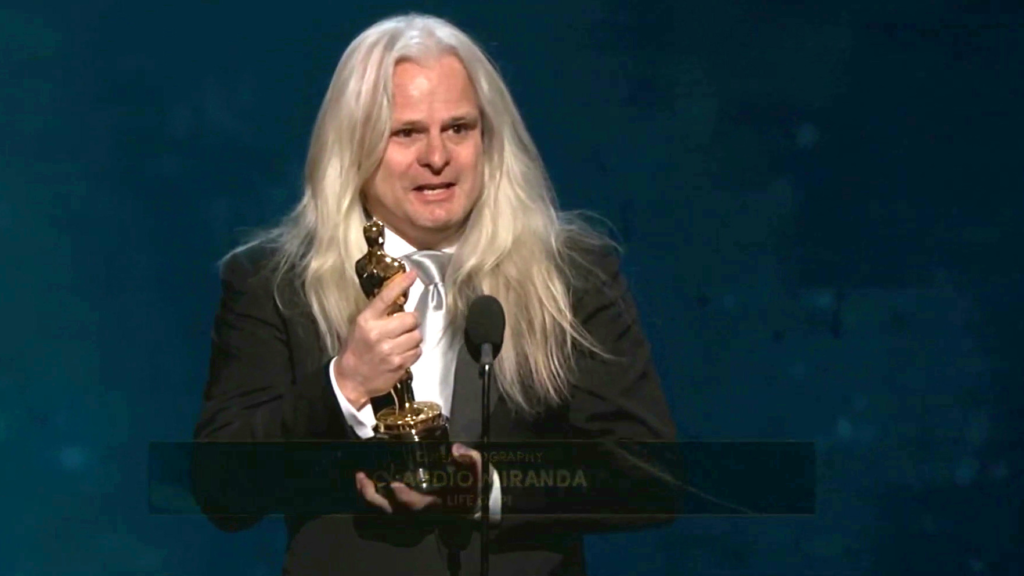
The lens behind Maverick belongs to Claudio Miranda, ASC. If you know his work with director Joseph Kosinski on Oblivion or Tron: Legacy, you know Miranda is obsessed with clean, high-contrast digital imagery. But this project required him to pivot from the stylized digital worlds he’s known for (including his Oscar-winning work on Life of Pi) to something gritty and tactile. His challenge wasn’t just making aerial sequences look “cool” it was about engineering a way to get IMAX-certified sensors inside a cockpit the size of a closet. It’s clear that his deep technical knowledge of the Sony VENICE ecosystem was the only reason this movie looks the way it does.
Inspiration Behind the Cinematography
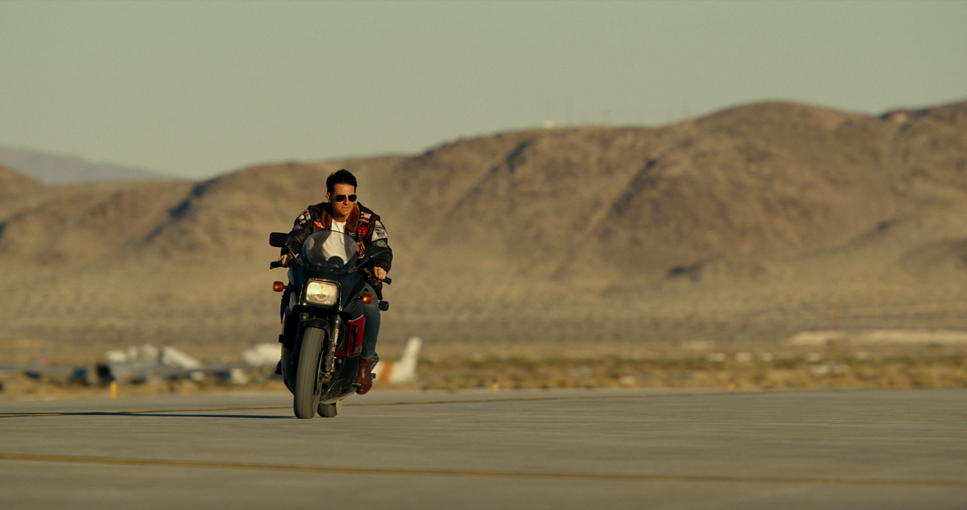
The primary inspiration was obviously Tony Scott’s original Top Gun, but Kosinski and Miranda stripped away the 80s romanticism for something harder and faster. As one reviewer noted, the original was made before CGI allowed filmmakers to do anything with zero risk. Maverick took that ethos and doubled down on the practical danger. Tom Cruise’s insistence on practical effects was the bedrock of the visual strategy; they wanted to, as the production put it, “gleefully shit in the face of the bland, sterile CGI garbage” we’ve been fed for the last decade.
This meant putting actors in real F/A-18 Super Hornets and pulling real Gs. The cinematography had to serve that reality, not hide it. The goal wasn’t just to replicate the spirit of the original but to fix its limitations. In 1986, they couldn’t fit a high-quality camera in the cockpit with the actor. Today, Miranda could. The inspiration here was pure physics: capturing the violent vibration, the light shifts, and the atmospheric pressure that no green screen compositor can ever truly fake.
Camera Movements
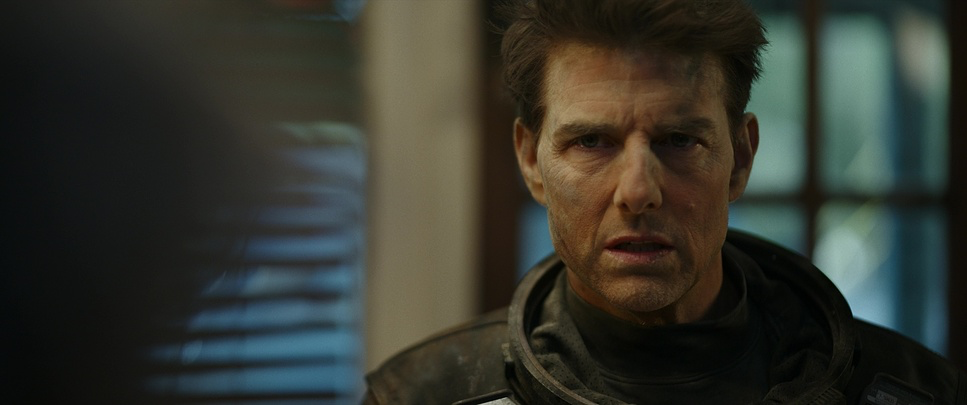
When you’re filming inside a jet pulling 7 Gs, “camera movement” isn’t about dollies or steadicams—it’s about holding on for dear life. The in-cockpit shots are a study in relative motion. Miranda utilized the Sony VENICE Rialtoextension system, which allowed them to detach the sensor block from the camera body. This was the game-changer. They could mount six of these sensor blocks inside the cockpit to capture the actors’ faces contorting under actual gravitational force. The camera moves with the plane, locking the audience into the pilot’s perspective while the horizon spins wildly in the background.
External shots were equally complex. Using the CineJet platform (an L-39 Albatros jet rigged with cameras), they achieved air-to-air photography that feels terrifyingly fast. We aren’t seeing static tracking shots; we are seeing complex choreography at 400 knots. The ground-based shots use long lenses to compress the background, emphasizing the sheer speed of the jets tearing across the slat flats. It’s a delicate balance of smooth, stabilized motion in a chaotic environment, and they nailed it.
Compositional Choices
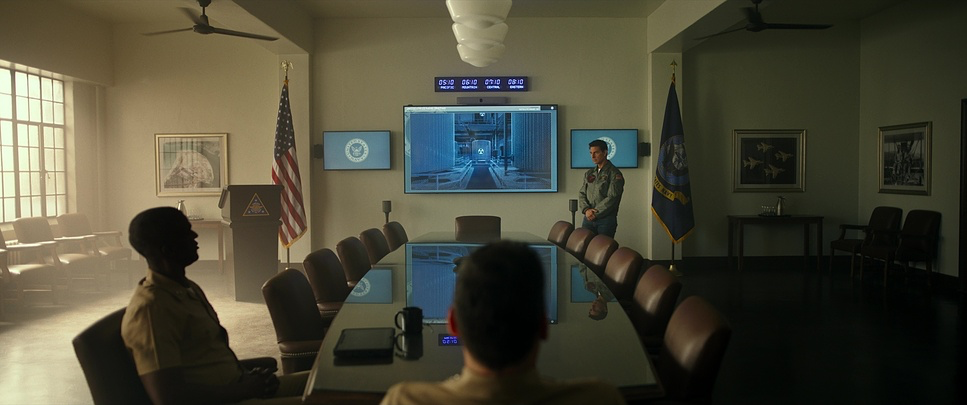
The composition in Maverick oscillates between the massive and the claustrophobic. Miranda uses the 1.90:1 IMAX aspect ratio to turn the sky into a massive canvas, frequently using strong horizon lines to ground the viewer before flipping that horizon upside down. Vapor trails serve as leading lines, guiding the eye through the 3D space of the dogfight.
However, the interior composition is where the genius lies. Instead of just tight chokers on the pilots’ faces, Miranda and Kosinski often opted for wider focal lengths inside the cockpit. They wanted us to see the instruments, the canopy rails, and the enemy aircraft over the pilot’s shoulder. This wide-angle approach maintains the context of the fight. We aren’t just watching an actor act; we are watching a pilot fly. It anchors the audience in the geography of the scene, which is crucial when the visual information is coming at you this fast.
Lighting Style
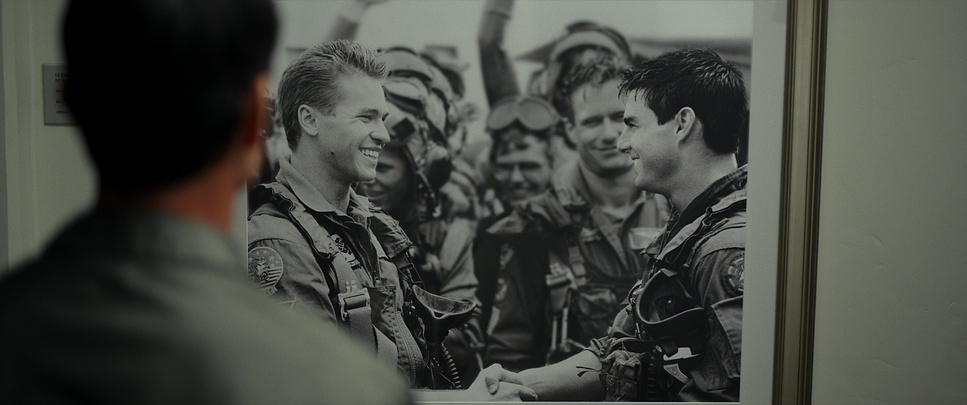
The lighting here is overwhelmingly motivated because, at 20,000 feet, you can’t exactly set up a skypanel. The sun is your key light, and Miranda used it with absolute mastery. The team had to chart the sun’s path for every single flight to ensure continuity. We see a lot of backlighting and high-contrast scenarios, particularly in the low-level training runs through the canyons. The “warm, desaturated” look listed in the production notes comes alive here, with the golden hour sun flaring aggressively into the lens.
Inside the cockpits, the lighting is a testament to the dynamic range of the VENICE sensor. Sunlight streams through the canopy, creating specular highlights on the helmets and visors that would clip on a lesser camera. There are plenty of lens flares, but they feel like authentic byproducts of the spherical glass rather than post-production plug-ins. For ground scenes, the lighting shifts to more controlled, soft sources, but it retains that naturalistic fall-off. It prioritizes authenticity over “glamour” lighting, which fits the military aesthetic perfectly.
Lensing and Blocking
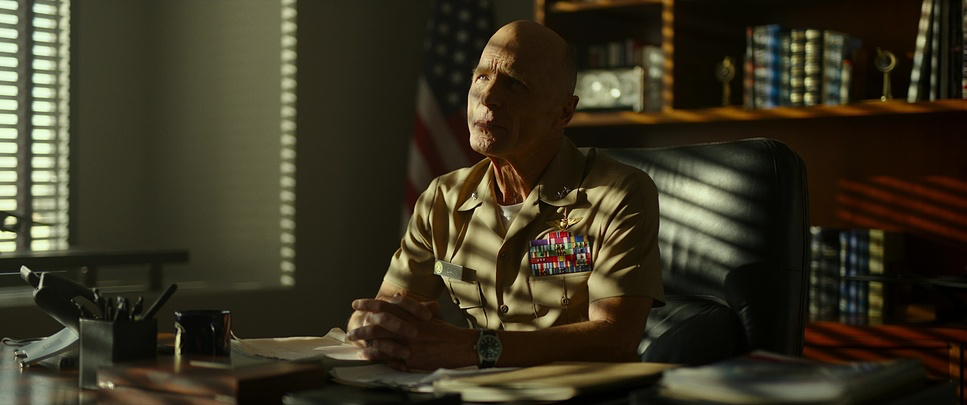
To pull this off, the glass matters as much as the sensor. Miranda employed a mix of Fujinon Premier zooms, Sigma Cine lenses, and Zeiss Master Primes. The choice to go spherical rather than anamorphic was crucial—it allowed for a taller frame (protecting for IMAX) and avoided the optical distortions that might have made the aerial horizons look bowed or distracting.
In terms of focal lengths, the film favors wider glass inside the cockpit to enhance that immersive POV feel. It exaggerates the distance between the pilot and the ground, making the altitude feel more dangerous. “Blocking” in this film is unique because the actors are strapped to ejection seats. The blocking was essentially dictated by the flight plan. The camera placement had to anticipate where the pilot would look and how their body would slump under G-force. It’s a unique form of performance capture where the environment directs the actor, and the lens just needs to be in the right place to witness it.
Color Grading Approach
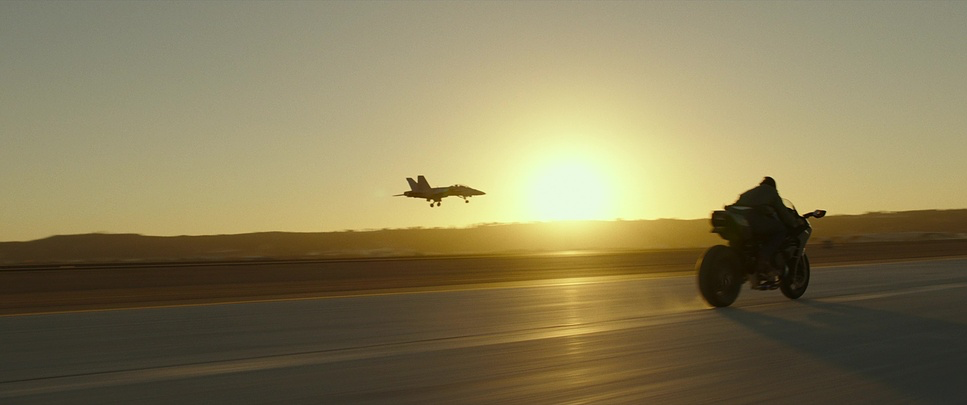
As a colorist, this is the part of the pipeline I appreciate most. The final grade was handled by the legendary Stefan Sonnenfeld at Company 3 (along with Adam Nazarenko), and you can see his fingerprints all over the image. The look isn’t the heavy-handed “teal and orange” of modern blockbusters; it’s a sophisticated, warm, and slightly desaturated palette that feels like high-end reversal film stock.
Sonnenfeld’s work on the contrast curve is exceptional. He manages to retain density in the highlights—look at the clouds and the sun flares—without them blowing out to pure white. There is a smooth, organic roll-off that emulates the response of celluloid. The shadows are deep and robust, providing that “crunchy” contrast that makes the aerial silhouettes pop, but they never get muddy. The separation between the warm skin tones and the cool, utilitarian greys and blues of the naval equipment is handled with subtle precision. It’s a DI (Digital Intermediate) that supports the narrative: it feels heated, sweaty, and dangerous. It doesn’t scream “color graded”; it just looks like a memory.
Technical Aspects & Tools
Top Gun: Maverick – Technical Specifications
| Genre | Action, Drama, Military, War |
| Director | Joseph Kosinski |
| Cinematographer | Claudio Miranda |
| Production Designer | Jeremy Hindle |
| Costume Designer | Marlene Stewart |
| Editor | Chris Lebenzon, Eddie Hamilton |
| Colorist | Stefan Sonnenfeld, Adam Nazarenko |
| Time Period | 2020s |
| Color | Warm, Saturated, Yellow |
| Aspect Ratio | 1.90 – Spherical |
| Original Aspect Ratio | 1.90, 2.35 |
| Format | Digital, Digital – Large Format |
| Lighting | Top light |
| Lighting Type | Daylight |
| Story Location | … North America > United States of America |
| Filming Location | … United States of America > California |
| Camera | Sony VENICE |
| Lens | Fujinon Premier Lenses, Sigma Cine Lenses, Zeiss Master Primes |
| Film Stock / Resolution | 4K |
The technical achievement here is monumental. The core of the production was the Sony VENICE, chosen for its full-frame sensor and dual-base ISO, which handled the shifting lighting conditions of aerial photography beautifully. But the MVP was the Rialto extension system. By separating the sensor block from the recorder, they could jam six IMAX-quality cameras into a space designed for one human.
The logistics of this data workflow are mind-boggling. They were recording 6K X-OCN RAW footage from multiple cameras simultaneously, generating petabytes of data. The cameras had to be ruggedized to withstand the G-forces and temperature drops at altitude. The “delays” mentioned in the press weren’t just marketing hype; they were necessary to engineer camera mounts that wouldn’t sheer off at Mach 1.6. They didn’t just point and shoot; they engineered a new way to capture reality.
- Also read: FULL METAL JACKET (1987) – CINEMATOGRAPHY ANALYSIS
- Also read: INDIANA JONES AND THE LAST CRUSADE (1989) – CINEMATOGRAPHY ANALYSIS
Browse Our Cinematography Analysis Glossary
Explore directors, cinematographers, cameras, lenses, lighting styles, genres, and the visual techniques that shape iconic films.
Explore Glossary →