Thor: Ragnarok (2017) feels less like a breakdown and more like a conversation. Taika Waititi’s 2017 entry didn’t just shift the tone of the MCU; it broke the mold entirely. At Color Culture, we often talk about how frame and color drive narrative, and Ragnarok is the perfect case study. It’s a film that fractures its visual language to serve two different worlds: the operatic gloom of Asgard and the jacked-up, neon chaos of Sakaar. It prioritized a “B storyline” that came to life not just through the script, but through a radical shift in lighting and color science.
About the Cinematographer
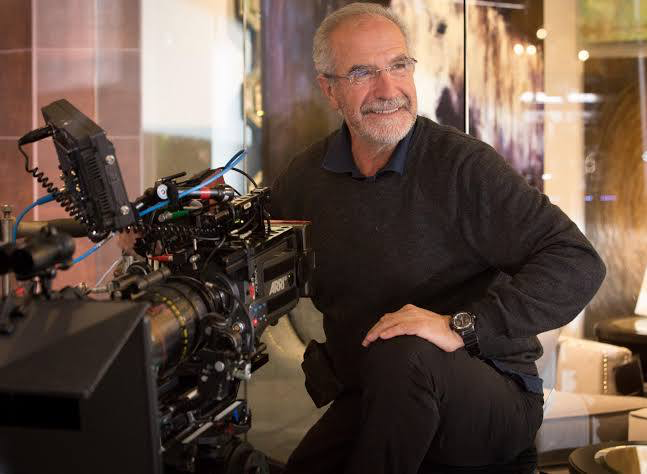
The DP behind this shift was Javier Aguirresarobe, which is a fascinating choice given his resume. Before Ragnarok, Aguirresarobe was known for atmospheric, heavy work on films like The Road where he shot bleak, desaturated landscapes and the visually sophisticated Vicky Cristina Barcelona.
Hiring him for Ragnarok was a gamble that paid off. It proves that a cinematographer’s skill isn’t just about having a signature “look,” but about adaptability. He had to pivot from the gritty realism of his earlier projects to a flamboyant, hyper-stylized comic book world. While Waititi’s vision dictated the aesthetic, Aguirresarobe brought a seasoned eye to a project that demanded both epic scale and precise comedic timing.
Inspiration Behind the Cinematography
The look of Thor: Ragnarok is built on a specific retro-futurism. It’s not just ’80s nostalgia; it’s a deliberate technical choice to embrace high saturation and “Jack Kirby-esque” designs. The reviews called it “deliberately ’80s space-operatic,” and that dictates the fabric of the cinematography.
You see it in the heightened color palette and the dynamic compositions. The planet Sakaar is where this influence takes over it’s essentially Mad Max meets The Fifth Element. Aguirresarobe and Waititi leaned into maximalism here: busy frames and constant visual stimulation. Unlike the grounded, sometimes dreary look of previous Thor films, Ragnarokneeded to feel like an unhinged romp. The cinematography had to sell a world entirely distinct from the “god-y settings” of Asgard. Even when the narrative shifts to serious moments, the visual language keeps that kitschy charm.
Camera Movements
The camera work serves two masters here: bombastic action and improvised comedy. For the action, particularly in the Sakaar arena, we see aggressive tracking shots. The camera follows Thor or Hulk with urgent momentum, pushing into close-ups on impact and pulling back for sweeping crane shots to show the scale of the crowd. It’s rarely static; it mirrors the “raging fire” of the characters.
But the film switches gears for the comedy. For scenes with the Grandmaster, the camera settles down. We get slow, precise pushes or static wide shots that let Jeff Goldblum inhabit the frame. There’s also noticeable handheld work during interactions between Thor and Valkyrie, which lends a sense of immediacy to their chemistry. This blend choreographed spectacle vs. reactive handheld creates a rhythm that keeps the audience engaged.
Compositional Choices
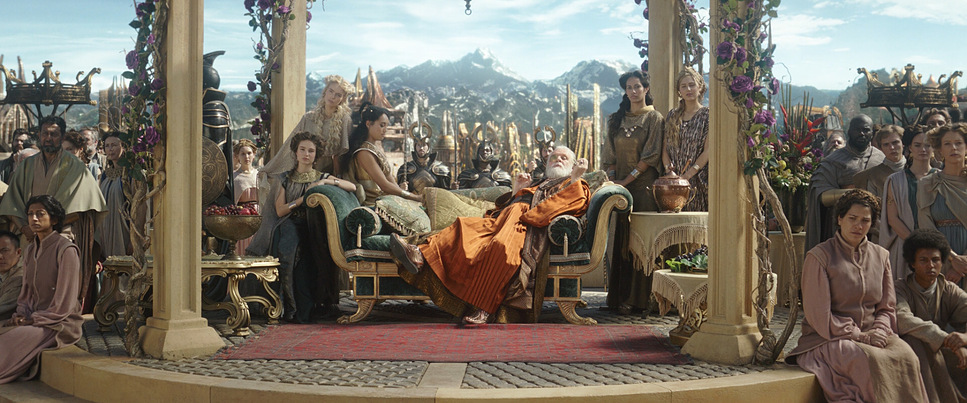
Composition plays a huge role in the comedy. On Sakaar, the frames are packed. Aguirresarobe utilizes wide and medium-wide shots to let the production design and the ensembles fill the screen. It creates a sense of organized chaos.
In the comedic beats, the composition often is the punchline. They isolate characters in wide shots to highlight absurdity or use tight framing to emphasize a reaction. The “go for the gag” mentality relies on clear sightlines, allowing Hemsworth and Ruffalo to play off each other physically.
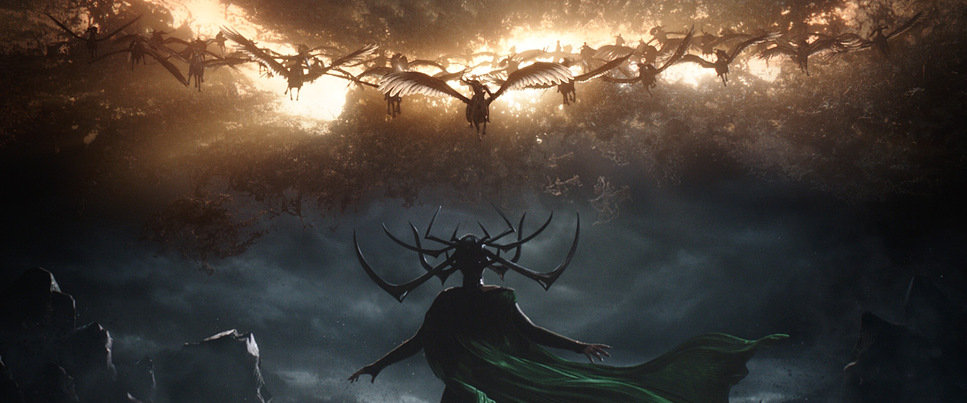
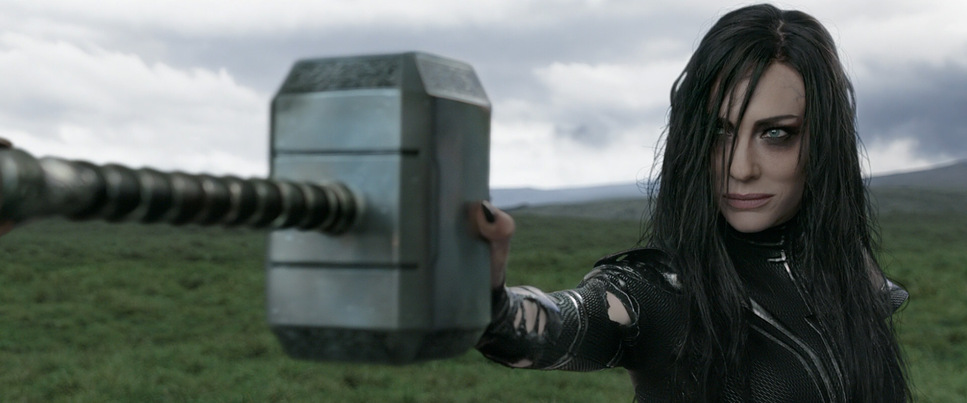
Contrast this with the Asgardian scenes. When Hela is on screen, the composition becomes classical and imposing. We see symmetrical framing and strong leading lines that underscore her power. The film manages to maintain clear visual storytelling despite the fragmented narrative by giving each realm a distinct compositional palette.
Lighting Style
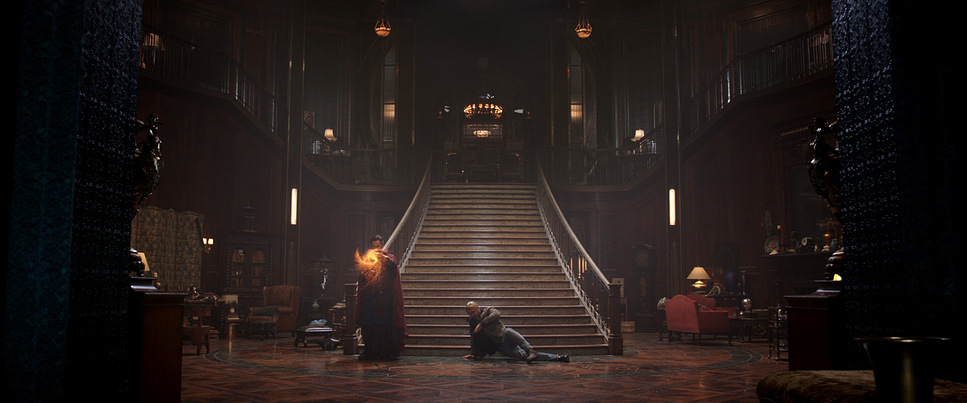
Lighting is the primary tool used to differentiate the two worlds. Asgard, especially upon Hela’s arrival, is lit with a high contrast ratio. We see deep shadows and stark highlights, often motivated by “natural” light filtering through halls, but shaped to feel operatic and gloomy. The palette is subdued cool blues and naturalistic daylight that eventually shifts to moody greens.
Sakaar is a different beast. It pushes into a theatrical realm with neon practicals and bold gels. The Grandmaster’s domain is bathed in a distinct sapphire blue a character-specific choice. The arena is a mix of fiery reds, electric blues, and purples, often clashing color temperatures in the same frame. It’s high-key and unashamedly bright. This isn’t just illumination; it’s world-building.
Lensing and Blocking
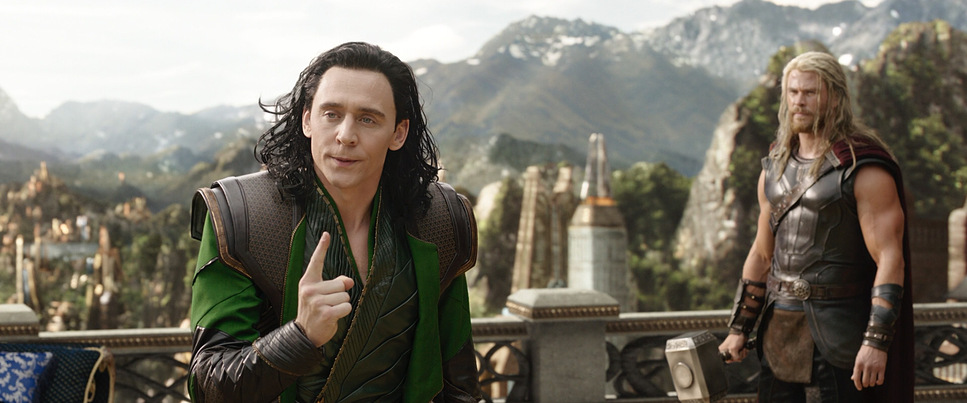
Technically, this is where the choice of gear matters. Aguirresarobe shot Ragnarok on the ARRI Alexa 65 using Hasselblad Prime 65 lenses. This large-format sensor is crucial to the look. It allows for those massive, expansive shots of Sakaar while maintaining a shallower depth of field than a standard Super 35 sensor. This helps separate characters from the busy, CGI-heavy backgrounds.
Blocking for comedy is like choreographing a play. The physical relationship between Thor and Hulk how one towers over the other is key to the humor. Considering Taika Waititi mentioned that 80% of the film was improvised, the focus pulling on these large-format lenses is impressive. The camera team had to be incredibly nimble. You can plan a master shot, but if an actor moves unexpectedly during a bit, the operator has to adjust instantly. That collaborative flexibility is why the performances feel alive; the camera is reacting to the actors, not just recording them.
Color Grading Approach
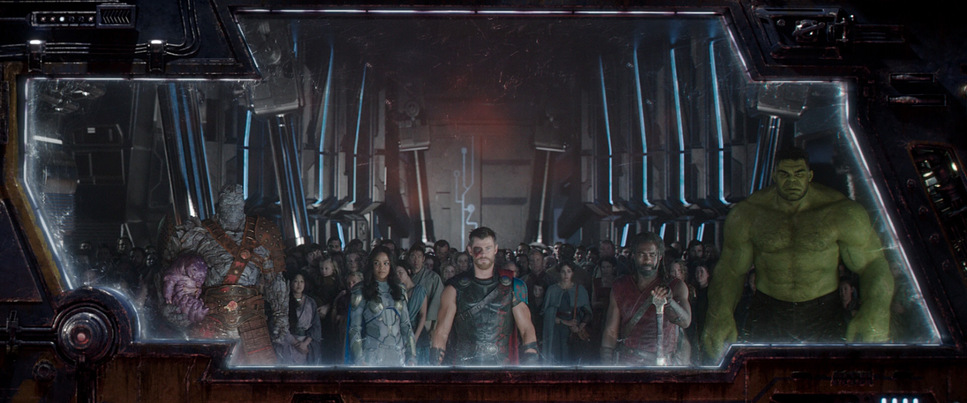
As a colorist, this is the fun part. The grade on Ragnarok (handled by veteran colorist Steven J. Scott) is aggressive.
On Sakaar, the strategy is hue separation. They didn’t just crank the saturation slider; they isolated specific ranges. The Grandmaster’s blue skin against the warm, fiery background of the arena is a perfect example of complementary color theory pushed to the extreme. The mid-tone contrast is punchy, giving the image weight, but the highlight roll-off is smooth. It feels like a print-film emulation likely modeled on a stock like Kodak 2383 which keeps the image from looking like a digital clip despite the neon colors.
Then you have Asgard. The grade shifts to cooler tones steely blues and grays. The shadows are crushed slightly more to convey menace. Even Thor’s lightning is a potent, elemental blue-white, distinct from the playful colors of the other world. The grade acts as the invisible hand, guiding us through these emotional landscapes and ensuring the film feels coherent despite the drastic tonal shifts.
Technical Aspects & Tools
| Thor: Ragnarok – Technical Specifications | |
|---|---|
| Genre | Action, Adventure, Comedy, Fantasy, Science Fiction |
| Director | Taika Waititi |
| Cinematographer | Javier Aguirresarobe |
| Production Designer | Dan Hennah, Ra Vincent |
| Costume Designer | Mayes C. Rubeo |
| Editor | Zene Baker |
| Colorist | Steven J. Scott |
| Time Period | 2010s |
| Aspect Ratio | 2.39 |
| Format | Digital |
| Lighting | Hard light, High contrast, Backlight |
| Lighting Type | Daylight, Overcast, Artificial light, Mixed light |
| VFX | Blue or Green Screen, CGI, Digital Composite, Digital Rotoscope, Set Extension |
| Story Location | Asgard, Rainbow Bridge |
| Filming Location | Oxenford, Village Roadshow Studios |
| Camera | ARRI ALEXA 65, Phantom Flex4K |
| Lens | Hasselblad Prime 65 lenses |
| Film Stock / Resolution | ARRIRAW (6.5K) |
The technical backbone of Ragnarok is impressive. The production relied on the ARRI Alexa 65 for main unit photography, supplemented by the Phantom Flex4K for those high-speed, slow-motion sequences (like the flashbacks). Capturing in 6.5K ARRIRAW gave the post-team a massive amount of dynamic range to work with.
That resolution and dynamic range were essential for the VFX workflow. When you are mixing live-action plates with heavy CGI (like the Hulk or the arena backgrounds), you need a robust digital negative. The choice to use large-format Hasselblad glass also contributed to the “epic” feel, allowing wide angles without the distortion you’d get on smaller sensors.
- Also read: IRON MAN (2008) – CINEMATOGRAPHY ANALYSIS
- Also read: AVATAR (2009) – CINEMATOGRAPHY ANALYSIS
Browse Our Cinematography Analysis Glossary
Explore directors, cinematographers, cameras, lenses, lighting styles, genres, and the visual techniques that shape iconic films.
Explore Glossary →