The Wild Robot (2024) didn’t let me. Directed by Chris Sanders, this isn’t just another photorealistic tech demo; it is a deliberate, textural rejection of the “clean” CGI look that has dominated the industry for the last decade. It captivated me not just because of the story, but because the cinematography treats every frame like a living, breathing canvas.
It is easy to dismiss animation as “cartoons,” but for those of us in the suite finessing pixels, The Wild Robot is a masterclass in visual intent. It proves that an animated world doesn’t need to mimic reality to feel real; it just needs to be emotionally true.
About the Cinematographer
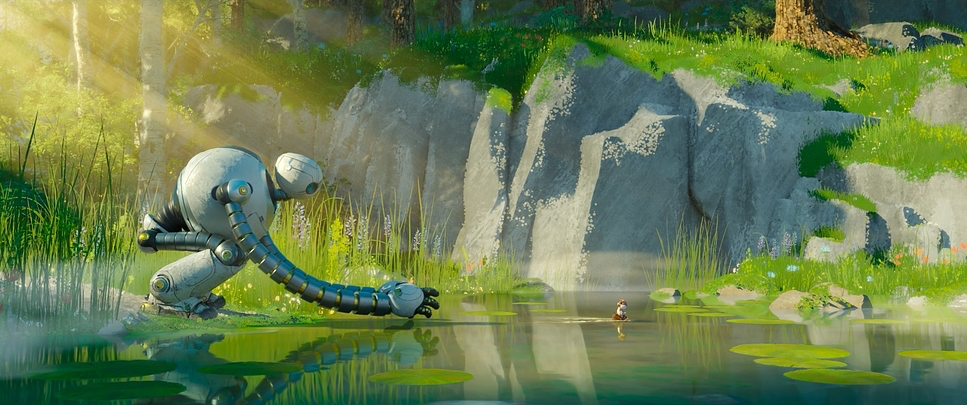
In animation, the “cinematographer” is often a misunderstood role, split between layout and lighting. Here, Head of Cinematography Chris Stover worked in tandem with Sanders to craft a visual language that feels less like a computer simulation and more like a storybook coming to life. Sanders, known for the watercolor backgrounds of Lilo & Stitchand the flight sequences in How to Train Your Dragon, leans heavily into a hand-painted aesthetic here.
Stover’s work is distinct because he treats the virtual camera with the discipline of live-action. He understands that the camera is a character. In The Wild Robot, the lens doesn’t just float; it reacts. It navigates the balance between the harsh, jagged realities of the wilderness and the sleek, mathematical perfection of Roz, creating a visual friction that drives the narrative.
Inspiration Behind the Cinematography
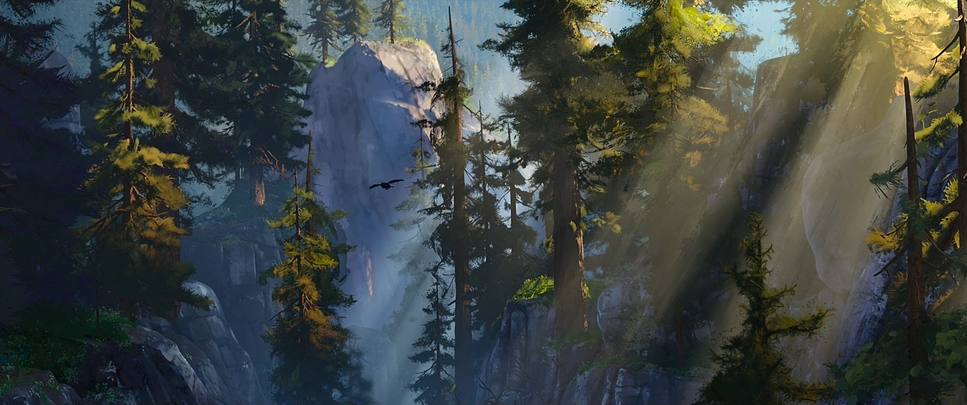
The core premise high-tech metal stranded in raw nature is a playground for visual contrast. The film’s look clearly draws from impressionist painting, prioritizing brushstrokes over pore-level detail. The visual development team avoided the trap of making a “dollar store WALL-E” by rooting the design in the chaotic textures of the forest.
The decision to stylize elements like animal fur and water, rather than simulating them with physics-perfect accuracy, creates a unique depth. It allows the film to handle mature themes predation, loss, survival without slipping into the uncanny valley. The “aggressive environment” isn’t rendered through high-polygon counts, but through sharp shapes and imposing shadows. It creates a world that feels dangerous not because it looks like a photograph, but because it feels emotionally volatile.
Camera Movements
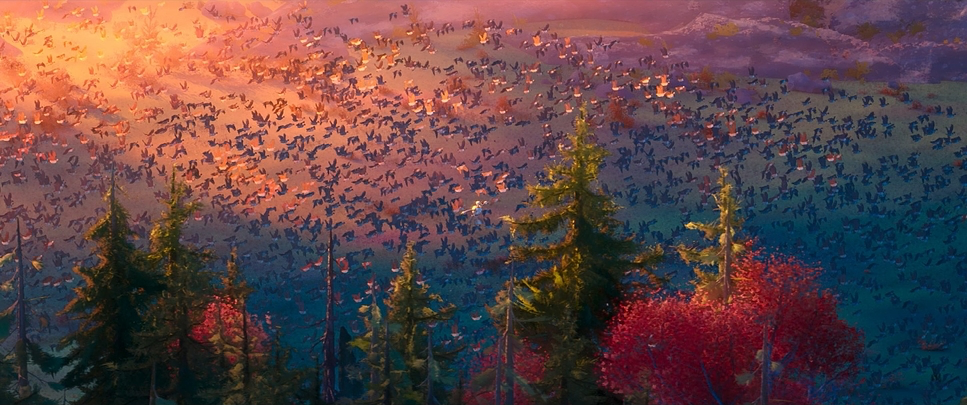
Animation offers unlimited camera freedom, but The Wild Robot shows restraint. The camera isn’t flying everywhere just because it can. Stover uses a blend of sweeping, epic wides to establish the island’s scale and frantic, handheld-style movements during the action beats to ground us in the danger.
The flight sequences, particularly with Bright Bill, are the standout. The camera embraces the Z-axis, offering exhilarating perspectives that emphasize speed and vertigo. But I was more impressed by the subtle work: the slow push-ins on Roz during moments of processing, or the way the camera tracks low to the ground, mimicking the eye-line of the smaller animals. It creates a sense of scale that makes Roz feel intrusive and alien. The slapstick moments use snap-zooms and locked-off wide shots to sell the comedy, proving that the timing of the cut is just as important as the movement itself.
Compositional Choices
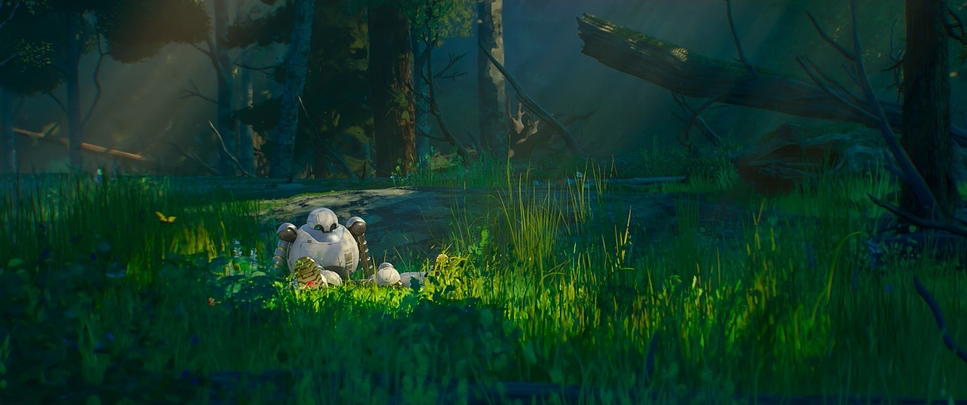
Composition is where the film’s “silent poetry” really works. The framing creates a stark visual metaphor for Roz’s journey from isolation to connection.
Early scenes utilize negative space heavily. Roz is often framed dead-center or dwarfed in the corner of a 2.39:1 anamorphic-style frame, emphasizing her loneliness against the massive, organic backdrop. As she integrates into the ecosystem, the frames become denser. The composition creates “depth cues” by layering foreground foliage and mid-ground animals, physically embedding Roz into the environment.
As a parent, the framing of the relationship between Roz and Bright Bill hit me hard. The visual language shifts from two distinct entities to a unified framing a “two-shot” that binds them together. The eventual separation is foreshadowed by the way the camera begins to widen, giving Bright Bill more lead room to fly out of the frame, leaving Roz behind. It’s a heartbreaking use of screen direction and empty space that tells the story without a line of dialogue.
Lighting Style
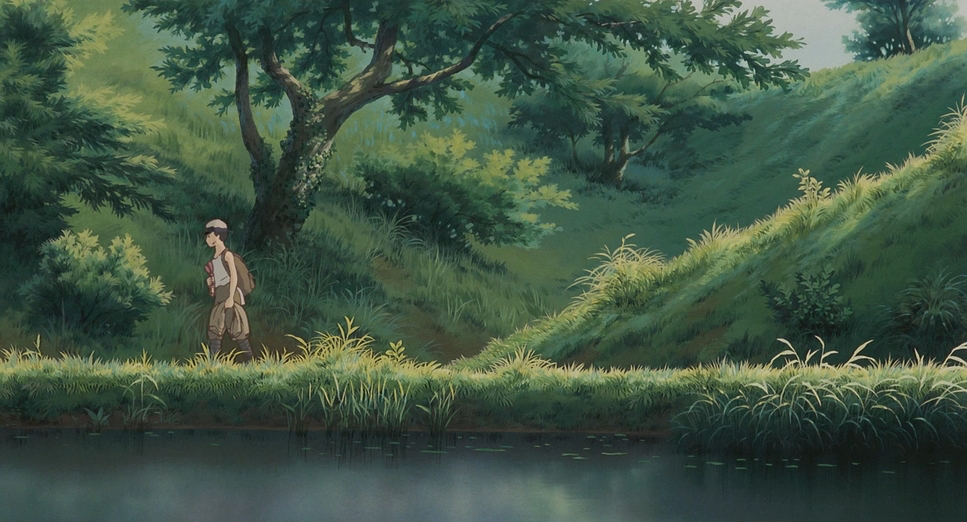
Lighting in The Wild Robot is the primary emotional driver. The film moves away from flat, high-key lighting and embraces hard, directional sources. The interplay between the cool, clinical light emitting from Roz and the warm, dappled sunlight of the forest creates a constant color contrast.
The “God rays” and volumetric lighting through the trees aren’t just for show; they create texture. I noticed a specific use of “underlighting” in the scarier sequences, reversing the natural shadows to make familiar animals look monstrous. Conversely, the golden hour sequences are bathed in a diffusion that softens the harsh edges of Roz’s metal chassis. It’s motivated lighting that borders on psychological using warmth to signal safety and stark contrast to signal peril.
Lensing and Blocking
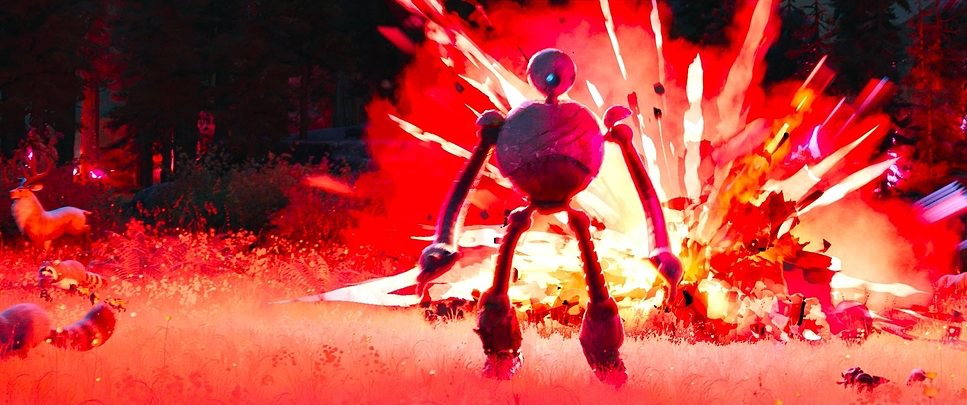
While the lenses are virtual, the physics feel grounded. The team uses simulated lens imperfections barrel distortion on the wide angles and a shallow depth of field on the telephoto close-ups to guide the eye. The focus pulls are deliberate, often racking from a texture in the foreground to a character in the background, mimicking the limitations of real glass.
Blocking is crucial with an ensemble of animals. Roz is often blocked stiffly, moving on grid lines, while the animals move in fluid, chaotic arcs. This blocking evolves; as Roz learns, her movement becomes less linear. The spatial relationship between Roz and the animals visually dictates the hierarchy of the scene. When she is a threat, she towers over the lens; when she is a mother, the camera brings her down to eye level, compressing the distance between her and the audience.
Color Grading Approach
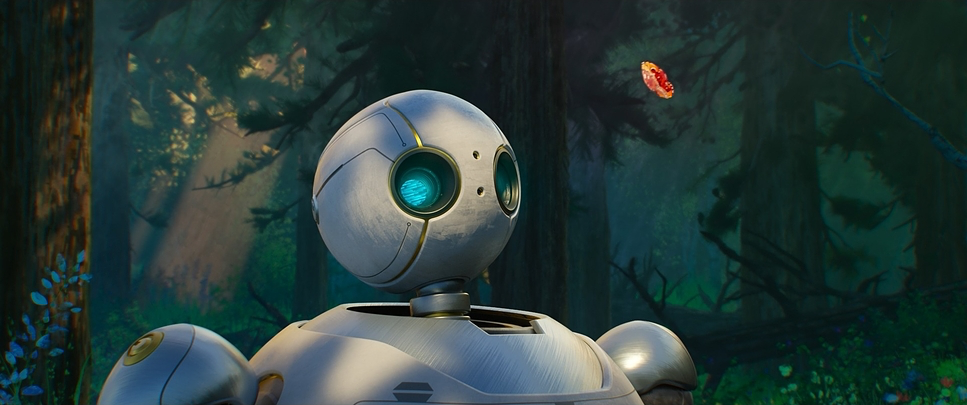
This is where the image gets its soul. Colorist Jason Hanel had a unique challenge here: grading a “painting.” Unlike live-action, where we are balancing skin tones and white balance, this grade is about hue separation and managing the “paint” texture.
The palette is a mix of saturated forest greens and earthy browns, punctuated by the distinct “sci-fi blue” of Roz’s interface. What impressed me was the highlight roll-off. In digital animation, highlights can often clip harshly to pure white. Here, the highlights have a creamy, almost print-film characteristic. They roll off gently, preserving the brushstroke texture even in the brightest parts of the frame.
The grade uses color contrast to separate the distinct biomes of the island. The shadows aren’t crushed to black; they are lifted slightly and tinted with cool teals to maintain detail in the “paint,” preventing the image from feeling too heavy. The use of pinks and purples during the emotional beats provides a break from the naturalistic greens, signaling a shift from survival mode to emotional connection. It is a sophisticated grade that respects the artistry of the source material while ensuring visual clarity.
Technical Aspects & Tools
The Wild Robot – Technical Specs
| Genre | Science Fiction, Animation, Family, Survival, CGI Animation, Artificial Intelligence, Adventure |
| Director | Chris Sanders |
| Cinematographer | Chris Stover |
| Production Designer | Raymond Zibach |
| Editor | Mary Blee |
| Colorist | Jason Hanel |
| Time Period | Future |
| Color Palette | Mixed, Saturated, Blue, Pink |
| Aspect Ratio | 2.39 |
| Format | Animation |
| Lighting | Hard light, Underlight |
| Lighting Type | Daylight |
| Story Location | North America > Pacific Northwest |
Under the hood, this film relies on advanced rendering techniques that handle global illumination and volumetrics to sell the atmosphere. However, the “cinematographer” in this context is also making choices about simulated sensor noise.
To prevent the image from looking too clean, there is a subtle grain structure layered over the final composite. This breaks up the digital gradients and helps blend the sharp vector edges of Roz with the softer, painted backgrounds. The team likely worked in a wide-gamut color space like ACES to retain the intensity of those painted colors from the art department through to the final DI (Digital Intermediate). These technical nuances the grain, the lens flares, the chromatic aberration are the “imperfections” that make the image feel handmade rather than calculated.
- Also read: KLAUS (2019) – CINEMATOGRAPHY ANALYSIS
- Also read: THE SECRET IN THEIR EYES (2009) – CINEMATOGRAPHY ANALYSIS
Browse Our Cinematography Analysis Glossary
Explore directors, cinematographers, cameras, lenses, lighting styles, genres, and the visual techniques that shape iconic films.
Explore Glossary →