When you watch The Night of the Hunter you aren’t just watching a “movie set in the 30s.” You’re stepping into a waking nightmare. While some call it a noir set in the Ohio River Valley of West Virginia, it’s really a genre-bending collision of a childhood adventure story and pure, high-octane dread. You’ve got the innocence of these kids straight out of a Twain novel being hunted by Robert Mitchum’s Harry Powell. It’s a story that still gets under your skin because it taps into that primal, universal fear of the “wolf in sheep’s clothing” coming for the most vulnerable among us.
What floors me is that Laughton wasn’t just making a thriller, he was experimenting with the very chemistry of film. François Truffaut called it “experimental cinema that truly experiments,” and you can see that DNA in everything from the Coen Brothers’ work to Guillermo del Toro’s gothic fantasies. It was a commercial flop at the time, which honestly makes sense. Real innovation usually scares people before it inspires them.
About the Cinematographer
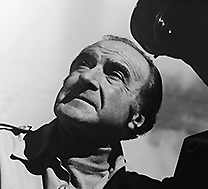
Laughton might have had the vision, but Stanley Cortez was the one who actually had to pull it off. If you know Cortez from Orson Welles’ The Magnificent Ambersons, you know the man was a titan of light and shadow. It takes a certain kind of guts for a first-time director to walk onto a set and demand a visual language this unconventional, but it takes a genius cinematographer to actually put it on the negative.
Laughton wasn’t just “blocking scenes”; he was choreographing a “nightmareish Mother Goose tale.” Cortez became his visual scribe. He was a master of expressive lighting and deep focus, which was exactly what this script needed. They created a world where innocence and absolute menace share the same frame with terrifying clarity. It’s the kind of creative synergy you rarely see where the tech and the art aren’t just working together; they’re the same thing.
Inspiration Behind the Cinematography
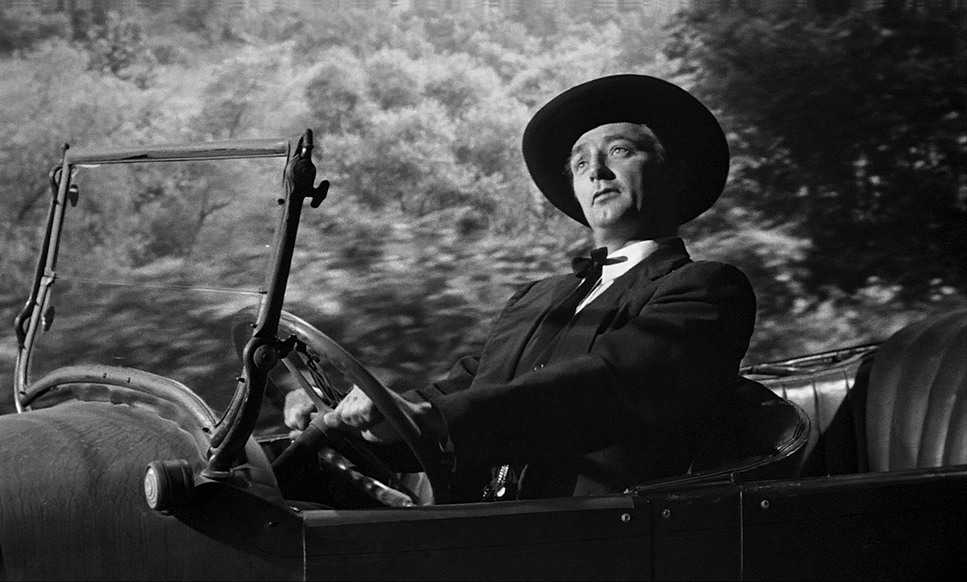
The visual DNA here is purposefully old-school, even for 1955. It’s a love letter to German Expressionist silent films. Those massive, distorted shadows and sets that feel slightly “off” aren’t just for style they’re psychological. Laughton knew that to show the internal rot of a character like Harry Powell, he had to distort the external world.
Guillermo del Toro often points out how Laughton, an Englishman, brought a European “exile’s eye” to a quintessential American setting. By stripping away the naturalism you’d expect from a 50s drama, he exposed the “shadow side” of the American dream. This isn’t just “good versus evil” in the script; it looks like a war. Every frame is a battle between light and dark, echoing the biblical themes of the “Book of First John.” It’s contrast as a narrative engine.
Camera Movements
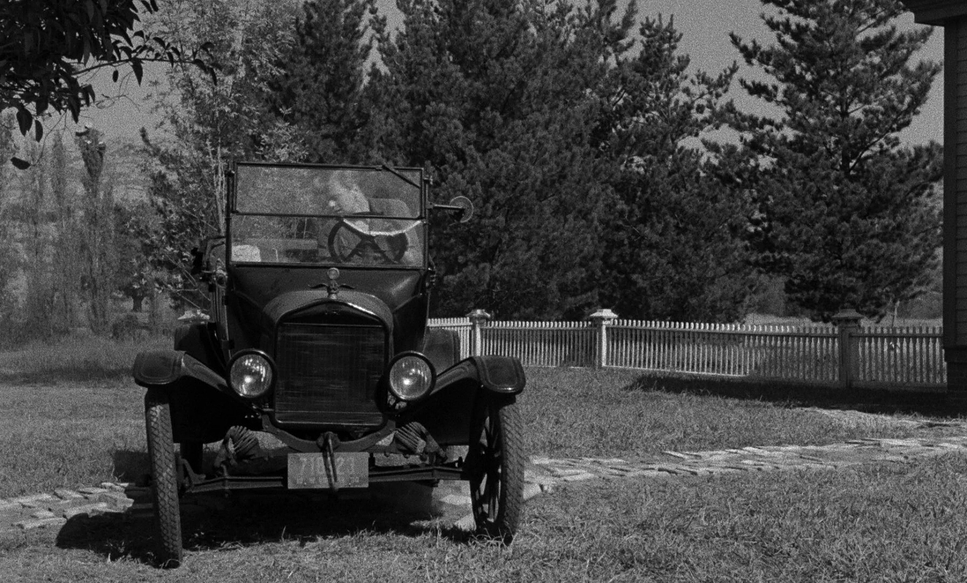
In The Night of the Hunter the camera doesn’t show off. There’s a watchful, almost predatory stillness to it. When it does move, it feels like it’s hunting. You see it in the way it glides down the river with the children it’s not a “pretty” tracking shot; it feels like the current of fate is pulling them along.
Laughton and Cortez use movement to emphasize how small these kids are. The “wandering through the woods” sequence is pure Brothers Grimm. The camera stays low, seeing the world from their vantage point, making Mitchum’s character feel like a literal giant. My favorite and perhaps the most unsettling shot is the camera following Powell’s voice as it seems to coil down the basement stairs. It’s visceral. It doesn’t just move the story; it moves your heart rate.
Compositional Choices
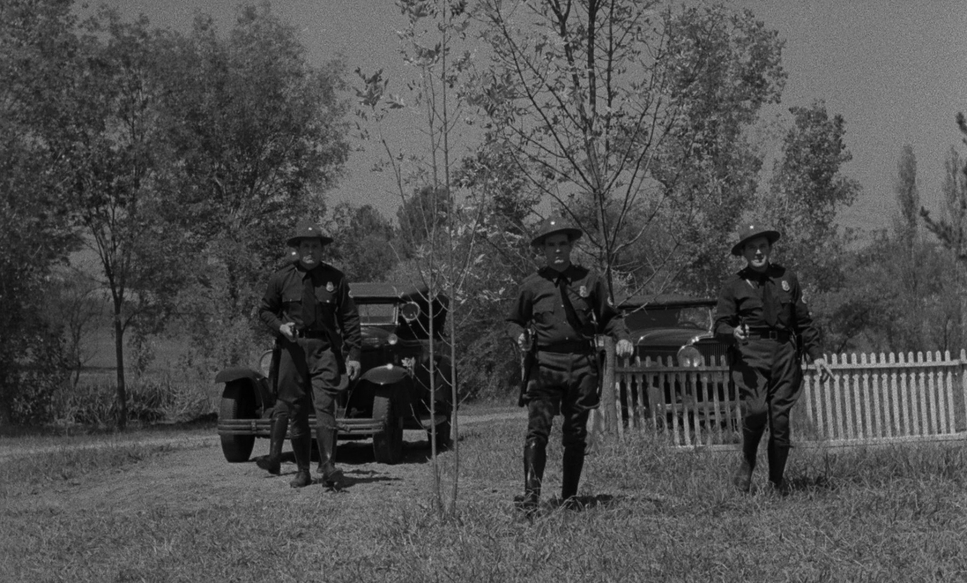
This is where the Expressionist influence really pays off. These frames aren’t just “composed”; they’re built like architecture. They use forced perspective to make Powell look grotesquely large, and negative space to make the kids look completely isolated.
The “hair floating in the water” shot is probably the most famous, and for good reason. Del Toro calls it “lyrical and poetic,” but from a technical standpoint, it’s just haunting. It’s a beautiful, tragic tableau that feels more like a painting than a movie. Laughton constantly juxtaposes the “idyllic” nature of the river with the harsh, man-made structures of threat. That visual push-and-pull is the reason the film still feels so modern.
Lighting Style
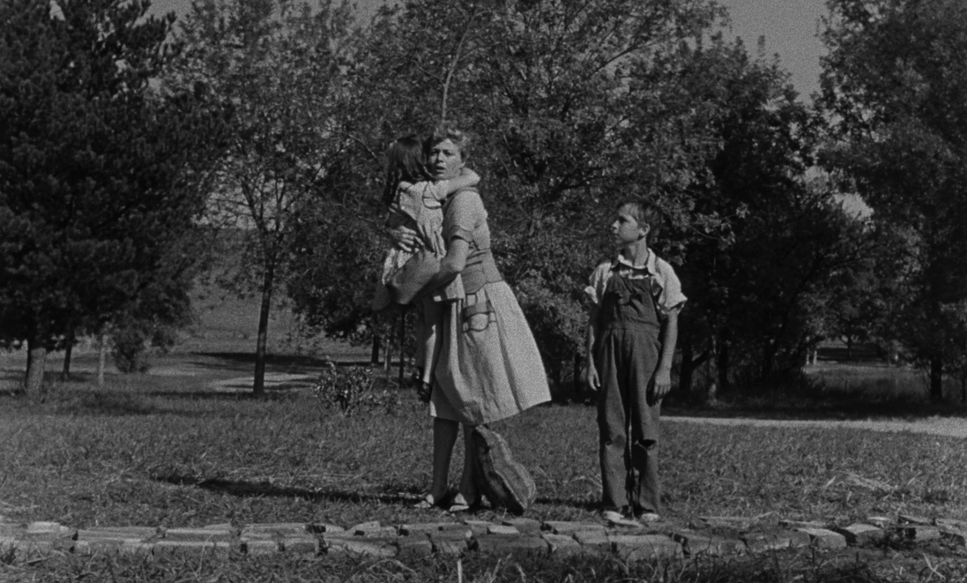
If I were scoring The Night of the Hunter, the lighting would be the lead instrument. This is hard-light territory no softboxes, no gentle wrap. We’re talking about sharp, angular shadows that stretch across the frame like claws. It’s a masterclass in chiaroscuro.
Those “monstrous shadows” make Powell feel less like a man and more like an archetypal bogeyman. Faces are often cut in half by shadow, suggesting that “Love/Hate” duality Mitchum carries on his knuckles. Even the moonlight isn’t “natural” it’s an ethereal, theatrical glow that manages to be both gorgeous and terrifying at the same time. The lighting here doesn’t just show you where the actors are; it tells you exactly how to feel about them.
Lensing and Blocking
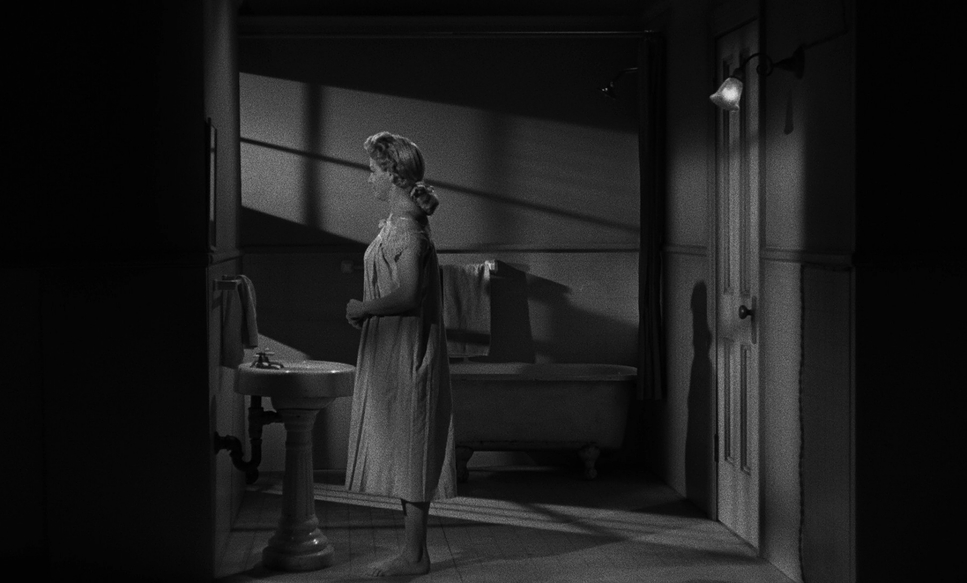
The choice of glass here is incredibly smart. Cortez used wider lenses for the landscapes, which sounds standard, but the way he uses them to maintain deep focus is incredible. It makes the kids look swallowed by the West Virginia wilderness. They aren’t just “lost”; they are tiny specs in a vast, uncaring world.
Then, they’ll switch to a longer lens to compress the space when Powell is close, making his presence feel immediate and inescapable. The blocking is just as calculated. Mitchum is almost always positioned high in the frame, looming over everyone else. He is “towering, psychopathic dominance” personified. The kids are huddled low, emphasizing their dependence on each other. It’s a masterclass in using the physical geometry of the frame to tell a psychological story.
Color Grading Approach
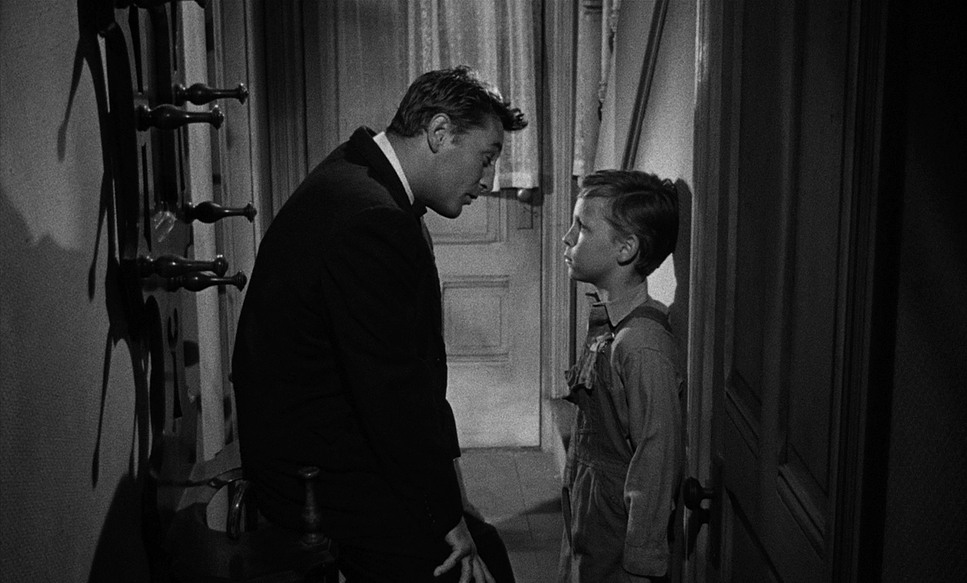
This is where my colorist brain starts firing on all cylinders. Even though it’s black and white, I look at this as tonal sculpting. When you strip away color, you’re left with the raw ingredients: luminance, texture, and form.
If I had The Night of the Hunter on my DaVinci Resolve timeline today, I’d be obsessing over the “inkiness” of the blacks. In the modern HDR world, we’re often tempted to lift the shadows and show detail everywhere, but for The Night of the Hunter, that would be a mistake. The power is in what you can’t see. I’d want those blacks to feel like physical voids. I’d push for a “piercing” white in the highlights the glint in Powell’s eye or the moon on the water without any of that soft, digital roll-off. I’d want the transitions from light to dark to be almost violent, mirroring the film’s moral absolutes. It’s about creating a tactile tonal symphony where every shade of gray has a job to do.
Technical Aspects & Tools
The Night of the Hunter | Technical Specifications
| Genre | Crime, Drama, Film Noir, Thriller, Mystery, Serial Killer |
| Director | Charles Laughton |
| Cinematographer | Stanley Cortez |
| Production Designer | Hilyard M. Brown |
| Costume Designer | Jerry Bos |
| Editor | Robert Golden |
| Time Period | 1930s |
| Color | Desaturated, Black and White |
| Aspect Ratio | 1.66 – Spherical |
| Format | Film – 35mm |
| Lighting | Hard light, High contrast |
| Story Location | United States > West Virginia |
| Filming Location | California > Los Angeles |
It’s wild to think this was made on a “B-movie” budget. But Laughton and his team turned those constraints into their biggest asset. When you can’t afford massive, realistic sets, you lean into stylization. The use of matte paintings and theatrical backdrops didn’t just save money; it created that fairytale-nightmare vibe that makes the film legendary.
The gear of the 1950s was heavy and slow, but Laughton embraced that. He didn’t try to make it feel “fast.” He leaned into the stillness. Even the film stock itself high-contrast panchromatic did half the work for them, baking in those deep blacks. And you can’t talk about the “look” without mentioning the sound. Mitchum’s baritone singing “Leaning on the Everlasting Arms” acts like a sonic shadow. It’s a reminder that every technical choice, from the lens to the audio mix, has to serve the same singular vision.
- Also read: SING STREET (2016) – CINEMATOGRAPHY ANALYSIS
- Also read: AMOUR (2012) – CINEMATOGRAPHY ANALYSIS
Browse Our Cinematography Analysis Glossary
Explore directors, cinematographers, cameras, lenses, lighting styles, genres, and the visual techniques that shape iconic films.
Explore Glossary →