As Salik Waquas from Color Culture, I spend a lot of time analyzing films. Usually, I’m looking for the “how”—the technical breakdown of a look. But sometimes, a film comes along where the technique is so perfectly woven into the narrative that you almost forget to analyze it. One of those films is Olivier Nakache and Éric Toledano’s The Intouchables (2011). It wasn’t just a box office monster; it is a prime example of invisible cinematography—visuals that serve the story without screaming for attention.
From my perspective as a colorist and filmmaker, The Intouchables proves that you don’t need heavy stylization to create an emotional impact. It’s a biographical comedy-drama that works because it feels honest. While the script does the heavy lifting for the humor, the visual language does the heavy lifting for the heart.
About the Cinematographer
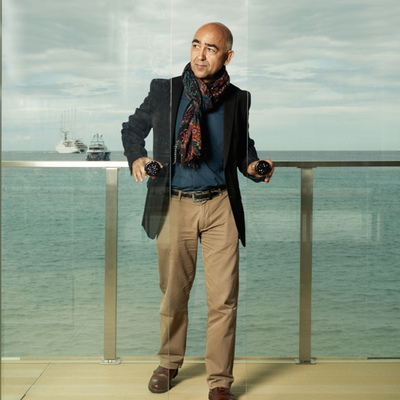
The look of The Intouchables was crafted by Mathieu Vadepied. Mathieu Vadepied isn’t just a DP; he’s also a director, and you can feel that dual experience in his lighting. He prioritizes performance over “cool” shots. His approach here is deeply rooted in French naturalism. He doesn’t light for the showreel; he lights for the actors. There is a restraint in his work here that I admire. In an era where everyone is obsessed with shallow depth of field and flares, Mathieu Vadepied steps back and lets the frame breathe, creating an observational style that feels less like a movie and more like a window into these characters’ lives.
Inspiration Behind the Cinematography
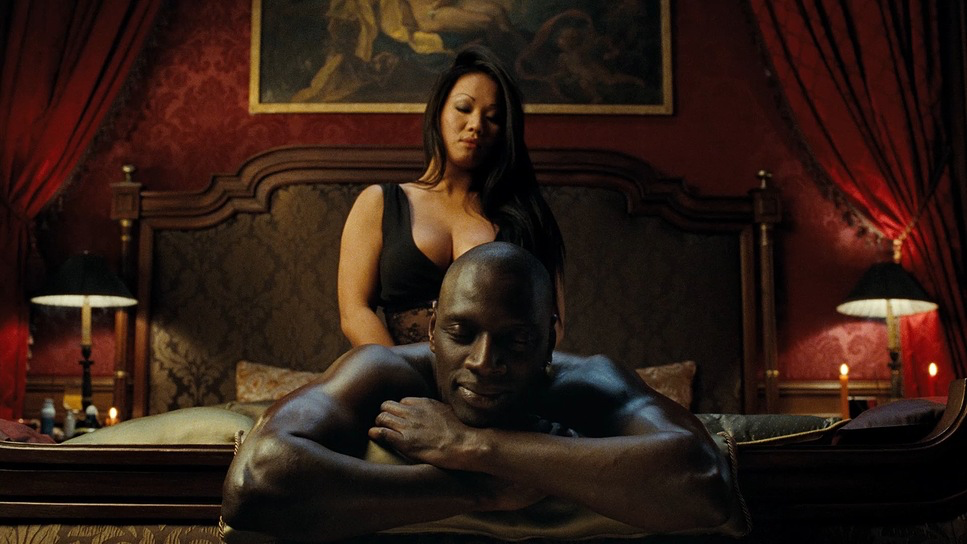
The visual language is built entirely around contrast. You have the true story of Philippe Pozzo di Borgo and Abdel Sellou (adapted as Driss, played by Omar Sy), which inherently deals with a clash of classes. The cinematography had to bridge the gap between the rigid, wealthy “intelligentsia” and the chaotic, vibrant energy of the Parisian projects.
The filmmakers weren’t just telling a story; they were colliding two different versions of France. I noticed this heavily in how the environments are treated. Philippe’s mansion is shot with symmetry and order—it’s beautiful but stifling. Driss’s world is handheld, messy, and energetic. The visuals don’t just show them meeting; they show their worlds bleeding into one another. When Driss takes the Maserati out, or when they go paragliding, the camera breaks free from the rigid tripod shots of the mansion, visually representing the freedom Driss forces Philippe to experience.
Camera Movements
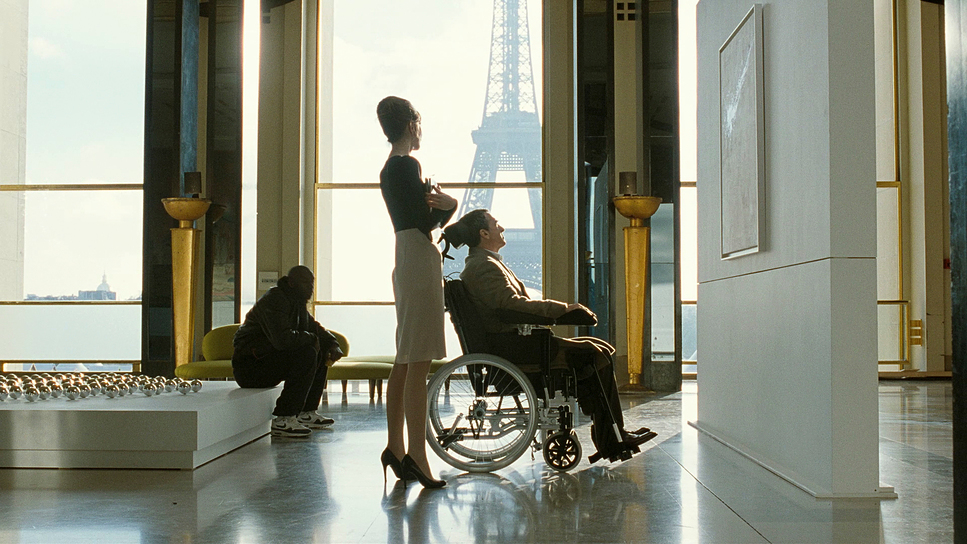
The camera motivation in this film is fantastic because it mirrors the physical limitations of the protagonist. The film opens with that high-speed chase through Paris. It’s kinetic, shaky, and alive. It immediately establishes the adrenaline that Driss brings to the table and the “past life” Philippe misses.
But once we settle into the mansion, the camera locks down. For the first half of the film, the shots involving Philippe are largely static or feature very slow, smooth dolly moves. This isn’t accidental; the camera is mimicking his paralysis. We feel the weight of his stillness. Conversely, when Driss enters the frame, the movement often loosens up. I love how the camera operator navigates this—respecting the stillness of Philippe while trying to keep up with the physical comedy of Driss. It creates a visual rhythm that prevents the drama from becoming too heavy and the comedy from becoming too loose.
Compositional Choices
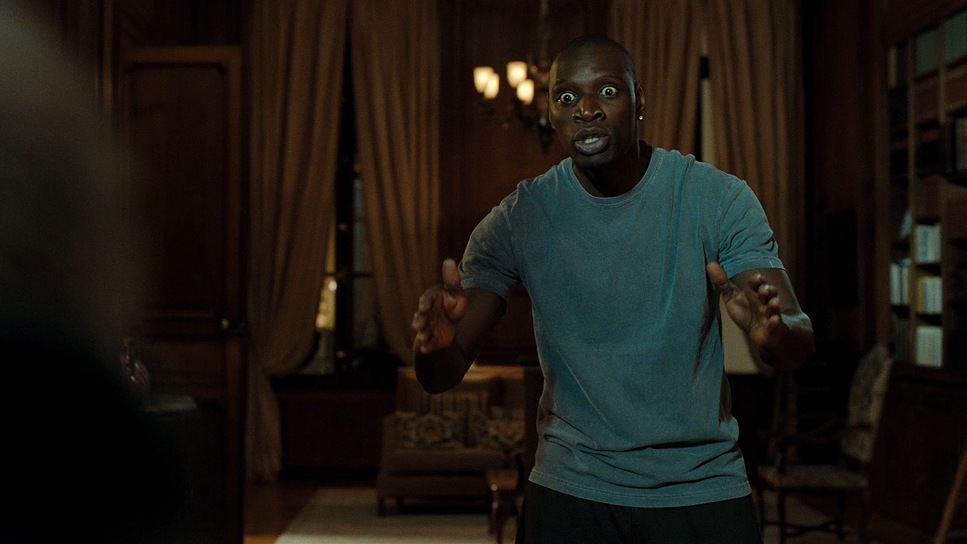
Framing is used brilliantly to show isolation versus connection. Early in the film, Philippe is often framed in wide shots, swallowed up by the ornate architecture of his home. He is a small man in a big chair in a massive room. It emphasizes his vulnerability despite his wealth. Driss, on the other hand, often breaks the frame. He’s tall, expressive, and constantly moving into the foreground, dominating the composition.
As the film progresses, watch how the two-shots change. Initially, there is a lot of distance between them in the frame. By the end, the composition tightens. They share the screen equally. There is a great use of depth, too—Driss in the foreground doing something physical, while Philippe watches from the mid-ground. It grounds the story in a physical reality. The composition stops looking at Philippe’s disability as a tragedy and starts framing him simply as a man observing a new friend.
Lighting Style
The lighting feels incredibly organic, which is harder to pull off than it looks. It relies heavily on motivated practical sources. In the mansion, the light is warm, coming from lamps and chandeliers, but it falls off quickly into soft shadows. It makes the large space feel intimate rather than cold and museum-like.
In contrast, the scenes in the projects or outside at night lean into the mixed lighting of Paris—sodium vapor streetlights and cooler ambient moonlight. It feels gritty without being “grim.” Mathieu Vadepied manages to keep light in the eyes (eye-lights) consistently, which is crucial for a film that relies so much on facial expressions. For Philippe, who cannot move his body, his eyes are his only tool for physical acting. The lighting team ensured those eyes were always catching a spark, keeping him alive in the frame even when he was physically static.
Lensing and Blocking
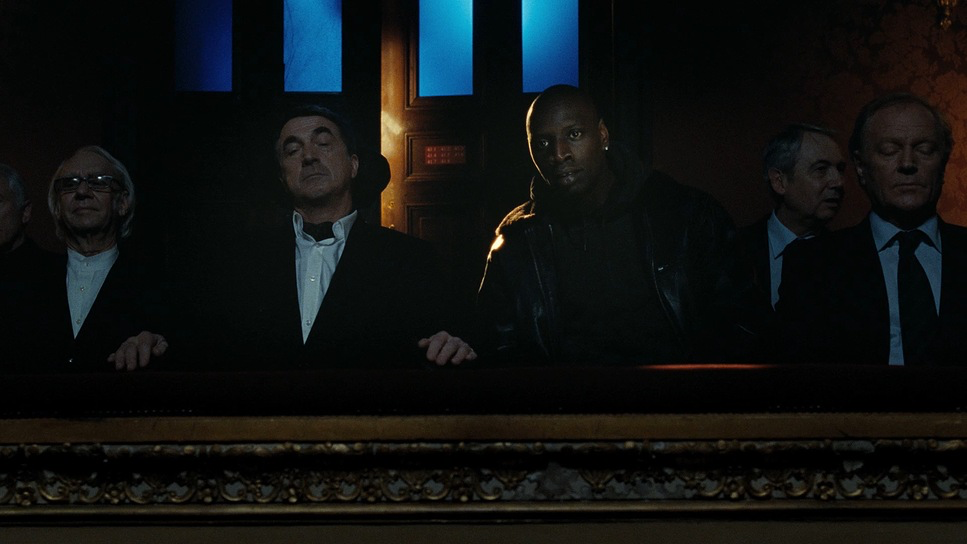
They largely stuck to spherical lenses here, avoiding the distortion and flares of anamorphic glass. This was the right call. Anamorphic can sometimes romanticize an image too much, and this story needed to feel grounded. They used standard focal lengths—likely 35mm, 50mm, and 85mm—which replicate the human field of view.
The blocking is where the real storytelling happens. Because Philippe is chair-bound, Driss has to orbit him. This creates a vertical dynamic—Driss standing over Philippe, then sitting down to be on his level as he starts to respect him. The scene where Driss shaves Philippe is a masterclass in blocking for intimacy. The camera gets close, the depth of field drops, and the physical barrier between them dissolves. It’s impressive how they made a film about a man who can’t move feel so physically dynamic.
Color Grading Approach

As a colorist, I appreciate that they didn’t try to force a “look” in the grade. Since the film was shot on 35mm stock, the color palette has that rich, chemical density that is hard to emulate digitally. The grade respects the film stock.
The skin tones are the priority here. Omar Sy’s skin tone is rendered with a beautiful, rich warmth that separates nicely from the cooler backgrounds of the city. Philippe’s skin is often paler, slightly cooler, reflecting his indoor existence, until he gets outside and the sun (and the grade) brings some life back into him.
The shadows aren’t crushed to a digital zero; they sit comfortably around 5-10 IRE, retaining all that glorious grain texture. The highlights have a soft roll-off, avoiding the harsh digital clipping you sometimes see in films from the early 2010s. The palette is mostly warm ambers, golds, and browns inside the mansion, contrasting with the cyans and greens of the outside world. It’s a classic warm/cool separation, but done with a print-film sensibility rather than a heavy digital hand. It feels like a movie, not a video.
Technical Aspects & Tools
The Intouchables (2011) — Technical Specs
| Genre | Comedy, Drama |
| Director | Éric Toledano, Olivier Nakache |
| Cinematographer | Mathieu Vadepied |
| Production Designer | François Emmanuelli |
| Costume Designer | Isabelle Pannetier |
| Editor | Dorian Rigal-Ansous |
| Time Period | 2010s |
| Color | Cool, Desaturated, Cyan, Blue |
| Aspect Ratio | 1.78 – Super 35 |
| Format | Film – 35mm |
| Lighting | Hard light, Top light |
| Story Location | … France > Paris |
| Filming Location | … Europe > France |
| Camera | Aaton Penelope, Arri 435 / 435ES |
| Lens | Panavision Lenses |
Contrary to the digital trend that was exploding in 2011, The Intouchables was actually shot on 35mm film, using Panavision cameras. This is a massive factor in why the film has aged so well. Film negative has a latitude that digital sensors of that era struggled to match, specifically in how it handles highlight retention in those bright windows of the mansion against the darker interiors.
Scanning that negative for the Digital Intermediate (DI) allowed the color team to manipulate the image without it falling apart. The grain you see is real, not a plugin. That organic texture acts as a veil that softens the image, taking the digital “edge” off the actors’ faces. It adds a layer of subconscious nostalgia. If they had shot this on the early Alexa or Red One, I don’t think it would have had the same timeless, romantic quality.
- Also Read: THE USUAL SUSPECTS (1995) – CINEMATOGRAPHY ANALYSIS
- Also Read: AMERICAN HISTORY X (1998) – CINEMATOGRAPHY ANALYSIS
Browse Our Cinematography Analysis Glossary
Explore directors, cinematographers, cameras, lenses, lighting styles, genres, and the visual techniques that shape iconic films.
Explore Glossary →