John Landis’s The Blues Brothers (1980) a movie that shouldn’t work on paper, but hits you with so much unadulterated energy that you stop thinking about the “how” and just start feeling the “why.” It’s anarchic, loud, and frankly, a bit miraculous. Beyond the music and the “mission from God,” there is a deliberate visual language here that I find myself coming back to constantly.
About the Cinematographer
Stephen M. Katz, ASC, was the guy John Landis tasked with capturing this glorious madness. Coming off films like The Wanderers and Grease, Katz brought a style that was and I mean this as a compliment completely unpretentious. He wasn’t trying to outshine the performers or the stunts. His job was pragmatic: maintain control over what could have easily devolved into a visual mess. When you’re dealing with live musical legends and a record-breaking number of car pile-ups, you don’t need “flashy” artistry; you need someone who knows how to keep the narrative threads visible through the smoke and twisted metal. It’s the kind of invisible craftsmanship that often goes unsung because it serves the story so flawlessly that you only notice the impact, not the effort.
Inspiration Behind the Cinematography
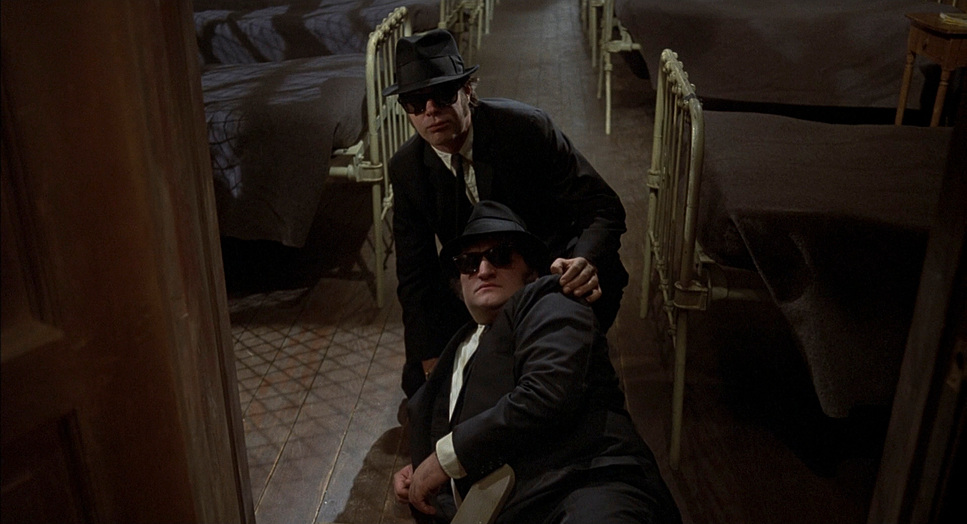
The visual DNA of this film is a weird, wonderful collision of worlds. You’ve got the raw grit of late-70s Chicago clashing with the high-energy “cartoonism” of the action. Dan Aykroyd and the team fought tooth and nail to get legends like Aretha Franklin and James Brown into the film, and the cinematography had to respect that. It wasn’t about making everything look “pretty” or “glossy” it was about amplifying the reality of these icons.
The look leans into a grounded realism, but it’s a realism that is constantly being interrupted by 100-mile-per-hour car chases. It’s that contrast the spiritual gravitas of James Brown in a church versus the visceral, tangible consequence of real cars hitting real buildings that gives the film its texture. No CGI meant real locations and real stakes.
Lighting Style
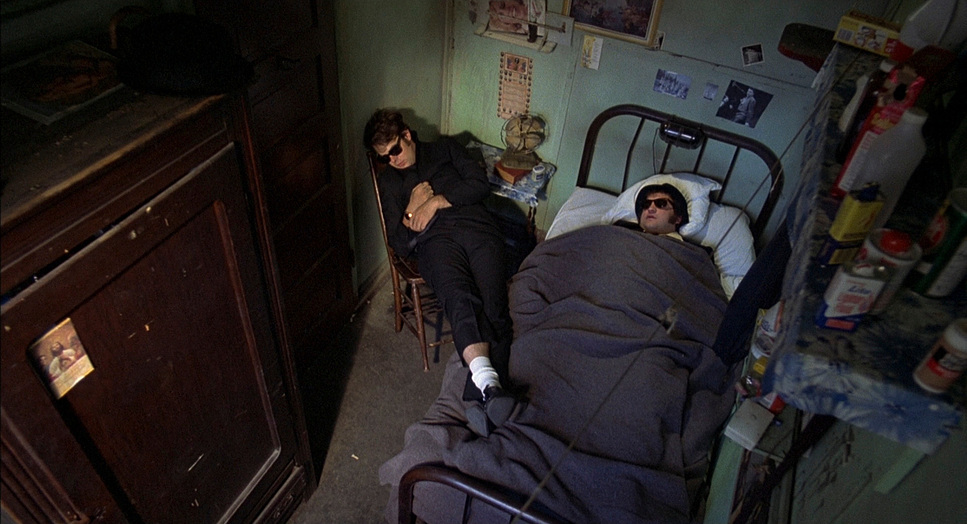
This is where the film’s dual identity really shows up. For the exterior Chicago scenes, Katz mostly stuck to naturalism. He used the city’s available light and practicals to create this “street-level” authenticity. It’s almost documentary-like at times, which makes the eventual chaos of the Bluesmobile feel even more disruptive to the everyday fabric of the city.
But the second the music starts? Everything shifts. When Aretha starts “Think” in that diner, or James Brown leads the gospel choir, the lighting becomes highly stylized. We see dramatic shafts of light, vibrant stage practicals, and sharp key lights that sculpt the performers. (The church scene, in particular, has this almost divine quality to it.) I love this contrast using unvarnished daylight for the “mission” and theatrical brilliance for the “music.” It differentiates the narrative modes without the audience even realizing why they feel the shift.
Color Grading Approach
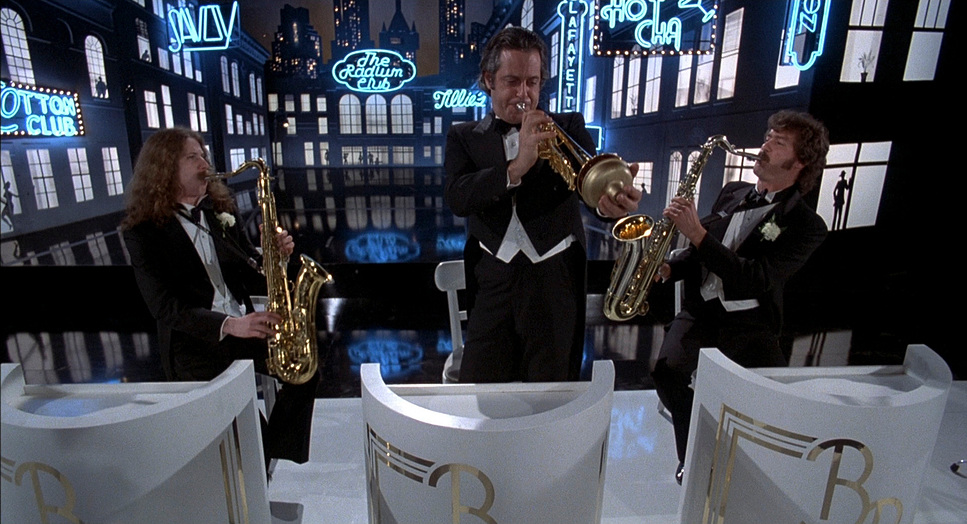
Looking at this through the lens of a colorist, I’m struck by the inherent “film-ness” of it all. Shot on 35mm (likely Eastman Kodak stock), the image has a grain structure and a density that we spend hours trying to replicate digitally today. Back in 1980, this was an optical printing process not the granular, frame-by-frame control I have in my suite.
The color palette is raw and unsentimental, focusing on urban grit. As a colorist, I’m jealous of the highlight roll-off here; look at how the streetlights or stage lights transition gently into white rather than just “clipping.” If I were grading this today, I’d be terrified of over-saturating it. The power is in the punchy blacks of Jake and Elwood’s suits against the natural hues of the Chicago streets. It’s a masterclass in tonal sculpting retaining depth in the shadows without “crushing” them, allowing the texture of the city to breathe.
Camera Movements
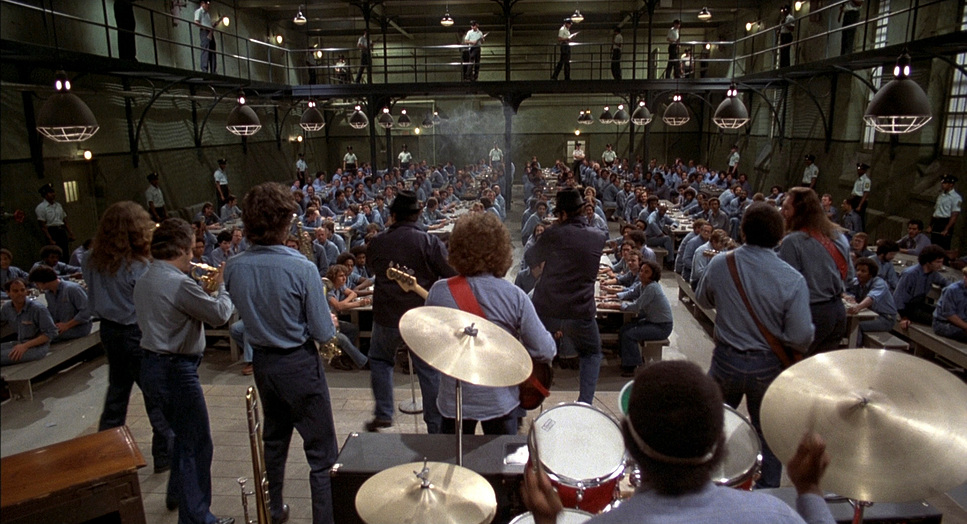
The camera in The Blues Brothers is a shark: it has to keep moving or the movie dies. Katz used the Panavision Panaflex to capture a sense of perpetual motion that modern gimbal shots sometimes lack. During those legendary car chases, we aren’t seeing shaky-cam chaos; we’re seeing deliberate, high-speed tracking shots.
The production actually got permission to hit 100mph in downtown Chicago, and you can feel that weight and velocity because the camera is right there on the bumper. Then you switch to the musical numbers, where the camera sways and draws you in like a crane move highlighting Cab Calloway or a wide dolly shot in the diner. The camera isn’t just watching; it’s a participant in the rhythm.
Compositional Choices
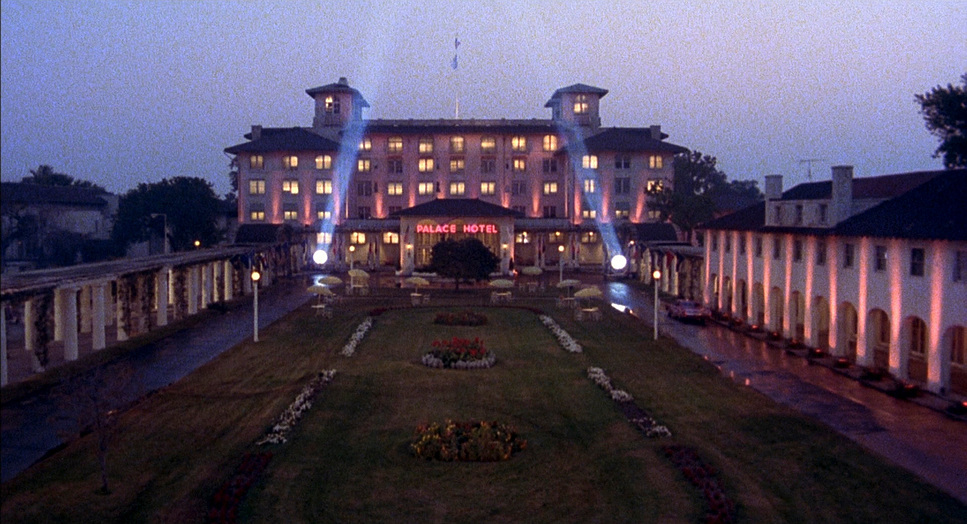
Katz loved a wide-angle composition, and for good reason. When you’re driving a car through the Dixie Square mall, you need to see the entire scope of the havoc the flying merchandise, the storefronts, the sheer scale of the mess. It’s about the impact on the environment.
In the musical sequences, he uses deep staging. Take “Minnie the Moocher”: you’ve got Cab Calloway in the foreground, the band in the middle, and the audience in the back. It creates this vibrant, three-dimensional space. And of course, there’s the framing of the brothers themselves usually centered, usually together. Their silhouettes are so iconic that they command the frame no matter how much literal trash is flying around them in the background.
Lensing and Blocking
The lensing here is utilitarian in the best way. Wide lenses exaggerate the speed of the chases and give us a sense of place, while standard focal lengths keep the character moments grounded. But the real star here is the blocking.
Think about the logistics: 40 stunt drivers, 60 police cars, and a total of 103 vehicles smashed. (A world record at the time, by the way.) Every single collision had to be blocked with the precision of a ballet because there were no “do-overs” in post. It’s a brutal, physical choreography. Even the musical numbers used real people pulled off the streets blocking that many non-professionals to feel “lived-in” and energetic is a feat in itself.
Technical Aspects & Tools
| Genre | Action, Comedy, Crime, Music, Musical |
| Director | John Landis |
| Cinematographer | Stephen M. Katz |
| Production Designer | John J. Lloyd |
| Costume Designer | Deborah Nadoolman |
| Editor | George Folsey Jr. |
| Time Period | 1970s |
| Color | Warm, Desaturated |
| Aspect Ratio | 1.85 – Spherical |
| Format | Film – 35mm |
| Lighting | Soft light, Backlight |
| Lighting Type | Daylight |
| Story Location | Illinois > Joliet |
| Filming Location | Joliet > Joliet Prison – Collins Street |
| Camera | Panavision Panaflex |
The “technical” brilliance of this film is actually its lack of technology. This was the pre-CGI era. If you see a car flipping, a real car flipped. If you see an explosion, something actually blew up. The filmmakers bought 60 old police cars for $400 a pop just to wreck them.
The fact that the city of Chicago eventually created a film office just to handle this production tells you everything you need to know about the scale. They weren’t finessing pixels; they were orchestrating physical, tangible mayhem. That’s why the film feels so visceral decades later you can’t fake the physics of metal twisting under that much pressure.
The Blues Brothers is more than a cult classic; it’s a reminder that great filmmaking doesn’t have to be “elegant” to be effective. As a colorist, I respect the grit of that 35mm stock. As a filmmaker, I’m just in awe of the sheer audacity it took to pull this off. It’s a symphony of calculated destruction and soul, proving that sometimes all you need is a full tank of gas, half a pack of cigarettes, and a mission you actually believe in.
- Also read: CARLITO’S WAY (1993) – CINEMATOGRAPHY ANALYSIS
- Also read: A FISTFUL OF DOLLARS (1964) – CINEMATOGRAPHY ANALYSIS
Browse Our Cinematography Analysis Glossary
Explore directors, cinematographers, cameras, lenses, lighting styles, genres, and the visual techniques that shape iconic films.
Explore Glossary →