I didn’t revisit Howard Hawks’ The Big Sleep (1946) for the plot nobody does. Even Raymond Chandler famously lost track of who killed whom in his own story. I went back for the blacks. I wanted to see how Sidney Hickox carved out that specific, ink-heavy brand of Warner Bros. gloom that still feels tactile eighty years later.
While the narrative is a total labyrinth, the cinematography is incredibly precise. It’s a masterclass in mood and the seductive power of film noir. For me, it’s not about untangling the mystery; it’s about surrendering to the atmospheric weight of the frame. It’s a reminder that when the visuals are this strong, the verbal roadmap can be as fuzzy as it wants to be.
Lighting Style
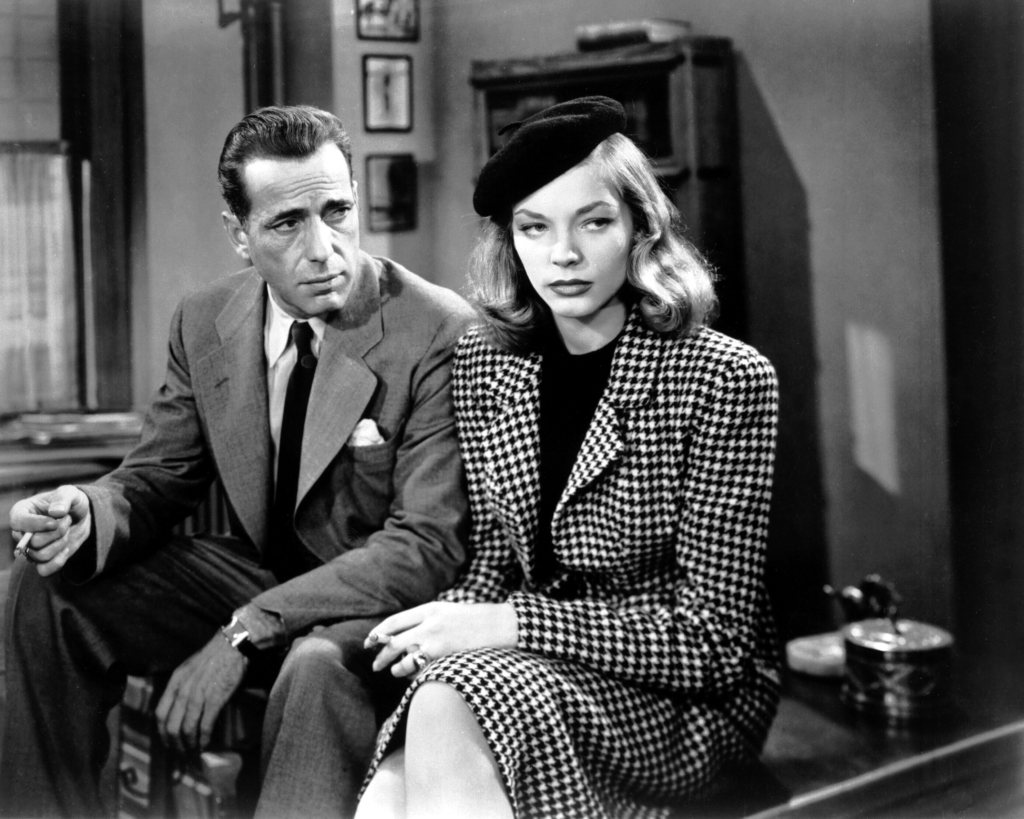
Let’s get into the beating heart of this film: the light. This is pure, unadulterated noir, built on the principles of chiaroscuro and aggressive low-key lighting. In The Big Sleep, shadows aren’t just an absence of light they’re a character. They’re a shroud, a hiding place, and a constant threat.
When I watch this, I’m constantly dissecting how Hickox achieved those “deep blacks.” It’s not just about cutting the lights; it’s about the surgical control of spill. You can see the work of flags and gobos everywhere, shaping the light so it only hits exactly what it needs to. He used negative fill religiously to drain light from the shadows, adding that dramatic modeling to the faces. Whether it’s the harsh glow of a desk lamp or the prison-bar shadows of Venetian blinds, the lighting is always “motivated.” It’s Rembrandt lighting with a gritty, urban edge. It leaves just enough detail to keep you hooked while burying the rest in darkness.
Color Grading Approach
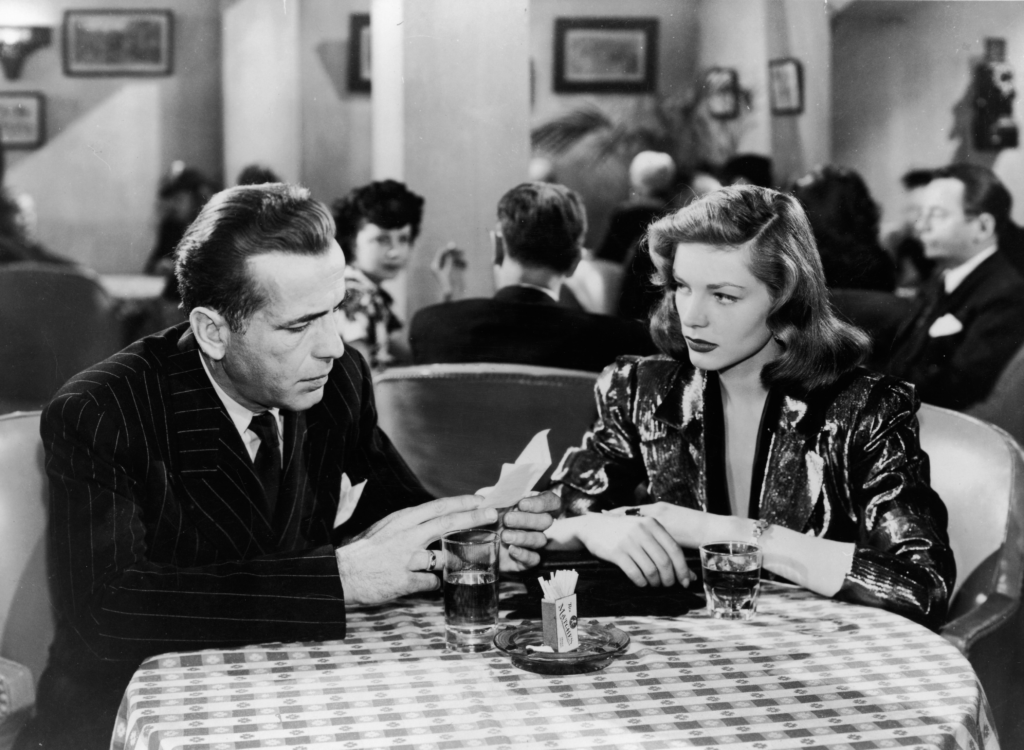
As a colorist, I tend to look at black-and-white films through the lens of a modern DI (Digital Intermediate) suite. Even though we aren’t dealing with hue or saturation here, the tonal sculpting is incredibly sophisticated. The “deep blacks” and “fine grain” mentioned in the Warner Archive reviews are exactly what I’d be chasing in a grade today.
The “grading” here happened on set and in the lab. It’s all about contrast shaping how the highlights roll off into the midtones and how those mids melt into the shadows. You want the blacks to feel heavy without “crushing” them into a featureless void. You want the glint of a .38 Special or the sheen on Lauren Bacall’s hair to have an organic, creamy roll-off rather than looking clipped. The 2K restoration did a beautiful job of preserving this original tonal grade. It’s a different kind of challenge than color work, but it demands the same intuitive understanding of how luminance drives emotion.
About the Cinematographer

The man behind this “dream-like fog” was Sidney Hickox. He was a Warner Bros. stalwart a craftsman in the truest sense of the word. He wasn’t as flashy as some of his contemporaries, but his filmography is legendary.
Hickox understood the studio system’s demands for speed, but he never sacrificed the psychological weight of a scene. For a film like The Big Sleep, where every character exists in a moral gray zone, you needed a cinematographer who understood subtlety. He knew how to make Bogie’s swagger look iconic and Bacall’s gaze look glacial with a quiet mastery that makes the most difficult shots look effortless.
Inspiration Behind the Cinematography
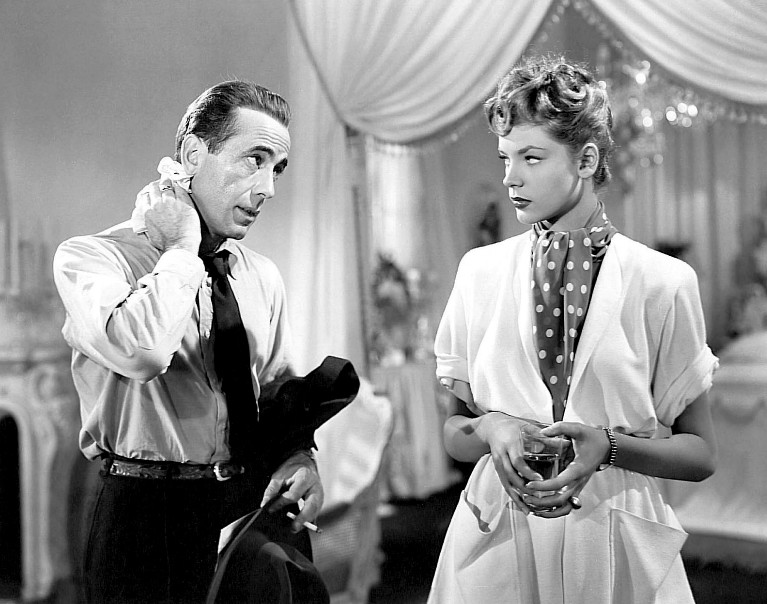
The visual DNA here is rooted in German Expressionism and American pulp. Those dramatic angles and oppressive shadows aren’t just “cool” stylistic choices; they are emotional statements. They externalize Marlowe’s internal world.
What’s wild is how much the production history shaped the look. The film was actually finished in 1944 but sat on a shelf for a year. After Bacall’s next film flopped, they went back to reshoot a huge chunk of The Big Sleep to capitalize on the Bogart-Bacall chemistry. They re-blocked scenes and leaned even harder into that “foggy, dreamlike” vibe. The cinematography wasn’t just a static plan; it was an evolving entity shaped by studio politics and star power. It’s proof that sometimes commercial pressure can actually result in better art.
Lensing and Blocking
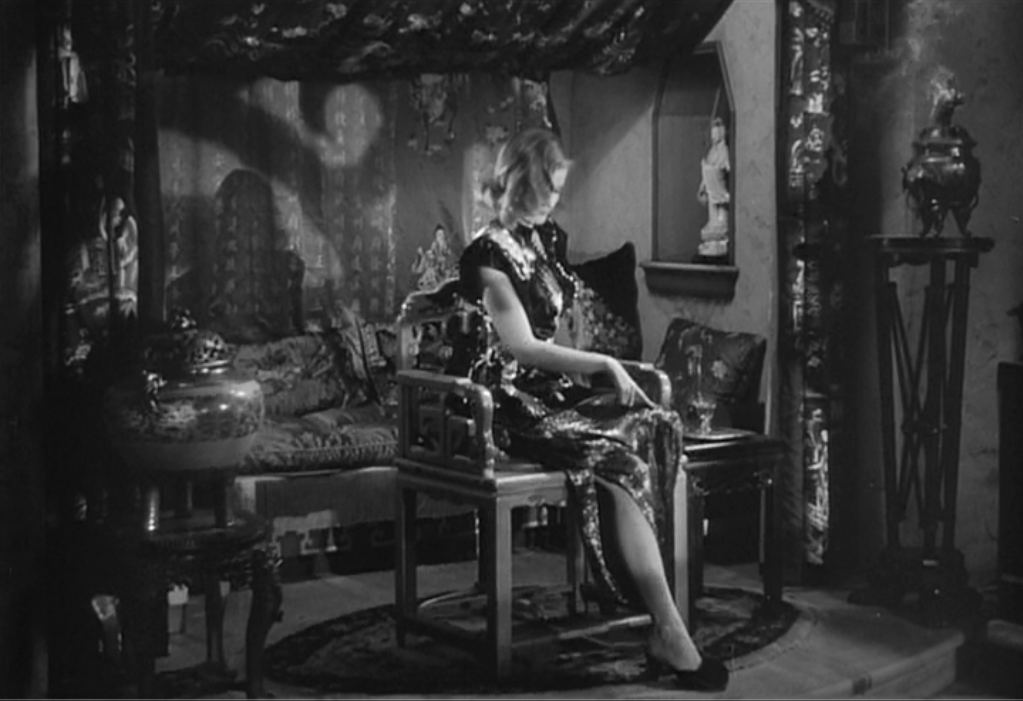
In the mid-40s, you didn’t have a massive kit of specialized glass. You had standard focal lengths that kept things looking relatively “normal.” Because they weren’t relying on extreme wide-angle distortion or telephoto compression, the blocking the physical movement of actors had to do the heavy lifting.
Hawks and Hickox were masters of using the set’s physical space. Characters don’t just move left to right; they move in depth. Look at the scenes between Bogart and Bacall. They are often crammed into the frame together, the space tightening around them until the tension is almost claustrophobic. Their verbal sparring is amplified by how they occupy the frame. It’s a reminder that you don’t need a 10:1 zoom to create intimacy; you just need to know where to put the actors.
Compositional Choices
The compositions in The Big Sleep are where the real psychological warfare happens. Even within the boxy 1.37:1 aspect ratio, the frames feel dense. You’ll rarely find a “dead” frame here.
They used depth cues brilliantly. Foreground objects a lamp, a shoulder, a cracked door are used to frame the subjects, making the audience feel like a voyeur. Think of how often Bogart is framed in a doorway, looking in. It reinforces his role as the ultimate outsider. It’s visual storytelling at its most fundamental: using negative space and the edges of the frame to signal power dynamics or impending danger. It forces the audience to scan the corners of the screen for clues, much like Marlowe does.
Camera Movements
I’m always struck by the restraint in the camerawork. There are no flashy, “look-at-me” dolly shots. The camera is a grounded observer, just like the detective.
When the camera moves, it’s deliberate. A slow pan to reveal a body or a tracking shot that follows Marlowe through a rainy street. This wasn’t because of technical limitations; it was a choice. By keeping the camera relatively static, Hickox forces you to sit with the characters and the tension. It mirrors the noir feeling of being trapped. When that camera finally does move, you feel it.
Technical Aspects & Tools
While the artistry feels timeless, the tools were purely industrial. We’re talking about a studio-bound production shot on large-format film likely Eastman Double-X. The camera was probably a Mitchell BNC, a beast of a machine known for being silent enough for sound stages.
The “Warner Brothers look” wasn’t an accident. It was the result of perfectly dressed sets, overhead rain rigs, and a lot of pumped-in smoke, all captured through Hickox’s controlled lens. The recent 2K restoration and the lossless DTS-HD audio on the Blu-ray finally let us appreciate the “grit” without the distractions of dust and scratches. It’s a reminder that gear matters, but the hands guiding the gear matter more.
- Also read: SHORT TERM 12 (2013) – CINEMATOGRAPHY ANALYSIS
- Also read: KING KONG (1933) – CINEMATOGRAPHY ANALYSIS
Browse Our Cinematography Analysis Glossary
Explore directors, cinematographers, cameras, lenses, lighting styles, genres, and the visual techniques that shape iconic films.
Explore Glossary →