The Coen brothers have always pushed boundaries, but with Lebowski, they created something that feels almost accidental in its brilliance, yet is technically rigorous at its core. On the surface, it’s a film about “nothing much,” where “stuff just kind of happens,” but beneath that shaggy exterior lies a precise visual language. It doesn’t just record the events; it embodies the unique, hazy spirit of the film itself.
When I first watched The Big Lebowski, it was just that “weird cult flick” we quoted endlessly. But as I’ve spent more time in the grading suite, my appreciation has shifted from the one-liners to the image pipeline. The film has solidified its status not just because of the philosophy, but because of how it looks. Despite a plot that meanders through kidnappings, nihilists, and stolen rugs, the visual aesthetic holds it all together. It anchors us to the Dude. We experience this chaotic world through his perpetually relaxed lens. The goal here isn’t to write another film theory essay, but to break down how Roger Deakins the technician behind the camera built this world, and why it still holds up as a reference point for colorists and DPs today.
About the Cinematographer
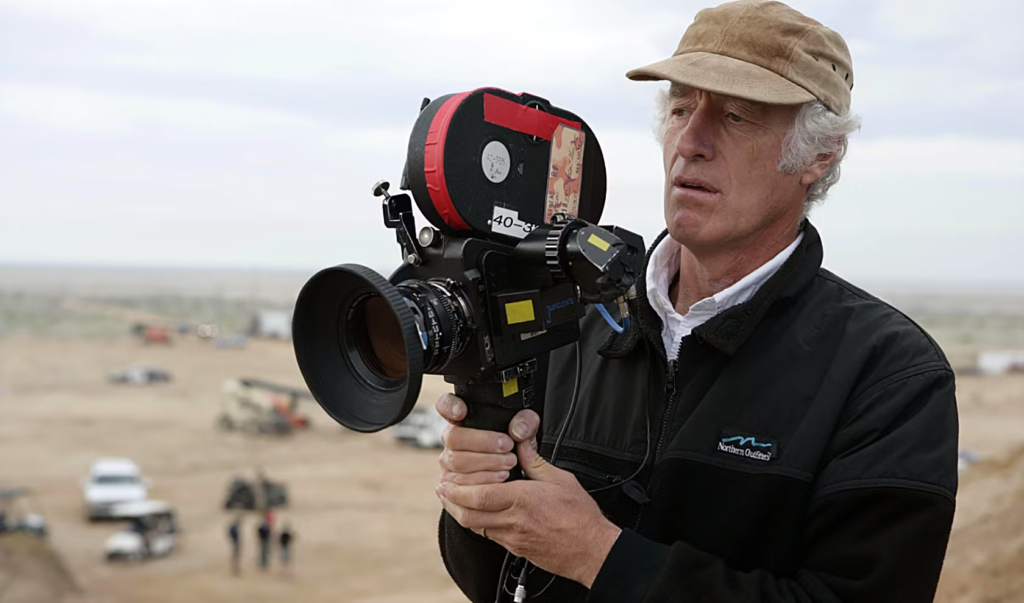
To discuss the look of The Big Lebowski is to discuss Roger Deakins’ chameleon-like ability to adapt. Deakins is a legend not because he has a single “style” he forces onto every script, but because he dissolves his ego into the story. His work here is distinct from the stark, snowy landscapes of Fargo or the desaturated grit of No Country for Old Men. For Lebowski, Deakins had to balance the mundane reality of fluorescent-lit bowling alleys with the hallucinatory madness of the Dude’s subconscious. He understands that the “why” of a shot the motivation is always more important than the “how.” He didn’t just light the set; he lit the vibe.
Inspiration Behind the Cinematography
The visual DNA of The Big Lebowski is a strange, effective cocktail. It leans heavily into the neo-noir traditionborrowing from Raymond Chandler detective stories but flips the lighting on its head. instead of rain-slicked streets and high-contrast shadows, Deakins gives us a sun-drenched Californian absurdity. The L.A. setting is a character in itself, embodying the faded idealism of the 60s.
Deakins translates the Dude’s worldview into the camera work. The Dude is the “laziest man in Los Angeles County,” and the cinematography often mirrors this lethargy. There’s a casual looseness to the framing, a refusal to impose too much order on the chaos. It embraces the disconnect. Even when the plot tightens, the visual language suggests that, much like the Dude, we should probably just abide.
Camera Movements
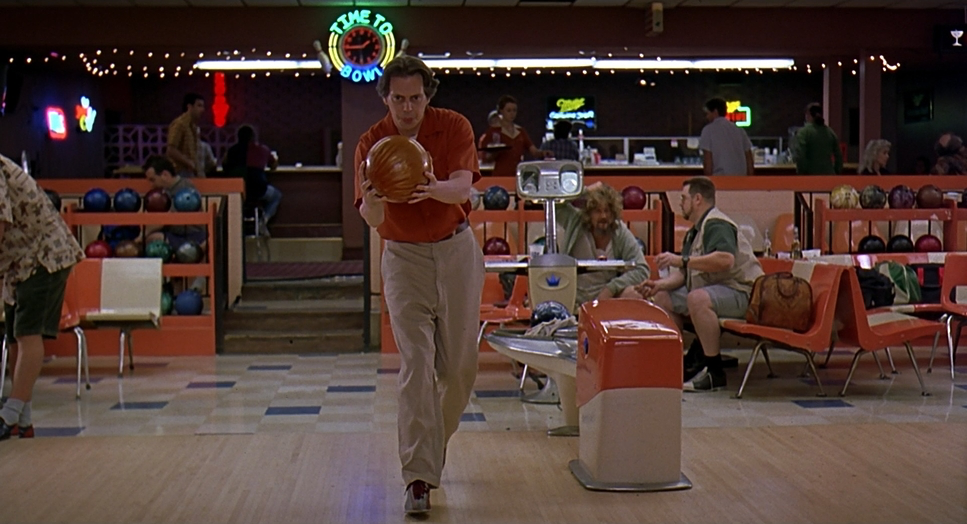
Deakins’ movement here is a study in controlled chaos. While he is known for elegant tracking shots, in Lebowski, they serve a specific, ironic purpose. Take the iconic POV shot of the bowling ball rolling down the lane. It’s not just a cool angle; it’s a moment of fluid, meditative focus in a film defined by aimlessness.
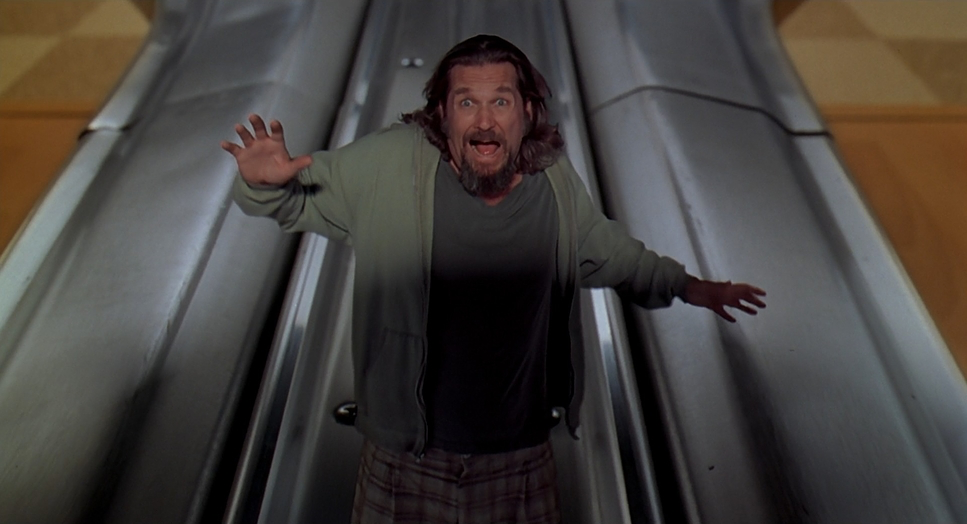
But then the film snaps into dynamic, disorienting movement, specifically in the dream sequences. The “Gutterballs” sequence uses elaborate crane moves and spinning camera work to jar us out of the Dude’s waking rhythm. Deakins also uses subtle push-ins on characters during monologues like Walter reliving Vietnam which lends unearned gravitas to their ridiculous rants. These aren’t arbitrary; they are orchestrated to reflect the shifting reality of the scene.
Compositional Choices
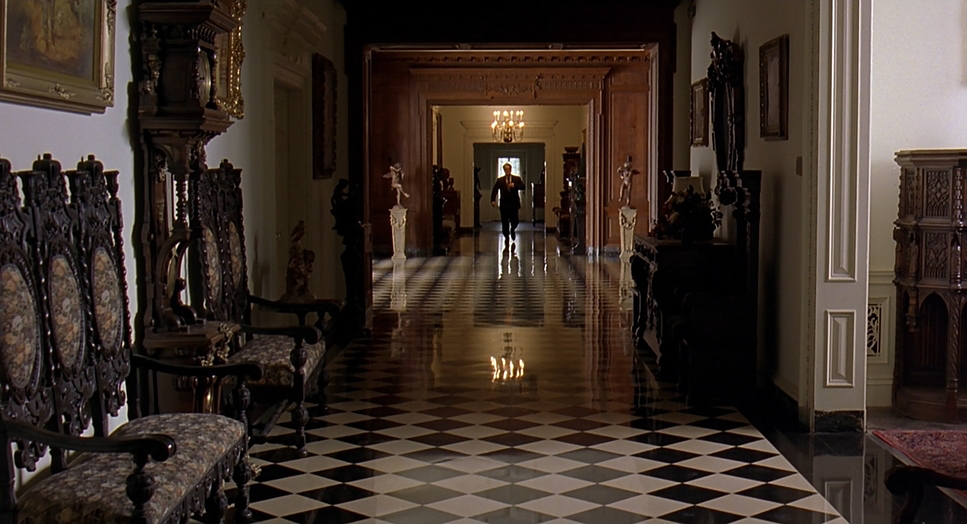
Compositionally, Deakins favors wider lenses to lock characters into their environments. We see the Dude as a small figure against larger, imposing backgrounds the vastness of the bowling alley lanes or the barren L.A. desert. This use of negative space reinforces the idea that he is “adrift,” a cork bobbing in the ocean of Los Angeles.
Inside the bowling alley, the frames become graphic and symmetrical, utilizing the leading lines of the lanes. Yet, Walter often disrupts this symmetry, physically dominating the frame, while the Dude slouches, dissolving into the background. The low-angle shots on “Jesus” Quintana are another great example elevating a registered sex offender in a purple jumpsuit to mythic status. The composition tells you everything you need to know about the power dynamics before a word is spoken.
Lighting Style
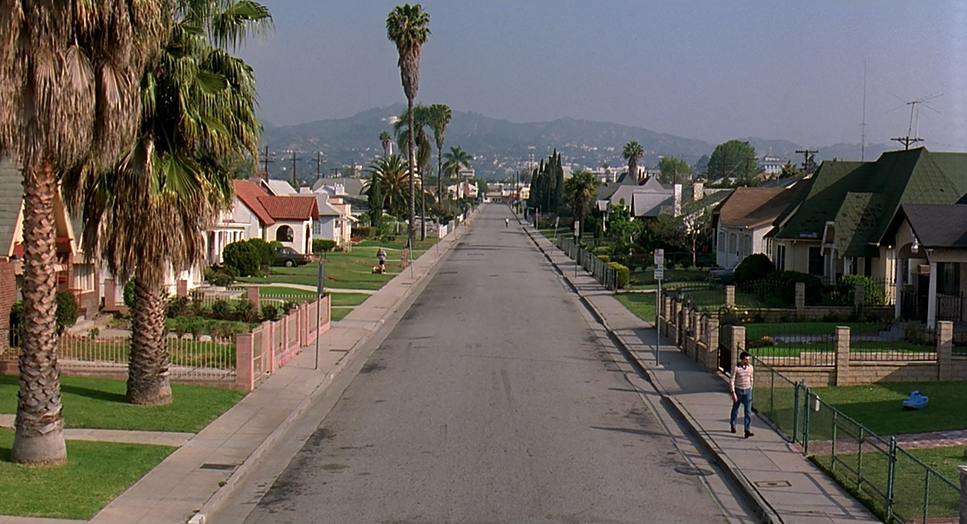
Deakins’ lighting here is motivated, yet heightened. For the L.A. exteriors, he embraces the harsh, direct sun, creating strong shadows and a vibrant, almost bleached feel. It gives the film an authentic texture that prevents it from feeling like a sitcom.
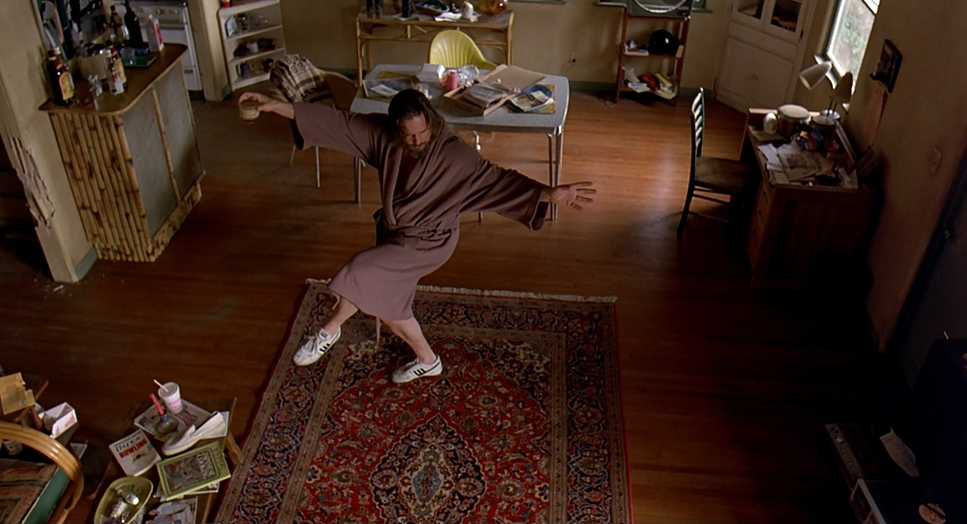
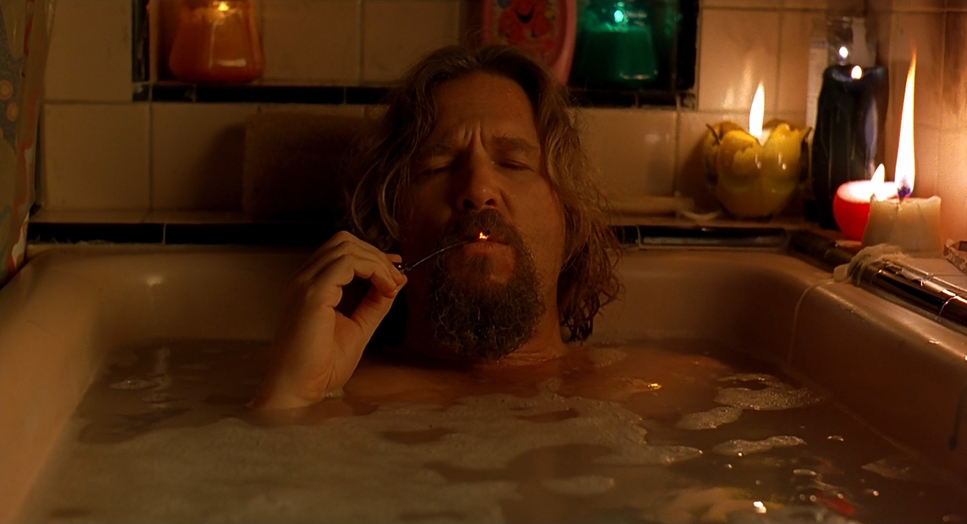
Interiors are where the contrast shines. The Dude’s apartment is dim, lit by practical lamps warm, tungsten pools of light. The bowling alley, conversely, is bathed in the cool, greenish cast of overhead fluorescents mixed with dramatic practicals over the pins. This separation helps orient the viewer instantly.
Then there are the dream sequences. Here, Deakins throws out the naturalistic rulebook. He employs saturated gels, deep reds, and theatrical spotlights. The “Gutterballs” sequence is a masterclass in using artificial color to signal a departure from reality. It creates a visual anxiety that cuts through the comedy.
Lensing and Blocking
We can’t talk about the Lebowski look without talking about the glass. Deakins shot this on Zeiss Standard Primes and Zeiss Super Speeds. Using that older German glass was a specific choice they have a distinct sharpness that doesn’t feel clinical, unlike some modern lenses. He stayed on the wider end of the focal lengths, likely in the 24mm to 35mm range (Super 35 equivalent), which keeps the characters rooted in their context. This facilitates deep focus, keeping multiple planes of action sharp essential for the ensemble blocking the Coens prefer.
The blocking is incredibly precise. Walter is often crowded into the lens, aggressive and distorted, while the Dude is blocked further back, passive and retreating. In chaotic scenes, like the nihilists’ attack, the blocking scatters characters across the wide frame, creating disarray. It’s a visual “il-logic” that perfectly serves the narrative.
Color Grading Approach
As a colorist, this is where I really connect with the film. The Big Lebowski was shot on 35mm film in 1998, meaning the “grade” was largely determined by the negative stock and the photochemical timing at the lab, not a digital intermediate (DI).
The palette is distinct. The film balances the cool, desaturated blues of the bowling alley nights against the warm, earthy tones of the L.A. days. There is a “print film” quality to the images that is hard to replicate digitally the highlights have a gentle roll-off, never clipping into harsh white, and the shadows retain a thick, grainy texture.
Hue separation is critical here. The Dude’s patterned shirts pop against the background, and the specific reds like the Nihilists’ car pierce through the otherwise dusty or cool scenes. The Coens and Deakins baked these colors into the production design and lighting, meaning the final timing was just about refining what was already captured on the negative.
Technical Aspects & Tools
The Big Lebowski – Technical Specs
| Genre | Comedy, Crime, Psychedelic, Dark Comedy, Detective, Neo-Noir |
|---|---|
| Director | Joel Coen, Ethan Coen |
| Cinematographer | Roger Deakins |
| Production Designer | Rick Heinrichs |
| Costume Designer | Mary Zophres |
| Editor | Ethan Coen, Joel Coen, Tricia Cooke |
| Colorist | David Orr |
| Time Period | 1990s |
| Aspect Ratio | 1.85 – Spherical |
| Format | Film – 35mm |
| Lighting | Soft light, Top light |
| Lighting Type | Artificial light |
| Story Location | … California > Los Angeles |
| Filming Location | … California > Los Angeles |
| Camera | Arri 2c (IIc), Arri 535 / 535B |
| Lens | Zeiss Standard Primes, Zeiss Super Speed |
Shot in the late 90s, the technical specs are a time capsule of peak photochemical filmmaking. Deakins utilized the Arri 535 and 535B as his workhorses, likely grabbing the compact Arri 2c for those erratic POV shots or handheld moments.
The choice of 35mm film (1.85:1 aspect ratio) was essential. It provided the latitude needed to handle the dynamic range of the Californian sun without losing information in the shadows. The combination of the Arri cameras, Zeiss primes, and the film stock created a natural grain structure and color rendition that gives Lebowski its organic feel. It reminds us that sometimes, the older tools offer a texture that modern 8K sensors still struggle to mimic.
- Also read: LOGAN (2017) – CINEMATOGRAPHY ANALYSIS
- Also read: THE TERMINATOR (1984) – CINEMATOGRAPHY ANALYSIS
Browse Our Cinematography Analysis Glossary
Explore directors, cinematographers, cameras, lenses, lighting styles, genres, and the visual techniques that shape iconic films.
Explore Glossary →