Nightcrawler (2014) shouldn’t look this good. Usually, when you’re dealing with low-budget night exteriors in Los Angeles, you’re fighting a losing battle against flat digital sensors and muddy shadows. But as a colorist running Color Culture, I look at this film as the definitive proof that “digital” doesn’t have to mean “sterile.”
Dan Gilroy and Robert Elswit didn’t just capture LA, they dissected it. It’s a film that gets under your skin because the visuals are in a chilling, deliberate lockstep with Lou Bloom’s sociopathy. We aren’t just watching a story; we are being forced to adopt Lou’s predatory gaze.
About the Cinematographer
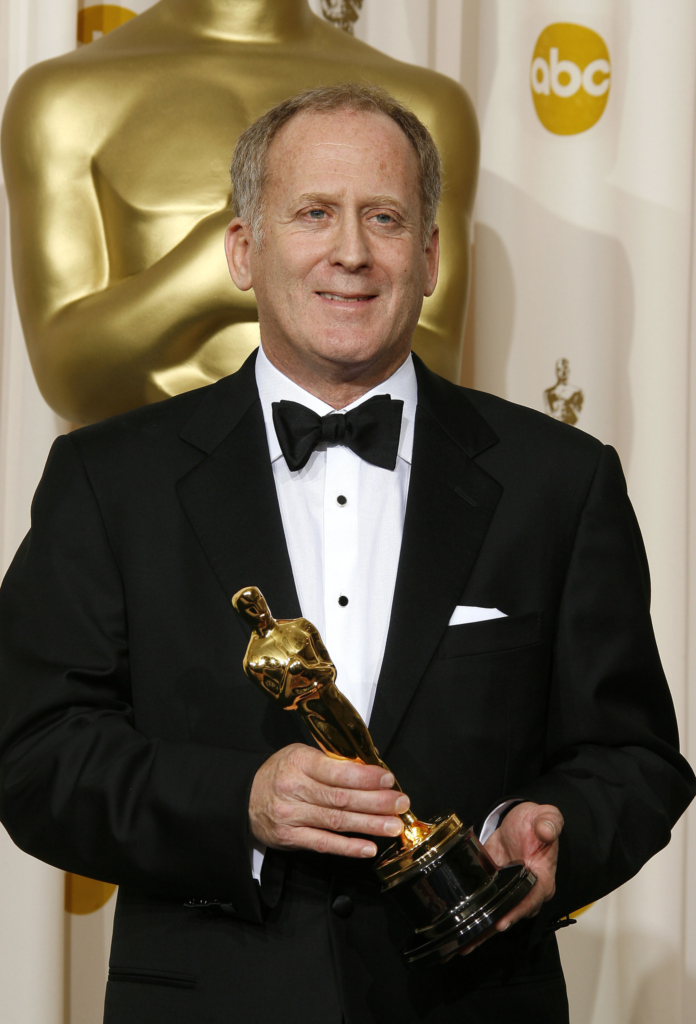
If you know Robert Elswit’s work on There Will Be Blood or Michael Clayton, you know he doesn’t do “flashy” for the sake of it. He’s a surgical cinematographer. In Nightcrawler, he brings a signature blend of grit and elegance to the streets, but there’s a new level of restraint here.
Elswit’s genius in this film is his invisibility. He isn’t hitting you over the head with “cinematography” with a capital C. Instead, he sets the camera up as a voyeur. He lets the environment the flickering sodium vapors and the harsh glare of the newsroom do the heavy lifting. It’s unadorned, raw realism that makes the sudden bursts of violence feel terrifyingly close.
Inspiration Behind the Cinematography
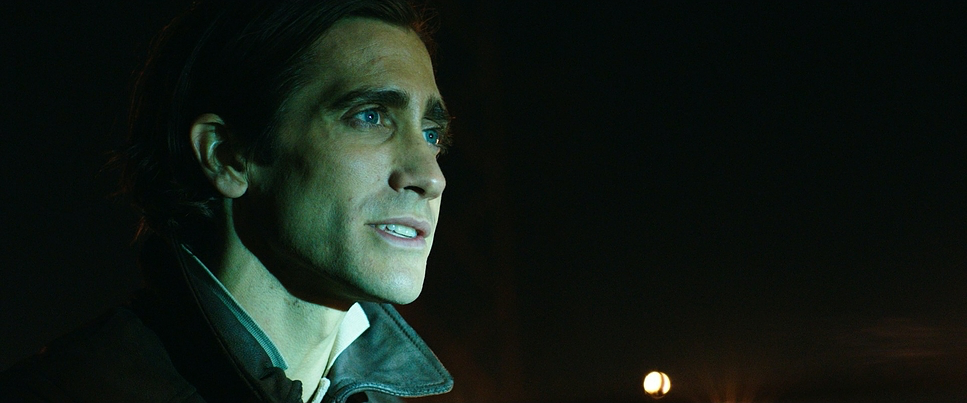
The aesthetic here is “Modern Neo-Noir,” but it’s stripped of the romanticism you see in movies like Drive. The inspiration clearly stems from the “creature” that is Lou Bloom. He is a nocturnal predator, and the city is his hunting ground.
There’s an indifference to the way LA is shot here. It feels vast and lonely. We see Lou as this skeletal, bug-eyed alien moving through a world of “breaking news” and car crashes. The visuals needed to capture that unnerving detachment. It’s voyeuristic in the worst way making us feel like we’re sitting in the passenger seat of Lou’s Challenger, complicit in every ethical boundary he crosses.
Camera Movements
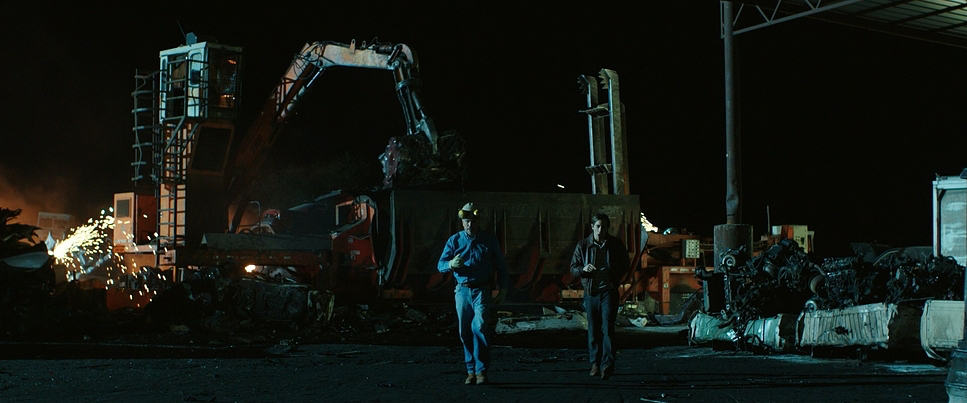
The camera work in Nightcrawler is all about the “shift.” When Lou is on the hunt, the camera is frantic. During the car chases, it’s handheld and breathless, mirroring his manic focus. It’s messy, immediate, and high-stakes.
But look at the scenes where Lou is manipulating Nina or Rick. The camera settles into these slow, agonizingly deliberate pushes. Or better yet, it just locks off. When Lou moves those bodies at the crime scene to get a “better shot,” the camera doesn’t blink. It stays steady, observing his cold efficiency. That stillness is more disturbing than any shaky-cam could ever be. It captures the two sides of Lou: the frantic “stringer” and the chillingly composed sociopath.
Compositional Choices
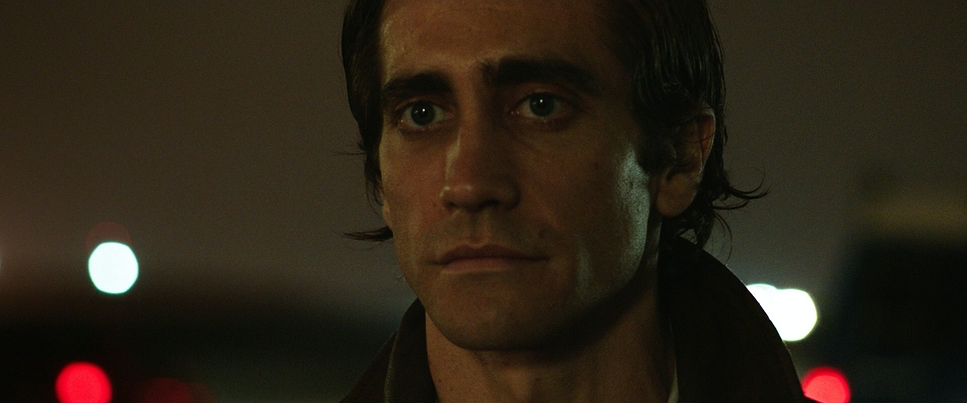
Elswit uses composition to isolate Lou in a way that feels almost claustrophobic despite the wide-open city. You’ll notice a lot of negative space. Even when Lou is in a wide shot of the LA basin, he’s framed in a way that highlights his isolation. He’s an outsider looking in.
Then, the film flips the script. In the newsroom or the car, Lou dominates the frame. His “bug-eyed” intensity fills the screen, pushing everything else to the edges. Elswit also loves “framing within frames” using doorways and windows to make Lou look like he’s peering out from a dark burrow. It reinforces that predator-prey dynamic. We aren’t just watching Lou; we are watching Lou watch his victims.
Lighting Style
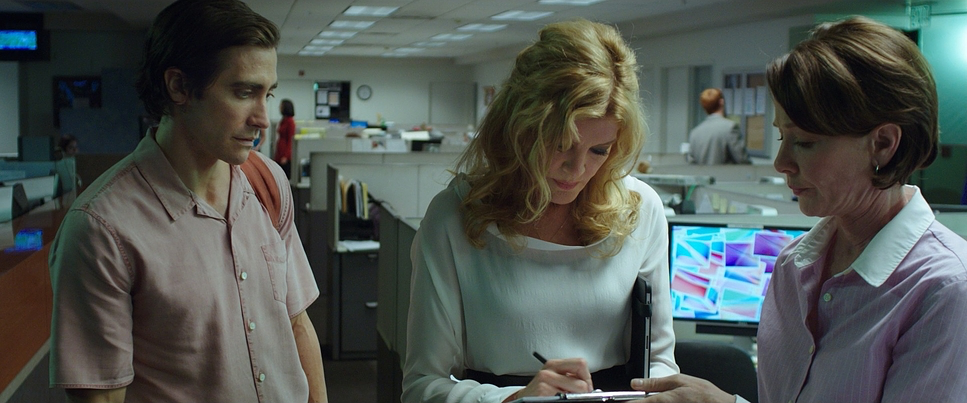
This is where the movie really defines itself. Elswit leans into “motivated” practical lighting, and it’s a masterclass in how to use “ugly” light sources to create beauty. We’re talking neon signs, harsh streetlights, and the blinding strobes of emergency vehicles.
There’s a fascinating contradiction in the lighting. While much of the film feels cold and clinical, there’s a “toxic warmth” in the practicals those oranges and yellows from shop windows that feel more like a warning than a comfort. My “hot take” as a colorist? The way Elswit handles skin tones under these mixed light sources is incredible. He lets Gyllenhaal look cadaverous. The directional key light sculpts his sunken eyes and cheekbones, making him look less like a leading man and more like a ghost haunting the 101 Freeway.
Lensing and Blocking
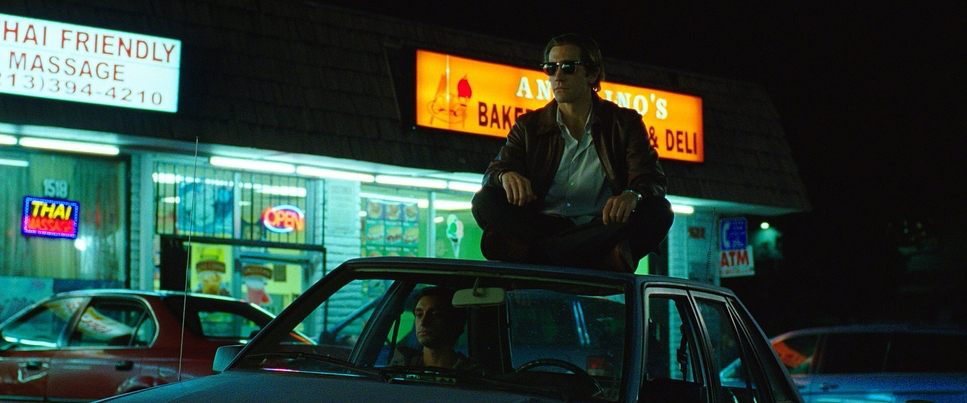
The lens choices here are all about surveillance. For the wide cityscapes, Elswit uses wide-angle glass to show the sprawling, indifferent beauty of Los Angeles. But for the intimate moments, I suspect he’s pulling out longer lenses to compress the space.
When Lou talks to Nina, even when they’re physically close, the lensing creates a psychological distance. It feels like we’re observing them through a long-range lens, reinforcing that Lou is incapable of genuine human connection everything is just a transaction. The blocking follows suit; Lou is rarely passive. Even when he’s just listening, he’s “studying” people, standing slightly apart, waiting for the right moment to strike. It’s predatory blocking at its finest.
Technical Aspects & Tools
Nightcrawler | ARRI ALEXA XT • 2.39:1 • 2.8K ArriRaw
| Genre | Crime, Drama, Thriller, Psychological Horror, Horror, Business, Neo-Noir |
| Director | Dan Gilroy |
| Cinematographer | Robert Elswit |
| Production Designer | Kevin Kavanaugh |
| Costume Designer | Amy Westcott |
| Editor | John Gilroy |
| Colorist | Sofie Friis Borup |
| Time Period | 2010s |
| Color | Warm, Saturated |
| Aspect Ratio | 2.39 – Spherical, Super 35 |
| Format | Digital |
| Lighting | Side light |
| Lighting Type | Artificial light, Practical light |
| Story Location | California > Los Angeles |
| Filming Location | California > Los Angeles |
| Camera | ARRI ALEXA XT / XTplus |
| Lens | Angenieux Optimo, Panavision Primo Primes, Panavision Ultra Speed MKII, Zeiss Super Speed MKII |
| Film Stock / Resolution | 2.8K / 2.8K ArriRaw, 5213/7213 Vision 3 200T |
The film was shot primarily on the ARRI ALEXA XT. In 2014, this was the gold standard for digital latitude, and you can see why. The Alexa’s ability to hold detail in the deep shadows of an LA night without becoming a noisy mess was crucial.
Interestingly, the production used Kodak Vision3 200T (5213) for certain elements, likely to bring in a bit of that organic texture that digital can sometimes lack. Shooting at 2.8K ArriRaw gave the post-production team enough “meat” to push the exposure in the grade. It’s a perfect marriage of high-end digital sensors and traditional film sensibilities, allowing them to capture the “blackest blacks” of the city while maintaining a cinematic softness in the highlights.
Color Grading Approach: The Professional View
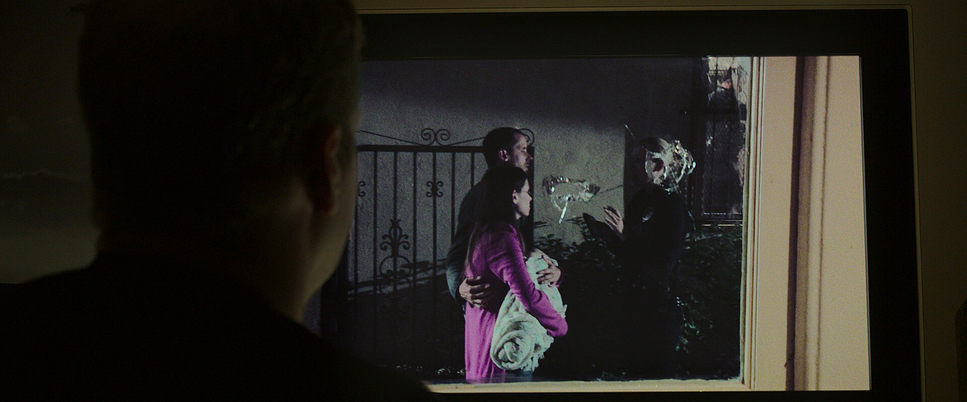
Now, let’s talk shop. As a colorist, Nightcrawler is a film I return to constantly for inspiration on contrast shaping.
The blacks here are deep and inky true neo-noir density. But what I really appreciate is the highlight roll-off. Look at the police sirens and headlights; they’re incredibly bright, but they never feel “clipped” or cheap. There’s a sophisticated tapering at the top of the curve that mimics the way film handles overexposure.
The color palette is a aggressive. It’s dominated by those cool, “sickly” blues and greens in the shadows, contrasted against high-saturation yellows and oranges from the practicals. This isn’t your standard “orange and teal” blockbuster grade; it’s more “sodium vapor and moonlight.”
- Hue Separation: The reds of the emergency lights and the yellow of the caution tape are kept incredibly distinct against the desaturated background. It pulls your eye exactly where Lou wants you to look.
- Tonal Sculpting: There’s a subtle, painterly use of vignettes and selective exposure to guide the eye. It’s not an overt “dark circle” around the frame, but a careful darkening of the edges to create a “tunnel vision” effect exactly how Lou sees the world.
- Also read: THE NOTEBOOK (2004) – CINEMATOGRAPHY ANALYSIS
- Also read: CAST AWAY (2000) – CINEMATOGRAPHY ANALYSIS
Browse Our Cinematography Analysis Glossary
Explore directors, cinematographers, cameras, lenses, lighting styles, genres, and the visual techniques that shape iconic films.
Explore Glossary →