Nausicaä of the Valley of the Wind. Released in (1984) before Studio Ghibli was even officially a thing it’s more than just a foundational anime. It’s a masterclass. When I watch Nausicaä, I’m not just looking at drawings; I’m looking at intentional, cinematic choices that build a world through the lens of a cinematographer. Even 40 years later, this film demands that you linger and actually feel its texture. Miyazaki wasn’t just directing here; he was acting as the ultimate visual architect.
About the Cinematographer

Miyazaki is the gold standard. He’s a visionary who gets the rhythm of movement and the emotional weight of a shadow. While Miyazaki provided the holistic visual philosophy, the technical execution of the “camera” was handled by the cinematography team: Yasuhiro Shimizu, Kôji Shiragami, Yukitomo Shudo, and Mamoru Sugiura. These four were responsible for the physical filming of the hand-painted cels, translating Miyazaki’s vision into light and depth. Looking at his run from Nausicaä of the Valley of the Wind through Kiki’s Delivery Service, the style is incredibly consistent. The team had a rare, gutsy willingness to “let things go” where most editors would cut. They let shots breathe through complex multiplane camera setups that created a deep sense of parallax. It’s hypnotic. They weren’t interested in chasing the audience with fast-paced fluff; they prioritized thoughtfulness and provocation over cheap spectacle. That’s why their collective work doesn’t age.
Looking at his run from Nausicaä of the Valley of the Wind through Kiki’s Delivery Service, his style is incredibly consistent. He has this rare gutsy willingness to “let things go” where most editors would cut. He lets shots breathe. It’s hypnotic. He isn’t interested in chasing the audience with fast-paced fluff; he’s prioritizing thoughtfulness and provocation over cheap spectacle. That’s why his work doesn’t age.
Inspiration Behind the Cinematography
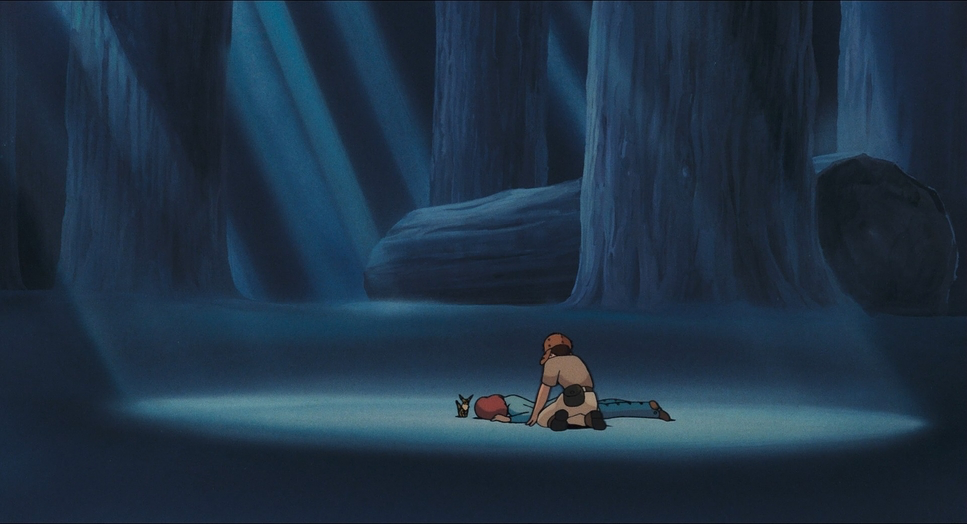
When I watch Nausicaä of the Valley of the Wind, I see a rich dialogue with the 80s sci-fi zeitgeist. You can feel echoes of Star Wars, Alien, and Dune, but Miyazaki isn’t copying he’s remixing. He takes that “doomed civilization” vibe from Mad Max and injects it with a massive dose of environmental philosophy.
The Star Wars influence is all over the aerial sequences. When Nausicaä is on her glider, dodging fire in those vast canyons, it feels like a spiritual successor to Luke Skywalker’s X-Wing runs, just with more ecological weight. The “camera” always makes sure to show how small she is compared to the world. It’s heroic, but it’s fragile.
Then there’s the Alien vibe. That opening where Nausicaä explores the Omu shell? It’s pure Giger. The Omu themselves are terrifyingly beautiful, but here’s where Miyazaki pivots. While Ridley Scott saw nature as “harsh and cruel,” Miyazaki uses his “camera” placement to move us from fear to understanding. He frames the Omu in ways that eventually reveal their majesty. It’s a visual shift that tells the story better than any dialogue could.
Camera Movements
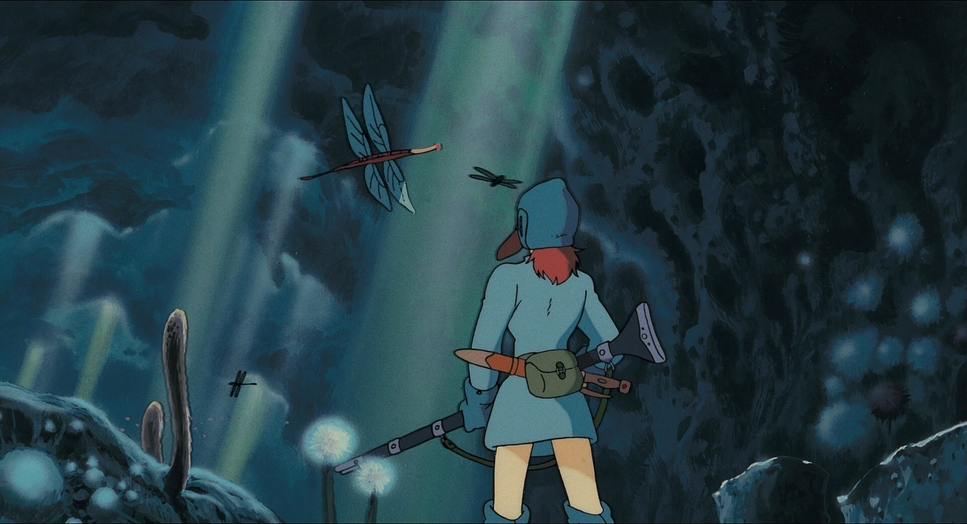
Miyazaki’s “camera” work is the most hypnotic part of this film for me. He hates the frantic cut. He lets the frame hold until you’ve absorbed every bit of visual info.
Take the airships, for example. They’ll cross the entire frame in long, unbroken takes. It’s a narrative choice: it emphasizes the sheer, exhausting distance of this world. When Nausicaä takes flight, the sweeping shots aren’t just for “cool factor” they’re immersive. Even in a stampede, the camera stays stable. It pans and dollys rather than cutting to a million close-ups. He wants you to see the whole of the event, forcing you to see the interconnectedness of it all. It’s slow, it’s thoughtful, and it’s deeply rhythmic.
Compositional Choices
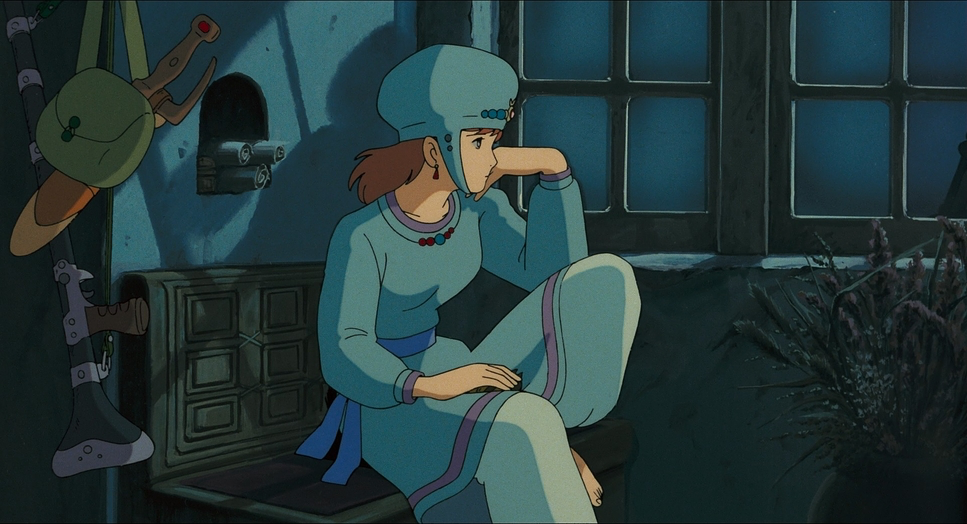
The compositions here are breathtaking, even when the subject matter is “ugly.” Miyazaki is a master of depth. He uses layers foreground foliage, midground characters, distant horizons to pull your eye deep into the frame.
He also understands scale better than almost anyone. Tiny humans against colossal insects tell you everything you need to know about how precarious life is. Look at Nausicaä’s “defenseless stance” when she faces the Omu. That’s a deliberate compositional pivot, setting her pacifism against the aggressive, weaponized framing of the Tolmekian forces. Even the negative space in the sky or the barren wastes feels like an active character. Every shot is a striking, touching transition from the manga page to the screen.
Lighting Style
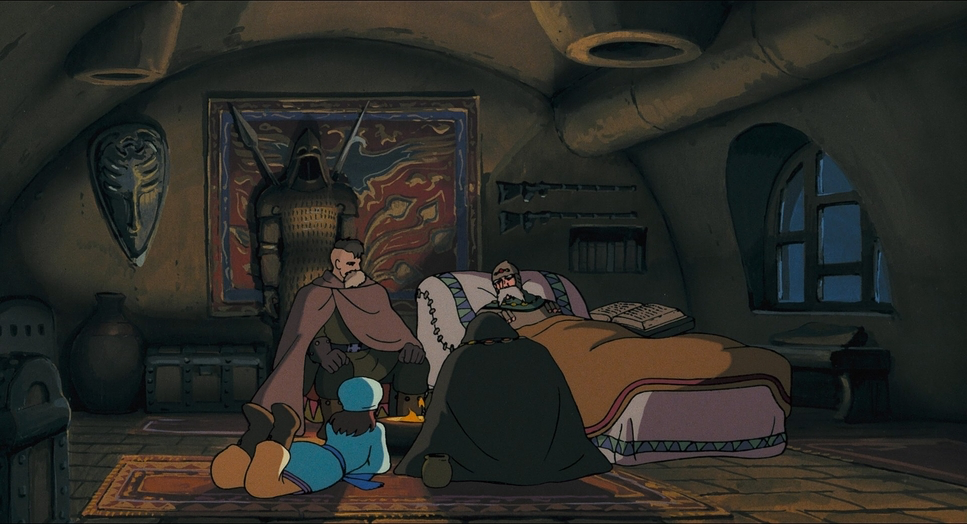
In animation, lighting is a calculated illusion, but Miyazaki handles it like a live-action DP.
We see this in the dappled sunlight of the Toxic Jungle. It’s oppressive but weirdly beautiful. He uses volumetric light shining through spores and dust to make you feel the air quality. It feels dangerous. On the flip side, the Valley is bathed in soft, warm light that feels like home. And then there’s the “Golden Field.” That specific, ethereal glow used for the prophecy and childhood memories is a powerful bit of visual shorthand. It’s not just light; it’s a spiritual indicator.
Lensing and Blocking
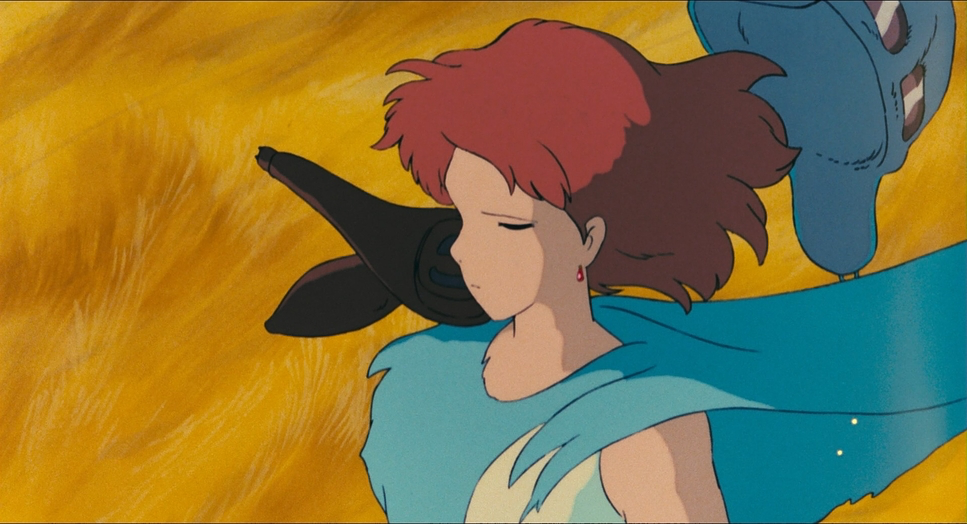
Even though it’s hand-drawn, the film “emulates” lenses perfectly. Wide-angle “lenses” are the go-to for those massive vistas, making humanity look resilient but tiny. Tighter “lenses” are saved for the internal stuff Nausicaä’s quiet moments or her flashes of rage.
The blocking is just as intentional. Think of the flashback where her father looks like a giant it’s a perfect use of a child’s perspective to ground the scene in vulnerability. Or the way the Omu are blocked during a stampede. They aren’t just “monsters”; they are blocked as a unified, elemental force of nature. I used to think they were the antagonists, but the way Miyazaki positions them makes you realize they aren’t malicious they’re just powerful.
Color Grading Approach
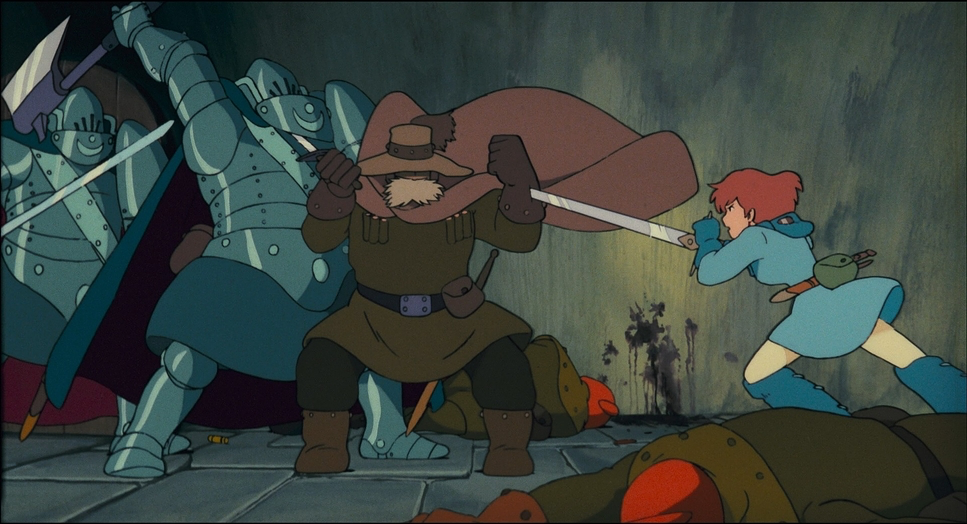
As a colorist, this is where I really geek out. Being 1984 cel animation, Nausicaä has those beautiful “print-film” sensibilities: deep blacks, controlled mid-tones, and a palette that was built to be projected on celluloid.
Miyazaki uses “hue separation” to tell the story. The Valley is all warm earth tones and serene blues. The Toxic Jungle? Sallow, desaturated greens and purples with pops of artificial-looking fungal color. It’s an immediate narrative “tell.” And the way the Omu’s eyes turn from red to blue that’s not just a color change, it’s an emotional shift from rage to grief. It’s analog “grading” at its absolute best, used to drive the theme of symbiosis home.
Technical Aspects & Tools
Nausicaä of the Valley of the Wind | 1.85 Aspect Ratio • Animation
| Genre | Adventure, Animation, Fantasy, Traditional Animation, Nature, Drama, Post-Apocalyptic, Anime, Science-Fiction |
| Director | Hayao Miyazaki |
| Cinematographers | Yasuhiro Shimizu, Kôji Shiragami, Yukitomo Shudo, Mamoru Sugiura |
| Production Designer | Mitsuki Nakamura |
| Editor | Naoki Kaneko, Tomoko Kida, Shouji Sakai |
| Colorist | Chris DeLaGuardia |
| Time Period | Future |
| Aspect Ratio | 1.85 |
| Format | Animation |
| Lighting Type | Daylight, Sunny |
| Story Location | Earth > Valley of the Wind |
| Filming Location | Tokyo > Studio Ghibli Inc |
We have to remember: there were no digital shortcuts here. No CGI, no “undo” button for vast environments. Every spore and ripple was hand-painted.
That manual process gives the film a texture and organic soul that digital often misses. They used a multiplane camera to get that parallax and depth in the landscapes, and it shows. When you combine that with Joe Hisaishi’s score those off-beat, synth-heavy tracks it creates a “hypnotic style” that’s impossible to replicate. The sheer scale of this pre-CGI production is a testament to the grind and the craft.
- Also read: CASTLE IN THE SKY (1986) – CINEMATOGRAPHY ANALYSIS
- Also read: COOL HAND LUKE (1967) – CINEMATOGRAPHY ANALYSIS
Browse Our Cinematography Analysis Glossary
Explore directors, cinematographers, cameras, lenses, lighting styles, genres, and the visual techniques that shape iconic films.
Explore Glossary →