Monty Python’s Life of Brian deserves a closer look, it’s celebrated for its satire and the “very naughty boy” line, but what actually makes the film work and what often gets ignored is its remarkable cinematography.
This is an epic satire masquerading as a biblical drama. The visual choices were pivotal in pulling off that balancing act. It’s a masterclass in how visual cues elevate comedy by grounding the absurd in an authentic, almost reverent aesthetic. The juxtaposition allows the humor to land with precision.
About the Cinematographer
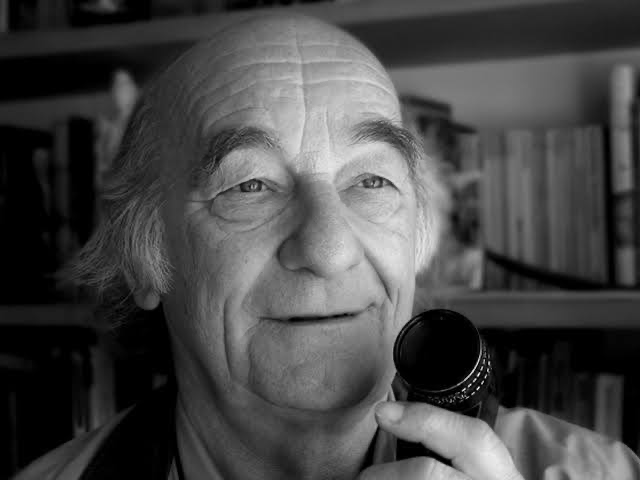
The DP for Life of Brian was Peter Biziou, a name synonymous with a gritty, elegant realism. He later won an Oscar for Mississippi Burning, but even early in his career, his work felt lived-in. For Life of Brian, Biziou had an unusual challenge: capturing the chaos of Python while giving it the visual gravitas of a David Lean epic.
He succeeded by making the film feel grand in scale yet intimately ridiculous. He collaborated to build a world that felt tangibly ancient, a canvas for the Pythons to paint on. His visual sensibility leaned towards naturalism, letting the environment and available light do the heavy lifting perfect for the sun-baked Judean setting.
Inspiration Behind the Cinematography
The film’s visual DNA is inherently parasitic. EMI Films pulled the plug days before shooting, deeming the script “too blasphemous,” until George Harrison stepped in to fund it through Handmade Films. That passion bred ingenuity.
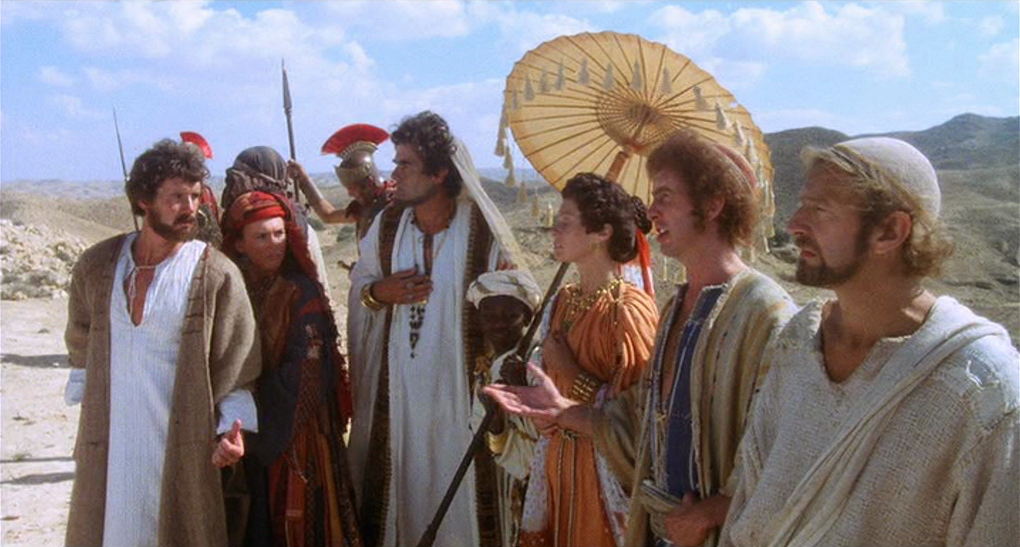
When production started, they didn’t have the budget to construct sprawling biblical sets. Instead, they reused the leftovers from Franco Zeffirelli’s 1977 miniseries Jesus of Nazareth. They used the same arches, temples, and dusty courtyards where solemn miracles had just unfolded on screen, filling them with fart jokes and stoning sequences.
By utilizing these existing sets, the cinematography inherited a massive production value. The visual backdrop was authentic, previously used to evoke sincere reverence. This foundation allowed the Pythons to layer irreverent comedy onto a “sacred” space, creating an instant contrast. The film looks like a genuine biblical epic, which makes Brian’s accidental Messiah narrative and the mob’s blind following much funnier. The visuals act as a Trojan horse, carrying subversive comedy into a familiar landscape.
Camera Movements
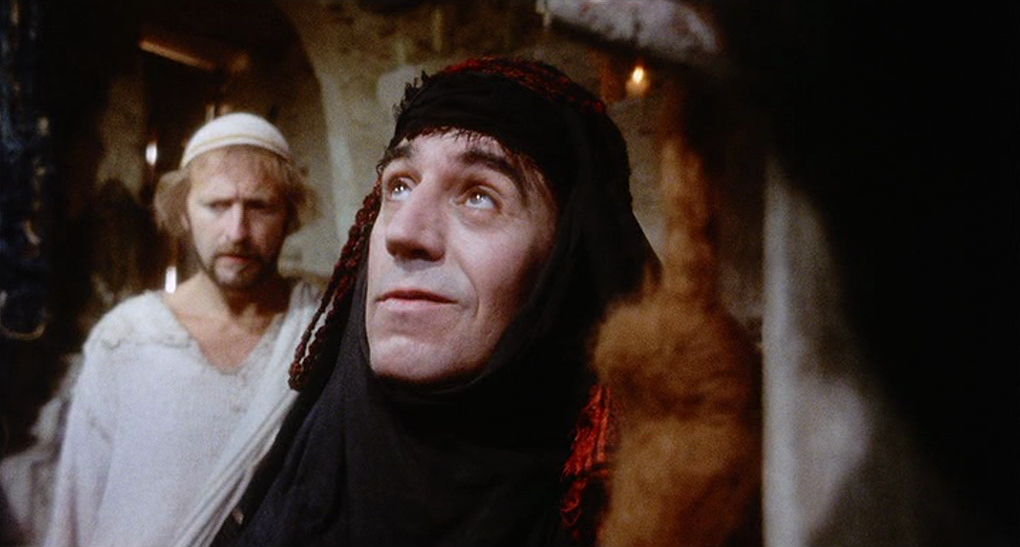
In Python-brand comedy, the performance usually dictates the camera. You don’t want sweeping movements drawing attention to themselves; you want the camera to serve the timing. Biziou adopted a functional approach here.
Many scenes rely on static wide shots or slow pans to establish the indifferent landscape against which human folly plays out. In the Sermon on the Mount sequence, the camera remains distant, showcasing the characters struggling to hear the words from the back. The distance is the joke. The camera doesn’t need to push in for a reaction when the comedy is the collective confusion.
However, the camera moves with grace when necessary. Reviews often point to the “Tarkovsky-an” moment where Brian looks out his balcony window. It’s a measured reveal likely a slow push-in or carefully framed static shot emphasizing the scale of his unwanted fame. The exception is Terry Gilliam’s “special effects flex” the random UFO chase. Here, the camera embraces kinetic energy and fantastical movement that derails the plot, fitting Gilliam’s unique signature and the spirit of the non-sequitur.
Compositional Choices
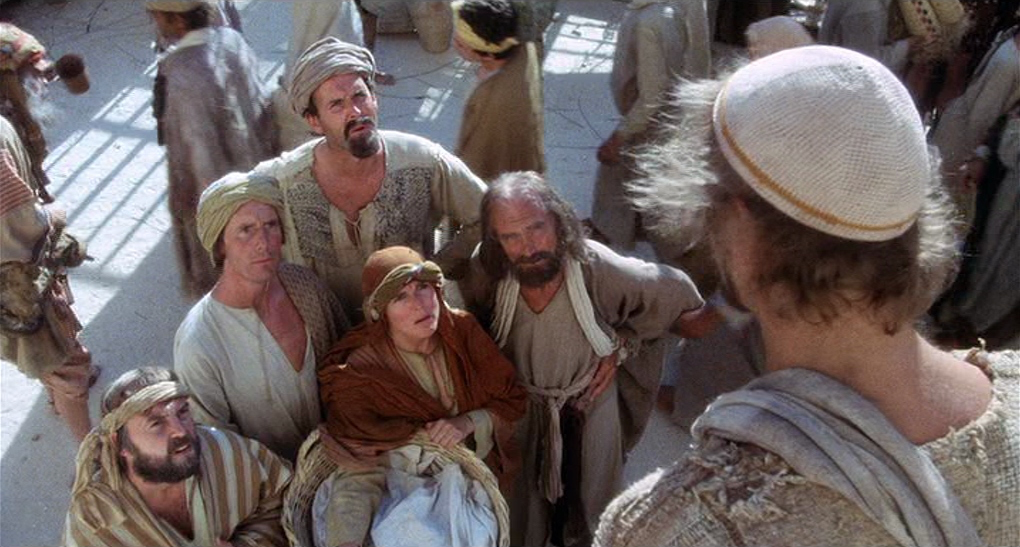
Biziou’s compositions play on deep staging, allowing for layers of action. This is crucial for ensemble comedy, where the joke isn’t just the speaker, but the crowd’s reaction or absurd details in the background.
The “Brian at the window” shot is a prime example. It’s a wide, balanced composition emphasizing the number of followers below, contrasting Brian’s isolation against a sea of faces. The negative space of the architecture frames the drama, making Brian seem tiny against the expectation.
Crowd scenes are another powerful tool. Whether it’s the Sermon or the crucifixion, the compositions are carefully orchestrated to reveal the mob mentality. When Brian loses his sandal and the crowd debates its significance, the camera frames these earnest, confused faces against a vast landscape. The visual depth cues allow the eye to wander and discover comedic details, ensuring the precise beats are visually supported.
Lighting Style
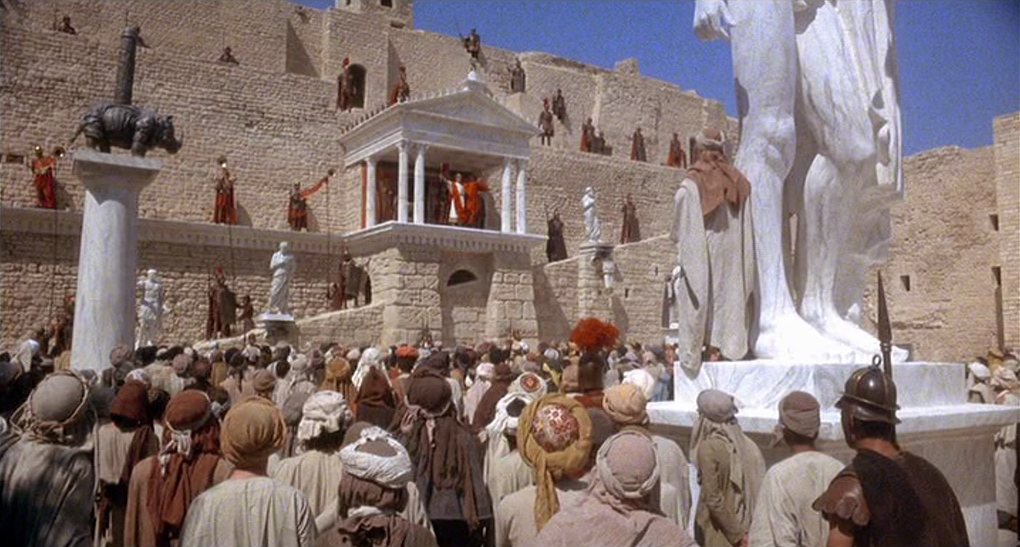
The lighting is driven by the Tunisian locations. Biziou opted for a naturalistic style that grounds the film. If it looked theatrical, the contrast between the setting and the stupidity would vanish.
Exteriors are bathed in the harsh, high-contrast light of the North African sun. This is characteristic of 1970s filmmaking, where DPs chased an authentic, available-light look. The top light emphasizes texture in the costumes and rough-hewn stone. It is motivated lighting: the sun is the primary source, and its behavior dictates the look.
For interiors, the lighting remains naturalistic. Torches and lanterns provide the illumination, creating warm glows against deep shadows. This adds density and texture. The dynamic range of the film stock handled these high-contrast scenarios well, holding detail in bright highlights and moody shadows. It creates a believable world, making the spaceship appearance even more jarring.
Lensing and Blocking
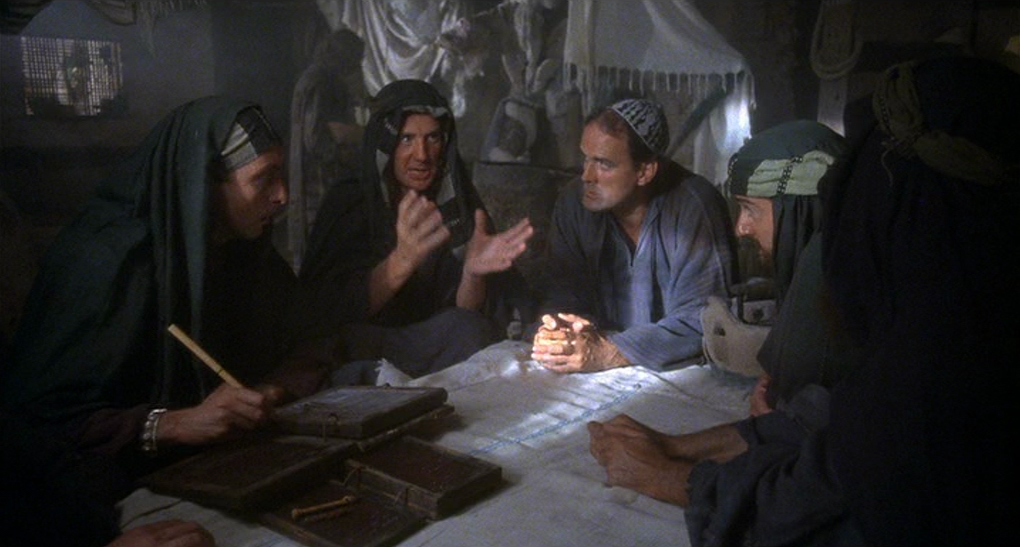
Lensing favors a wider perspective for establishing shots to capture the desert vistas. This reinforces the epic aesthetic ironically. Closer in, medium shots and medium close-ups capture the Pythons’ timing without using extreme telephoto lenses to flatten the perspective. The film prefers a grounded approach.
Blocking is the real masterclass here. Terry Jones focused on “performance wrangling,” and he was meticulous in orchestrating movement. In the “What have the Romans ever done for us?” scene, the action is set in a confined space, yet the blocking of the resistance members their interjections, gestures, and reactions to Reg is carefully managed. It’s about visual rhythm.
Even in crowd scenes, there’s a conscious effort to block for organic chaos. The Spike Milligan cameo, where he wanders off while the camera rolls on a long shot, encapsulates the Pythons’ embrace of spontaneity.
Color Grading Approach
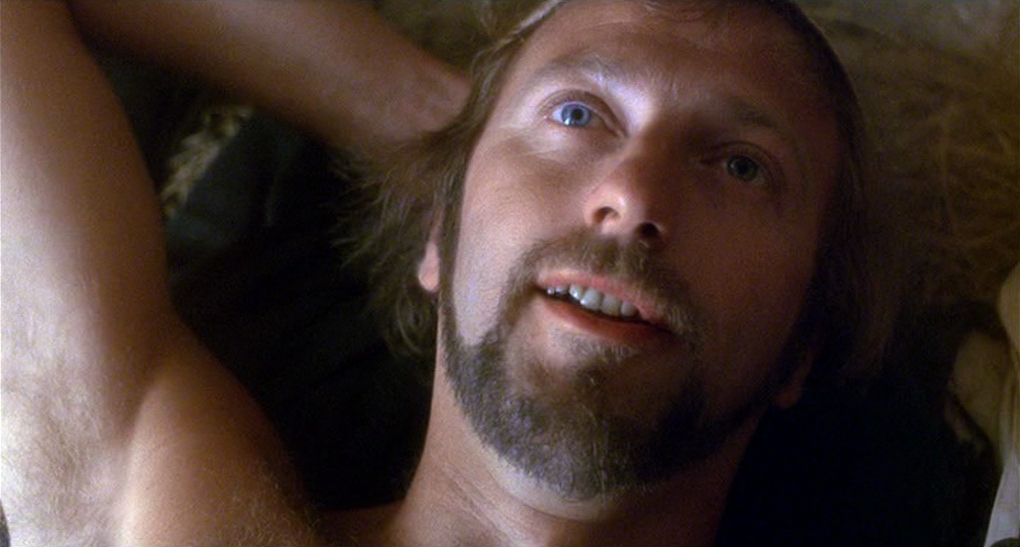
From a colorist’s perspective, this is where the film gets interesting. We are looking at a 1979 release, meaning we are dealing with photochemical timing and the specific characteristics of Eastman stocks from that era, likely the 5247. The palette is dominated by the earthy browns, yellows, and ochres of the desert.
There is a deliberate choice to lean into the warmth. The highlights on the sand and stone exhibit that characteristic filmic roll-off a smooth transition into white rather than the harsh clipping we fight against in digital workflows. The “golden cast” isn’t a digital tint; it’s the response of the emulsion to the hard sunlight.
The shadows hold excellent density. They aren’t crushed to a digital zero; they have a rich texture, likely sitting around the 10-15 IRE mark on a waveform, allowing us to see into the darker corners of those borrowed sets. The contrast curve is robust but organic. The grain structure, particularly visible in the blue channel during the sky shots, adds a period authenticity you can feel.
If I were grading this today, I wouldn’t try to “clean it up.” The goal would be to maintain that print-film sensibility—keeping the separation of skin tones natural against the monochromatic background and preserving the density of the blacks. The color isn’t stylized; it’s utilitarian and realistic, providing the emotional bedrock of authenticity that allows the absurdity to play out.
Technical Aspects & Tools
Monty Python’s Life of Brian
Technical Specifications| Director | Terry Jones |
| Director of Photography | Peter Biziou |
| Production Design | Terry Gilliam |
| Costume Design | Charles Knode & Hazel Pethig |
| Year | 1979 |
Filming in Tunisia meant dealing with blistering heat. Graham Chapman, who quit drinking cold turkey for the role, ended up playing on-set doctor. These physical realities impacted the production; you have to manage heat and exhaustion, which often means embracing simpler setups.
The low budget forced ingenious solutions. Chapman’s “rubber band” circumcision gag is a prime example of practical problem-solving. Gilliam’s UFO sequence, while complex for the time, showed a DIY spirit. They even scorched part of a historic stone wall with black powder for the crash site and had to sneak back to clean it filmmaking with a sense of adventure.
Splitting the directing roles between Terry Jones (performance) and Terry Gilliam (design) was a smart move after Holy Grail nearly tore them apart. Gilliam crafted the gritty, ancient look, freeing Jones to focus on the comedy. It’s a perfect example of two artistic voices complementing each other.
- Also read: THE PRINCESS BRIDE (1987) – CINEMATOGRAPHY ANALYSIS
- Also read: BEAUTY AND THE BEAST (1991) – CINEMATOGRAPHY ANALYSIS
Browse Our Cinematography Analysis Glossary
Explore directors, cinematographers, cameras, lenses, lighting styles, genres, and the visual techniques that shape iconic films.
Explore Glossary →