It is a film that resonates on two levels: as an elegant exploration of a child’s psyche, and as a piece of visual engineering. While the medium is different, the discipline is the same. The principles of visual language camera, light, color density, composition are executed here with a precision that live-action rarely achieves. From my seat in the grading suite, I see the bones of this film clearly, and the visual skeleton Pete Docter’s team built is extraordinary.
About the Cinematographer

Animation doesn’t have a single cinematographer. It has a hive mind. In live-action, one DP calls the shots; in Inside Out, that responsibility was split to handle the sheer scale of the visual ambition.
The “eye” of the film was a collaboration between Kim White (Director of Photography – Lighting) and Patrick Lin (Director of Photography – Camera). They didn’t just make pretty pictures; they had to build virtual lenses and light sources from scratch. Working under Docter and producer Jonas Rivera, they were tasked with sculpting emotional landscapes using data rather than celluloid. They are the operators through which we experience Riley’s world. The result isn’t just “lush animation”; it is a deliberate application of cinematic grammar that elevates the narrative beyond mere spectacle.
Inspiration Behind the Cinematography
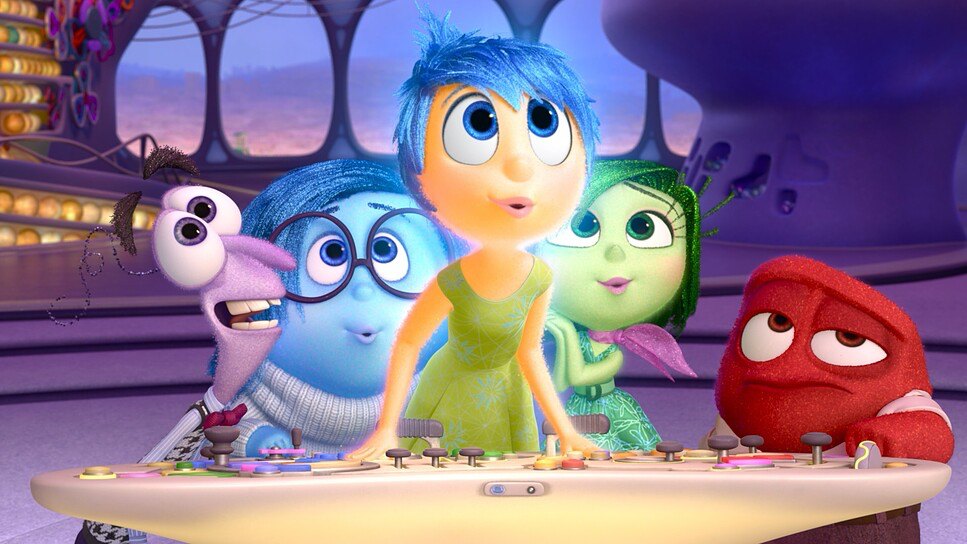
The visual strategy here is built entirely on dualism. The team had to craft two distinct visual languages: the grounded reality of Riley’s life and the abstract, bio-luminescent landscape of her mind.
Early on, Joy is constantly trying to push Sadness out of the frame, mimicking exactly how our brains work in the beginning. This narrative simplicity dictated the initial look: binary visual cues and a pristine aesthetic in the Mind World. As the film progresses and the themes mature questioning self, embracing sadness the visuals fracture. The crumbling personality islands and the dusty, fading Imagination Land are rendered with meticulous decay. It’s a clever visual trick: physicalizing abstract psychological concepts so the audience “feels” the breakdown before the characters even speak.
Camera Movements

The camera work in Inside Out is incredibly distinct. It treats the “virtual camera” with the physics and limitations of a real one, which grounds the fantasy.
When we track Joy, the camera mimics her energy it’s fluid, buoyant, almost carrying an “Animaniacs” kind of kineticism. It uses swift pans and dollies to emphasize her boundless optimism. Conversely, when the control panel malfunctions, the camera destabilizes. Lin and his team introduced a subtle handheld feel to amplify the chaos.
We also see wide, sweeping crane-like shots that establish the vastness of the Mind World, making the journey to the core memories feel epic. A specific continuity detail I love is how the camera follows “the same arc and velocity” when cutting between the mind world and the real world. It’s a subtle subliminal cue that connects Riley’s external reaction to the internal mechanical process.
Compositional Choices
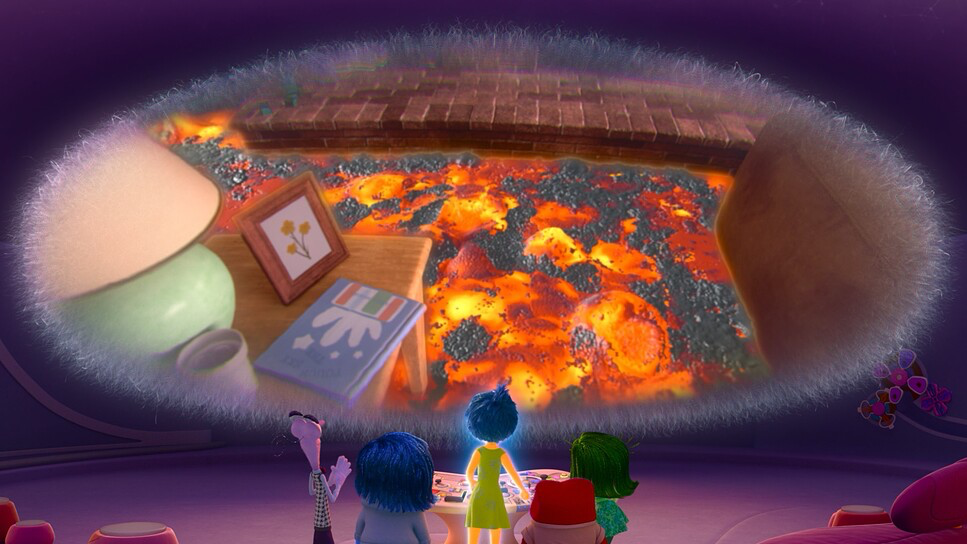
Space defines status. The composition inside Headquarters is a lesson in character dynamics. The control console acts as the stage; early frames show Joy dominating the center, while Sadness is relegated to the far edges of the widescreen aspect ratio.
The contrasting “command centers” of the parents are equally brilliant. Mom’s center is soft, open, and inviting. Dad’s is angular, tightly framed, and almost claustrophobic, reflecting his stress.
Then there is the scale. The vastness of the memory stacks is often shot in wide, overwhelming compositions—looking like “brain matter” from a distance. These shots dwarf Joy and Sadness, visually reinforcing their vulnerability. When the emotions eventually unite around the expanded console, the composition widens, allowing them to share the frame equally. It’s visual integration mirroring emotional integration.
Lighting Style
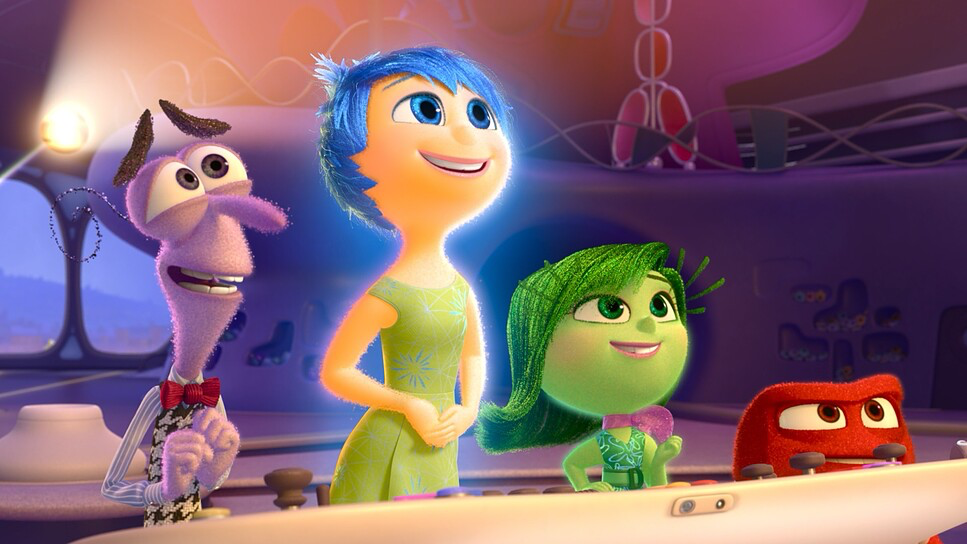
Lighting is the primary tool used to distinguish the two worlds. The Mind World, particularly Headquarters, relies on unmotivated, luminous sources. Joy isn’t just lit; she is the light source. She is made of light particles and leaves a sparky trail, making her the brightest element in the waveform on every shot. This gives the emotions a non-corporeal feel.
Riley’s real world, by contrast, uses motivated, naturalistic lighting. The San Francisco apartment is dim and moody, reflecting the family’s disarray. The lighting in the Mind World reacts to Riley’s state; as she deteriorates, the saturation drops and the shadows crush specifically in the memory dump, where the lighting becomes grim and despondent. The return to warmth at the climax is a dynamic range decision that creates a profound emotional release.
Lensing and Blocking
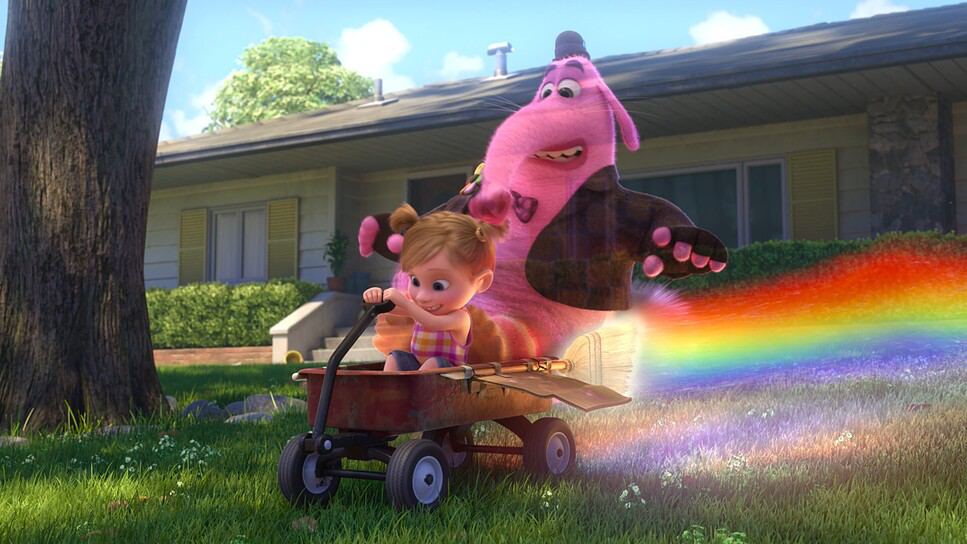
Inside Out uses virtual focal lengths to great effect. The team utilized wide-angle distortions to emphasize the sheer scale of the long-term memory banks and the towering personality islands. These wider field-of-views make the internal world feel insurmountable.
For intimate moments like the emotions struggling at the console the “lens” tightens, compressing the background and forcing us to focus on the character performance. The blocking mirrors the character arc: Joy initially blocks herself in front of everyone, physically obscuring Sadness. By the end, the proximity changes. They stand side-by-side. The sequence where the islands crumble uses dynamic blocking to show characters reacting to the sweeping destruction, making the abstract consequences of emotional turmoil feel tangibly, terrifyingly real.
Color Grading Approach
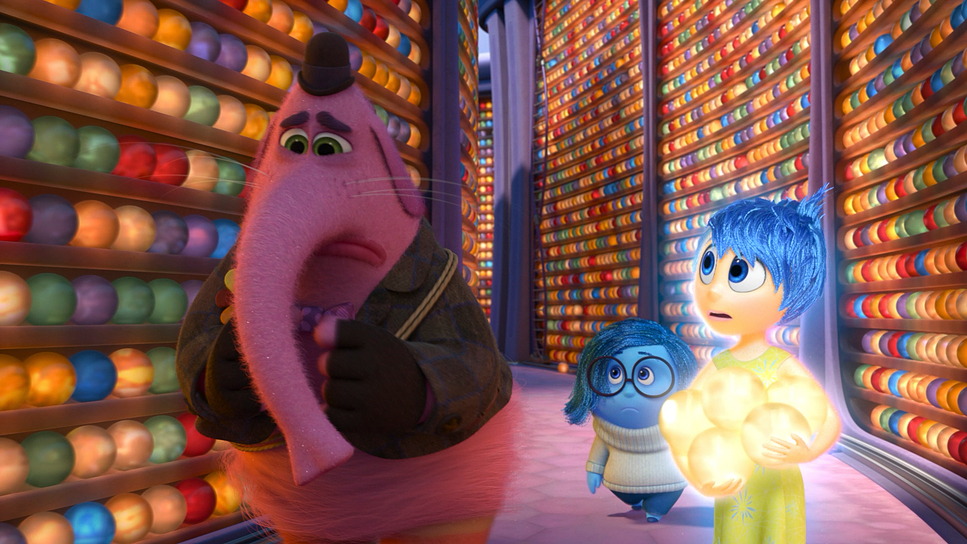
This is where the film finds its soul. As a colorist, I look at Inside Out and see a masterclass in hue separation and density management.
The immediate takeaway is the character coding: Joy is radiant yellow, Sadness is deep blue, Anger is fiery red. But look closer at the texture of the grade. In the Mind World, the colors hold high saturation but with a distinct “print-film sensibility.” The highlights roll off gently rather than clipping digitally, and there is a subtle warmth in the midtones that prevents the high-key lighting from feeling sterile.
The real technical achievement, however, is the blending. When Joy creates a core memory that is both happy and sad, we see a blend of blue and yellow. In a traditional Digital Intermediate (DI), mixing pure yellow and pure blue often results in a muddy green. Pixar avoided this. They managed a tonal sculpting where the two hues coexist, vibrating against each other to create a new “nostalgia” palette. It is a visual metaphor for the alchemy of human feeling, executed with incredibly precise contrast shaping. They used color not just to identify emotions, but to make us feel them.
Technical Aspects & Tools
Inside Out – Technical Specifications
| Genre | Animation, Comedy, Family, CGI Animation, Mental Health, Drama |
| Director | Pete Docter, Ronnie del Carmen |
| Cinematographer | Patrick Lin |
| Production Designer | Ralph Eggleston |
| Editor | Kevin Nolting |
| Colorist | Mark Dinicola |
| Time Period | 2010s |
| Color | Mixed, Saturated, Yellow, Blue, Purple, Magenta |
| Aspect Ratio | 1.78 |
| Format | Animation |
| Lighting Type | Artificial light |
| Story Location | … United States of America > Minnesota |
| Filming Location | … United States of America > California |
For an animated film, “technical specs” aren’t about camera sensors, but about render engines and simulation physics. Inside Out pushed the boundaries of what was computationally possible in 2015.
The texture work is astounding the “cotton candy fibers” of Bing Bong or the realistic viscosity of the lava in the subconscious required heavy simulation data. The blend of 2D and 3D animation during the “Abstract Thought” sequence is a standout technical marvel, breaking the established visual rules to convey a distorted mental state. Even the way memories are visualized as glowing orbs required a robust lighting engine to handle the thousands of light sources in a single frame without crashing the render farm.
- Also read: THE BIG LEBOWSKI (1998) – CINEMATOGRAPHY ANALYSIS
- Also read: LOGAN (2017) – CINEMATOGRAPHY ANALYSIS
Browse Our Cinematography Analysis Glossary
Explore directors, cinematographers, cameras, lenses, lighting styles, genres, and the visual techniques that shape iconic films.
Explore Glossary →