I live and breathe the visual language of cinema, but rarely does a blockbuster hit me quite like Guardians of the Galaxy Vol. 3. Stepping out of the IMAX marathon, having watched the trilogy back-to-back, I felt a familiar blend of exhaustion and exhilaration. There’s been a lot of noise about “Marvel fatigue” lately, and frankly, a lot of it is justified. But this film was different. It didn’t feel like content churned out for a release schedule; it felt like a singular vision. It’s a return to form for the MCU, but more importantly, it’s a triumph of craft specifically in its cinematography and post-production.
About the Cinematographer
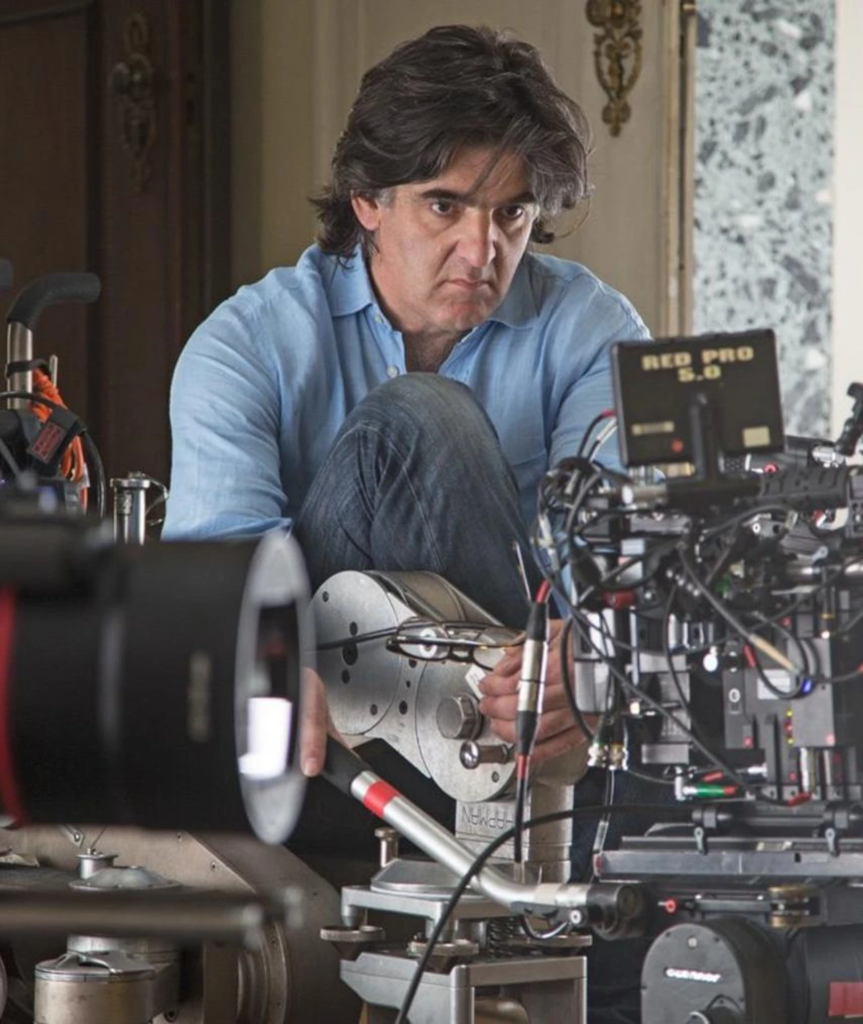
The visual architect behind this trilogy-capper is Henry Braham BSC. His collaboration with James Gunn is well-established, having previously lensed Guardians Vol. 2 and The Suicide Squad. That partnership is vital here. Braham isn’t just executing a shot list; he understands Gunn’s specific frequency that chaotic blend of heartfelt emotion, grotesque humor, and explosive action. Because they have that shorthand, Braham pushes the visual storytelling further than most hired guns would dare. He translates Gunn’s tonal balance into a coherent visual experience, proving that a superhero film can have a distinct, human fingerprint behind the lens.
Inspiration Behind the Cinematography
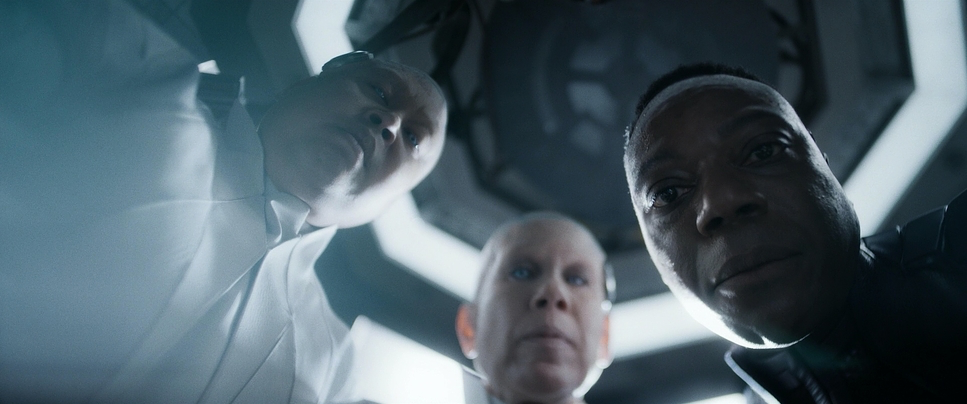
Vol. 3 marked a massive tonal shift. While the previous films were vibrant space operas, this entry leaned into a darker, emotionally taxing space. We are diving into Rocket Raccoon’s tragic backstory themes of animal cruelty and experimentation don’t mesh well with flat, high-key sitcom lighting. The cinematography had to evolve.
Braham’s approach moved away from the pure pop-art aesthetic of Vol. 2 toward something grittier. The visual inspiration feels like a blend of classic sci-fi texture and a deliberate embrace of the grotesque, especially in the High Evolutionary’s domains. There is a noticeable absence of the safety net found in other recent MCU entries; the dark moments here are allowed to actually be dark. Braham moves us from the expansive cosmic landscapes we expect to claustrophobic, sterile environments that mirror Rocket’s trauma. The contrast isn’t just narrative; it’s baked into the look.
Camera Movements
If there’s one sequence that screams “peak James Gunn,” it’s the hallway fight on the High Evolutionary’s ship. It is a masterclass in dynamic camera movement. The camera isn’t just an observer here; it’s a participant, weaving through the chaos, handing off the focus from Star-Lord to Nebula to Drax seamlessly.
What struck me most was the motivation behind the speed ramps. In lesser hands, ramping is just a flashy effect. Here, the camera speeds up and slows down to emphasize specific physical impacts a heavy landing, a reload, a brutal takedown before snapping back into the frenetic pace. This requires incredible coordination, likely utilizing the stabilized handheld rigs Braham is famous for, allowing the operator to be right in the middle of the stunt team.
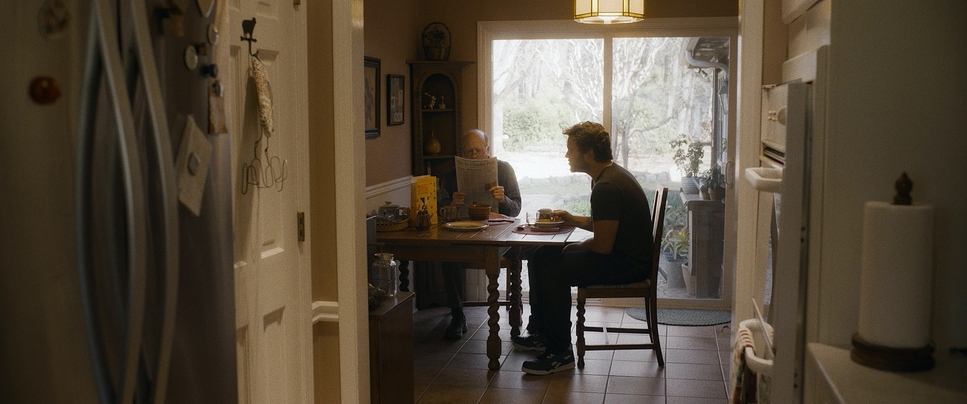
Beyond the action, the camera work in the flashback sequences is heartbreakingly intimate. The camera hangs low, often at Rocket’s eye level, making the world feel towering and threatening. It invites us to feel the vulnerability rather than just watching it.
Compositional Choices
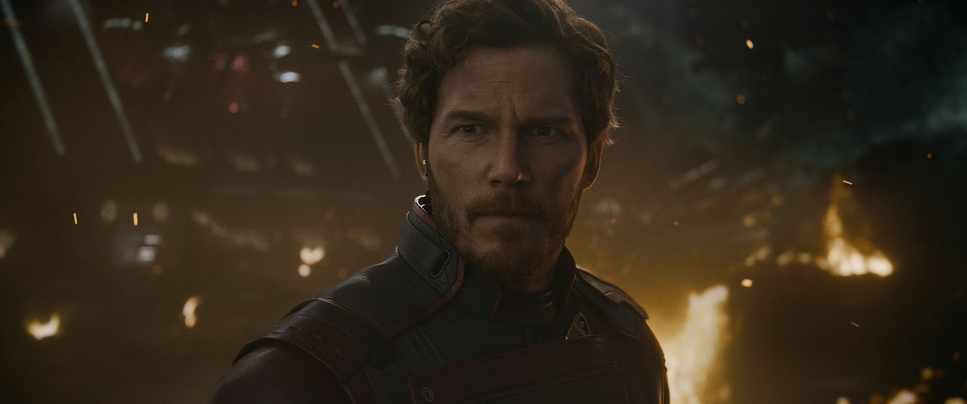
Braham’s composition in Vol. 3 balances the epic with the uncomfortable. In the grand cosmic sequences, such as the approach to Counter-Earth, we get those massive wide shots with strong leading lines, emphasizing the god-like (and ego-driven) ambition of the villain.
However, the film truly shines in its “found family” framing. Gunn and Braham constantly group the Guardians together within the frame, creating a visual cohesion that reinforces their bond. They use depth cues skillfully foreground, midground, background to keep every team member active in the shot, even when they aren’t speaking.
In the darker moments, specifically the cages, the composition becomes tight and isolating. Braham avoids stylized Dutch angles, opting instead for a straightforward, almost documentary-style framing that forces us to look at the raw emotion on the faces of the test subjects. It creates a sense of helplessness that is genuinely difficult to watch.
Lighting Style
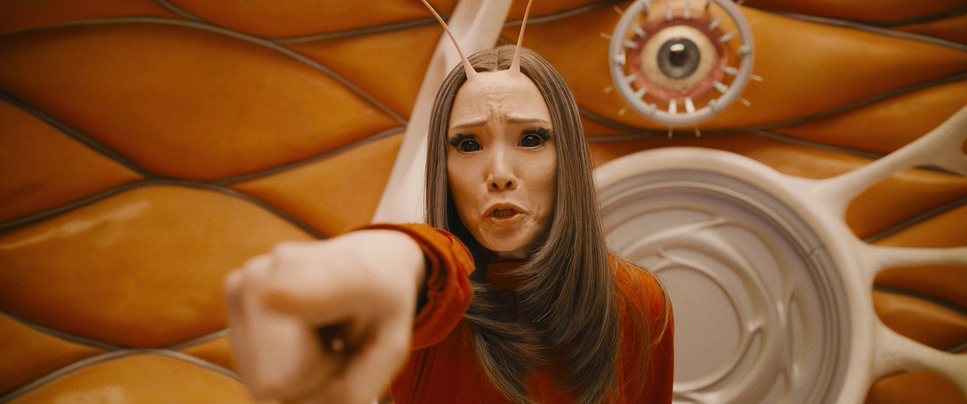
This is where Vol. 3 separates itself from the “flat” look that plagues modern blockbusters. The lighting palette is sophisticated, embracing deep shadows and motivated sources. Braham isn’t afraid to let characters fall into silhouette or let a scene be lit entirely by the harsh, cold fluorescents of a lab.
The contrast ratio is high. The High Evolutionary is often lit with surgical precision sharp, top-down lighting that hollows out his eyes and emphasizes his lack of empathy. Conversely, the scenes with the Guardians, especially on Knowhere, are bathed in warmer, grimier, more practical sources. The “gold” skin of Adam Warlock is particularly interesting; it’s lit in a way that feels reflective and metallic, catching the specular highlights, rather than just looking like yellow body paint. It’s this intentionality with light using chiaroscuro to sculpt depth that gives the image a cinematic weight.
Lensing and Blocking
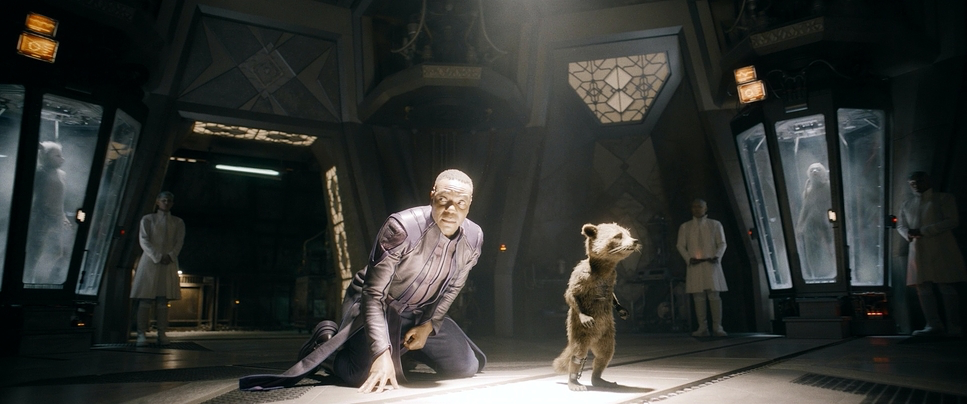
To achieve the unique look of Vol. 3, Braham utilized the RED V-Raptor and the compact RED Komodo. This choice was critical. The small form factor of the Komodo allowed the camera to get into spaces a traditional cinema camera never could, enabling that “inside the huddle” intimacy.
Pairing these sensors with Leitz M 0.8 lenses was a brilliant move. These aren’t clinically perfect lenses; they have character, slightly softening the digital edge of the 8K sensor. For the flashbacks, the depth of field is incredibly shallow, isolating Rocket and blurring out the terrifying context of the lab.
The blocking capitalizes on this gear. Braham can place the camera inches from an actor’s face or move it freely around a tight cockpit set. When the High Evolutionary asserts dominance, he is often blocked centrally and shot from a low angle, towering over the frame. When the Guardians are vulnerable, they are clustered together, physically supporting one another. The technology didn’t just capture the blocking; it dictated the possibilities of it.
Color Grading Approach
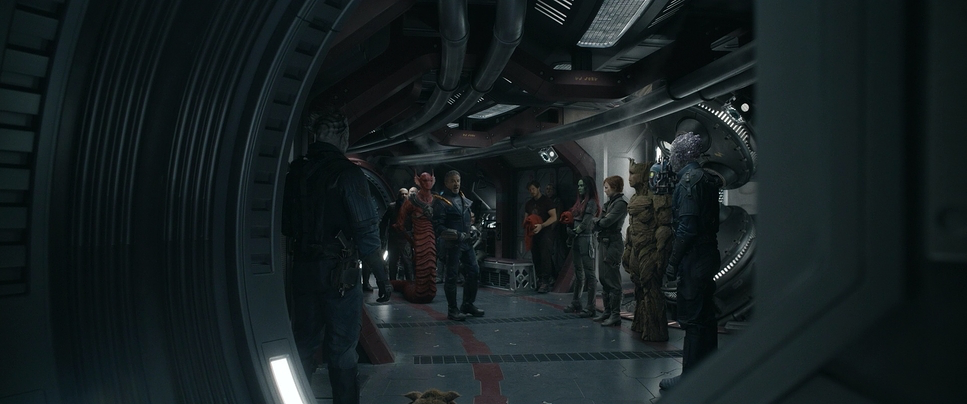
As a colorist, I can see Stefan Sonnenfeld’s touch all over this grade (completed at Company 3). While previous Guardians films were candy-colored, Vol. 3 uses a more nuanced, film-emulation approach. The palette is still vibrant, but the “density” in the image is much higher.
The contrast shaping is aggressive. We see true blacks, not the lifted, milky shadows common in streaming content. This anchors the image and adds a sense of danger. The highlight roll-off is smooth and organic, avoiding that harsh “digital clipping” look on bright sources like energy blasts or spaceship engines.
Hue separation is used intelligently to orient the audience. The sterile, artificial cyans and magentas of the High Evolutionary’s world stand in stark contrast to the rusty, earthy tones of Knowhere or the desaturated, bleach-bypass look of Rocket’s flashbacks.
Crucially, the film utilizes film grain emulation masterfully. In a movie so reliant on CGI, a layer of high-quality grain helps glue the visual effects to the live-action photography. It adds a texture that tricks the brain into seeing “film” rather than “pixels,” grounding the fantastical elements in a tangible reality.
Technical Aspects & Tools
Guardians of the Galaxy Vol. 3 – Technical Specifications
| Genre | Action, Adventure, Science Fiction, Superhero, Space |
|---|---|
| Director | James Gunn |
| Cinematographer | Henry Braham |
| Production Designer | Beth Mickle |
| Costume Designer | Judianna Makovsky |
| Editor | Tatiana S. Riegel, Fred Raskin, Greg D’Auria |
| Colorist | Company 3 |
| Time Period | 2020s |
| Color | Warm, Saturated |
| Aspect Ratio | 2.39 |
| Format | Digital |
| Lighting | Hard light, High contrast |
| Lighting Type | Artificial light, Practical light, Firelight, Mixed light |
| VFX | Blue or Green Screen, CGI, Digital Composite, Set Extension |
| Story Location | Space > Arête Laboratoires |
| Filming Location | Georgia > Atlanta |
| Camera | RED Komodo |
| Lens | Leitz M 0.8 |
| Film Stock / Resolution | 4K, Redcode RAW 6K, Redcode RAW 8k |
The technical pipeline for Vol. 3 was designed for immersion. The film was finished with a 4K Digital Intermediate (DI), ensuring that the detail from those RED sensors was preserved. The shifting aspect ratios alternating between 2.39:1 for standard scenes and 1.90:1 for IMAX sequences worked effectively to open up the scope during major set pieces.
The use of HDR10 in the grading process allows for the specific lighting choices to sing. The specular highlights on the space suits and the deep shadow detail in the cages take full advantage of the dynamic range. It’s a robust technical foundation that supports Braham’s sophisticated lighting and the complex VFX wor
- Also read: E.T. THE EXTRA-TERRESTRIAL (1982) – CINEMATOGRAPHY ANALYSIS
- Also read: ZACK SNYDER’S JUSTICE LEAGUE (2021) – CINEMATOGRAPHY ANALYSIS
Browse Our Cinematography Analysis Glossary
Explore directors, cinematographers, cameras, lenses, lighting styles, genres, and the visual techniques that shape iconic films.
Explore Glossary →