A film like this hits differently. It’s not just a narrative; it’s a visceral, sensory experience testament to what happens when cinema stops trying to be “balanced” and starts being true. When the controversy erupted around its release the calls for cancellation and the outrage over its depiction of the Nakba my reaction was immediate: this is exactly why this film had to exist.
Director Darin J. Sallam didn’t set out to make a political statement; she set out to document a memory. She depicts the 1948 catastrophe through the eyes of a 14-year-old girl with dreams of a city education, who is suddenly forced into a storage room to survive. It’s a brilliant, heartbreaking choice. It humanizes the monumental. My goal here isn’t to walk you through the plot, but to dissect the visual language how the cinematography and color work in a frantic, desperate concert to make that “bleeding wound” feel real.
About the Cinematographer

The visual weight of Farha rests on the shoulders of Ahmad Almurrar. His work here is a masterclass in understated power. When you’re dealing with the Nakba, the cinematographer’s job isn’t to hunt for “pretty” shots. It’s about bearing witness. Almurrar resists the urge to sensationalize. He creates an aesthetic that feels grounded and emotionally raw, almost as if the camera itself is a survivor.
It’s a delicate, high-stakes balance: capturing the innocence of a girl under a tree in one frame and the unspeakable violence of an invasion in the next. Almurrar acts as a conduit. There are no flashy crane moves or distracting “look at me” cinematography. Instead, he uses a quiet, observant eye that understands how much more powerful a single, static shot can be than a hundred quick cuts.
Inspiration Behind the Cinematography
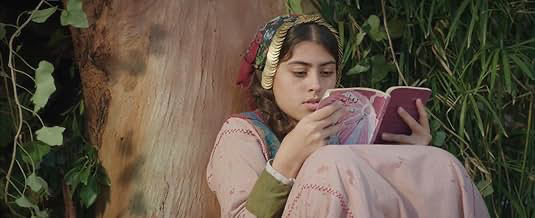
The core inspiration for Farha is the director’s intent to make the audience feel the Nakba, not just observe it. Sallam believes that “when you feel something, it stays with you,” and that belief dictates every frame.
The early scenes establish a village life defined by warmth and normalcy. This isn’t just “b-roll”; it’s the visual establishment of what is about to be stolen. But the real shift happens when Farha is locked away. The cinematography mirrors her internal world it constricts. The camera becomes a captive. This isn’t just an aesthetic choice; it’s an ethical one. It forces us into her shoes, staring through a narrow hole in the wall, making the historical event an acutely present terror.
Color Grading Approach
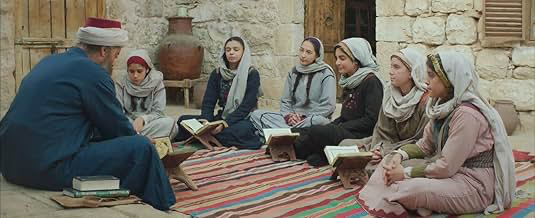
This is where I really lean in. As a colorist, I see the grade in Farha as a profound act of testimony. The film likely begins with a naturalistic, earthy palette warm ochres and healthy skin tones that feel authentic to the Levantine landscape. It’s a baseline of peace.
But once Farha is trapped, the grade takes a hard, purposeful turn. We see the palette desaturate, mirroring the loss of hope. In my suite, I’d be looking for rich, deep shadows with a sensitive highlight roll-off a look that feels like a chemical film print rather than a digital sensor. This avoids that “clean” video look and lends an archival weight to the imagery. Contrast shaping is vital here; the blacks need to feel heavy, almost physical, to enhance the claustrophobia. I noticed the way the skin tones stay legible even in the murk that’s careful tonal sculpting. If I were at the wheels, I might have pushed the cool tones even further in the shadows to emphasize the “stale” air of the room, contrasting it against the searing, overexposed heat of the violence outside.
Camera Movements
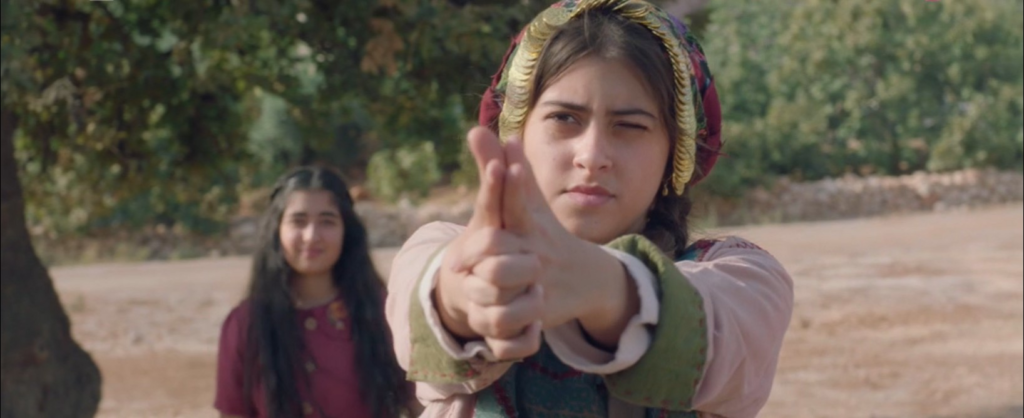
The camera movements in Farha are never ostentatious. In the beginning, the camera breathes. We see gentle tracking shots and a subtle handheld quality as Farha moves through the village, conveying a sense of freedom.
But the moment she is hidden, the rhythm dies. The camera becomes static, mirroring her physical entrapment. When there is movement inside the room, it’s frantic small, desperate pans as she hunts for water or light. The most jarring movements happen outside the room, glimpsed through that tiny aperture. We see the chaotic, aggressive handheld work of the soldiers. These external glimpses are framed as fleeting, disturbing fragments. It’s a masterful use of cinematic grammar: the stillness of the victim versus the kinetic violence of the oppressor.
Compositional Choices
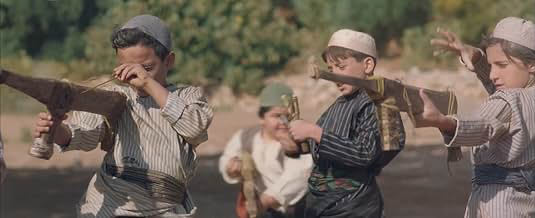
Composition is Sallam’s most ruthless tool. Early on, wide shots give us the breadth of the village openness and possibility. But the film’s heart beats in the storage room.
The “hole in the wall” becomes the ultimate compositional device. It’s an extreme frame-within-a-frame that limits our perspective to exactly what Farha sees. We aren’t just watching a movie; we are voyeurs to a massacre. Almurrar uses negative space brilliantly here. The emptiness around Farha in the dark underscores her isolation, while the tight framing often places her off-center, making her look small and vulnerable against the oppressive walls. Every composition reinforces the fact that she is a prisoner of history.
Lighting Style
The lighting in Farha is a character with its own arc. It begins with abundant, naturalistic sunlight warm and hopeful. But once she’s in that room, the light becomes a scarce resource.
The darkness is pervasive. The primary “motivated” light comes from a single hurricane lamp, casting dancing, erratic shadows that amplify her fear. There is a brutal contrast between the dim, suffocating interior and the blindingly bright world outside the hole. Handling that dynamic range is a nightmare for a DP, but Almurrar nails it. He holds detail in those deep shadows while letting the exterior world feel almost painfully overexposed a visual metaphor for a world that has become too harsh to look at.
Lensing and Blocking
The lensing choices here are incredibly restrictive. For the village scenes, I suspect the use of wider primes maybe 24mm or 35mm to show Farha as part of a community. But inside the room, the lens behavior changes.
While wide lenses are used to distort the corners and make the walls feel like they’re closing in, the “hole” shots likely utilize longer glass maybe a 50mm or 85mm. This compresses the background, making the horror outside feel distant and surreal, like a nightmare she can’t touch. The blocking is equally tight. Farha’s body language crouching, pressing against the stone, lying defeated is choreographed to show the physical toll of her confinement. The absence of other humans in her space makes her isolation feel deafening.
Technical Aspects & Tools
To get this level of visual integrity, you need serious tools. I’d bet my career they used something like an ARRI Alexa Mini LF or a Sony VENICE. These sensors are famous for their highlight roll-off and the way they handle skin tones in low-light environments essential for a film that spends so much time in a dark room.
The lenses were likely vintage or “character” primes, chosen for a natural feel that lacks digital sharpness. In the post-production pipeline, likely in DaVinci Resolve, the collaboration between the DP and the colorist would have been intense. They would have labored over LUTs that could handle the extreme contrast of the “hole” shots without losing the texture of the stone walls. It’s about translating emotional logic into technical metadata.
- Also read: ELITE SQUAD 2: THE ENEMY WITHIN (2010) – CINEMATOGRAPHY ANALYSIS
- Also read: SHOPLIFTERS (2018) – CINEMATOGRAPHY ANALYSIS
Browse Our Cinematography Analysis Glossary
Explore directors, cinematographers, cameras, lenses, lighting styles, genres, and the visual techniques that shape iconic films.
Explore Glossary →