As a filmmaker and a full-time colorist running Color Culture, there are certain films that just stick with you. They don’t just tell a story; they mess with your head. Eternal Sunshine of the Spotless Mind is absolutely one of those films for me. It isn’t just “good visual storytelling”; it’s a blueprint for how to visualize a psychological breakdown without relying on cheap tricks. Every time I re-watch it—whether I’m analyzing the grade or just watching for fun—I spot something new. Maybe it’s Clementine’s missing leg in a single frame, or the subtle loops in the background action. It’s a film that changes as you change.
My goal here isn’t to write a generic breakdown. I want to look at how the cinematography and the grade build a world that feels intimate and completely broken at the same time. It captures that messy, subjective feeling of memory—not as a recording of what happened, but as a biased, fading struggle inside Joel’s head.
About the Cinematographer
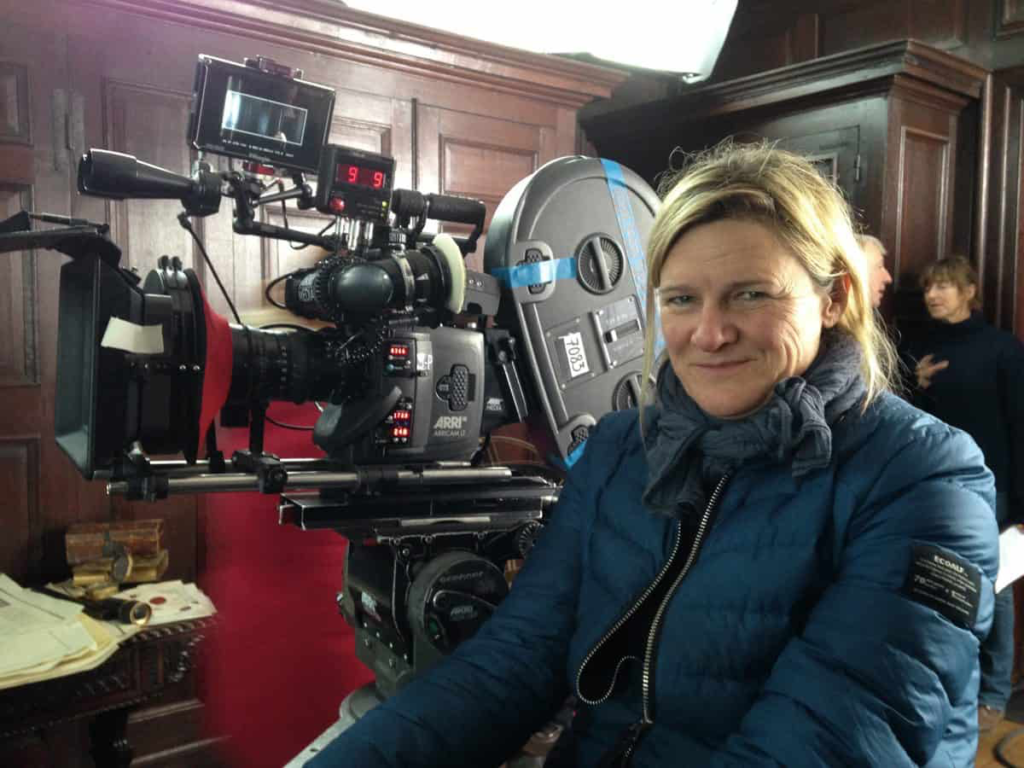
The visual architect here is Ellen Kuras, ASC, and she was the perfect pick for this. Kuras comes from a background that blurs the line between documentary grit and narrative polish. She doesn’t just make things look “cinematic” in the Hollywood sense; she makes them feel honest. For a script as weird and hypothetical as Charlie Kaufman’s, you needed someone who could ground it in reality. If this had been shot too cleanly, it would have felt like a sci-fi gimmick. Kuras brings a sensitivity to the performance that prioritizes the actor’s emotional state over a “perfect” lighting setup. She understands that in a story about heartbreak, a raw image hits harder than a pretty one.
Inspiration Behind the Cinematography
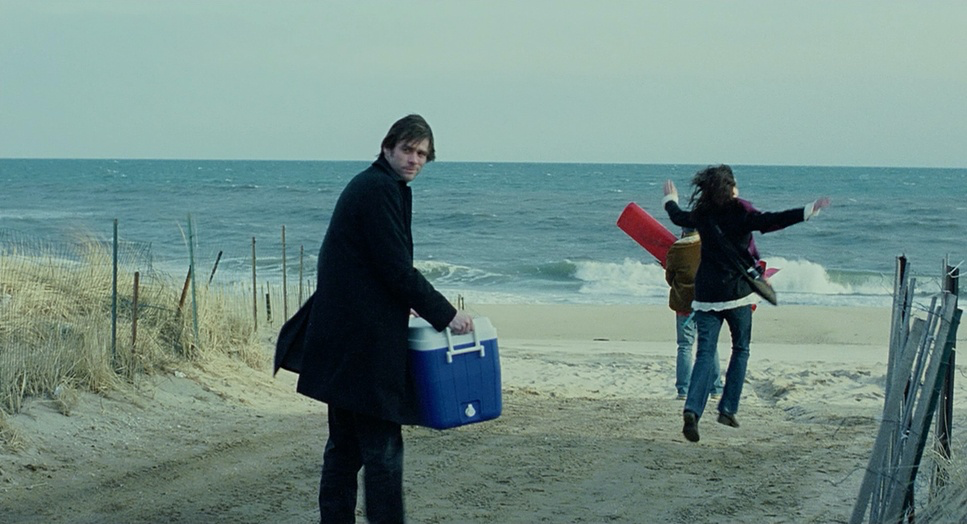
Charlie Kaufman’s script is famously a “circular narrative,” throwing us into the deep end right alongside Joel. The visuals had to match that confusion. The inspiration here clearly comes from the nature of memory itself: it’s glitchy, it’s unreliable, and it decays over time.
The cinematography had to visualize Joel’s “private and biased” version of Clementine. We aren’t seeing the real woman; we are seeing Joel’s projection of her. This meant the camera had to embrace a style that felt disjointed and fluid. It ties into the whole concept of predestination—that these two are doomed to meet, crash, burn, forget, and do it all over again. The look had to convey that inescapable loop. The unvarnished, rough aesthetic serves a specific purpose: it reminds us that underneath the sci-fi memory erasure tech, this is just a raw, painful breakup story.
Camera Movements

The camera work in Eternal Sunshine avoids the “steady” look of standard romance dramas. It uses a dynamic, almost improvisational handheld style, but it’s not handheld just to be edgy. It’s motivated by Joel’s panic. When he’s lucid, the camera settles down. But as the deletion process kicks in and the map of his mind starts crumbling, the camera starts fighting the frame just like he is.
You’ll notice these subtle shifts—sometimes a floaty drift, other times a frantic push-in that mimics the feeling of a thought suddenly disappearing. I love the scenes where the set physically vanishes or distorts; the camera tracks Joel through these shifts, forcing us to feel his disorientation. It puts us squarely in his shoes. What I really admire is how much of this was done in-camera. It’s not just digital shake added in post; it’s careful choreography between the operator and the actor to sell the illusion of a collapsing mind.
Compositional Choices
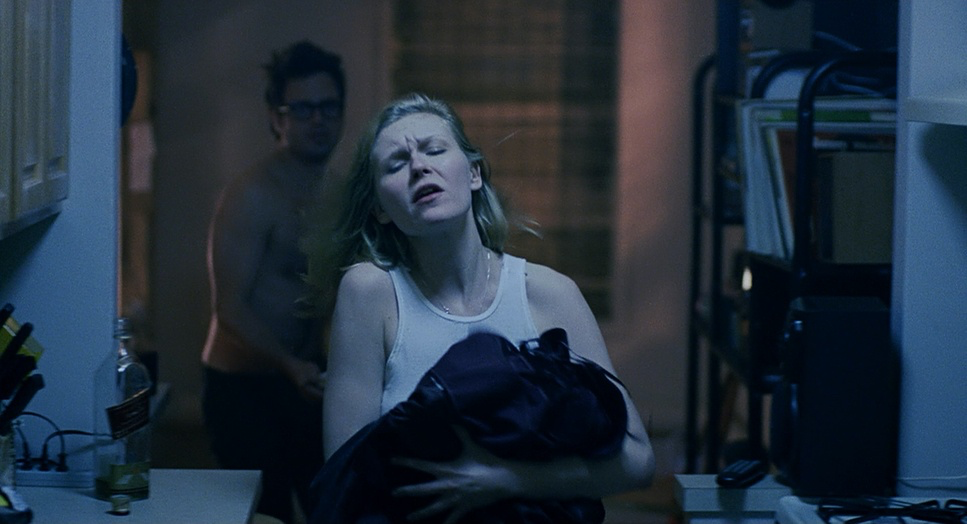
Composition here is largely about isolation. Kuras uses wide shots to make Joel look tiny in vast, empty spaces—like that freezing Montauk beach or his empty apartment. It screams loneliness. But then, when he’s deep in a memory of Clementine, the framing gets suffocatingly tight. It’s intimate, but almost uncomfortably so, showing just how much space she takes up in his head.
A technique I really like is the use of foreground elements to create a voyeuristic feeling, like we’re peering into memories we aren’t supposed to see. Objects block the frame or disappear entirely, distorting the reality. There are moments where Joel is framed by a doorway that literally shrinks, or a wall that closes in. These aren’t subtle metaphors, but they work. The film plays with depth cues to compress space, making Joel feel trapped, or expanding it to leave him adrift. It’s a great example of how “rough” framing can carry more emotional weight than a perfectly balanced shot.
Lighting Style
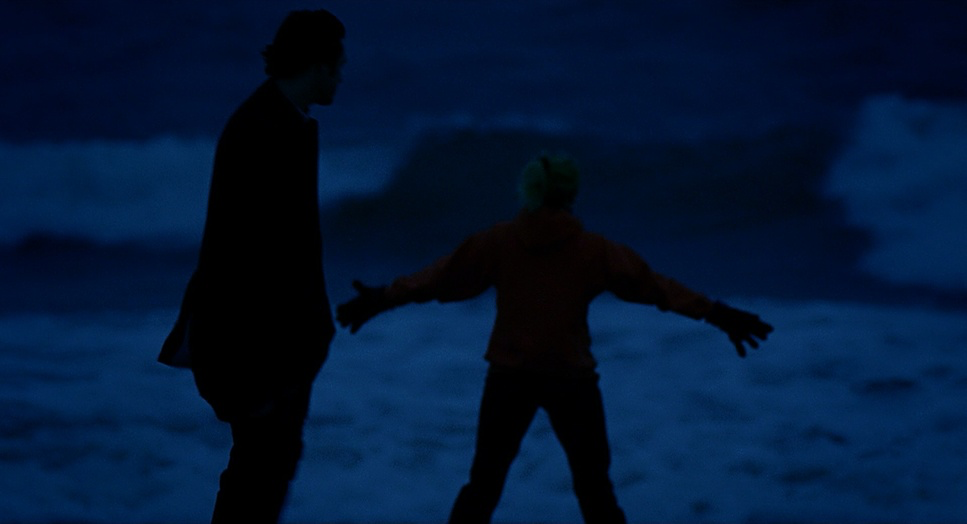
The lighting in Eternal Sunshine is famously anti-glamour. It embraces an “intentional roughness” that feels baked into the source material. Kuras leans heavily on available light and practical sources (lamps, overheads), keeping the exposure low-key. It makes the world feel tactile and lived-in, rather than a soundstage.
During the erasure sequences, the lighting shifts into something closer to psychological horror. We get hard flashlights cutting through the dark, or flickering practicals that mimic the “glitching” of Joel’s synapses. Light becomes a symbol of awareness—or the loss of it. The contrast ratios are aggressive, with deep, crushed blacks. On the recent 4K transfer, these blacks look particularly dense. They aren’t just “dark”; they’re heavy. The highlights are rarely blown out; they’re subdued to match the melancholic tone. It tells you immediately: this is a story about internal turmoil, not external beauty.
Lensing and Blocking
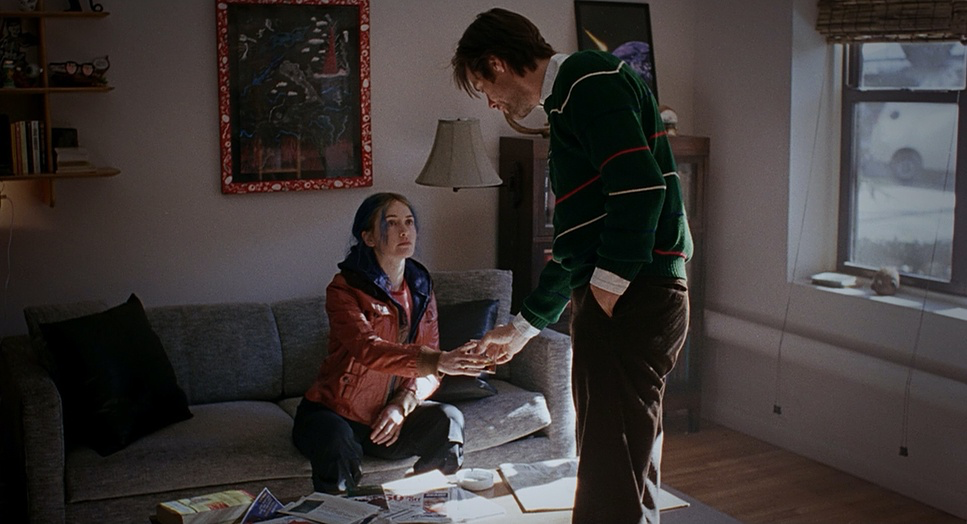
The lens choice and blocking are where Gondry’s influence really shines. They often used wider lenses for close-ups than you’d typically see in a drama. This introduces a slight barrel distortion—faces look a bit weird, backgrounds warp slightly. It subconsciously tells the audience that Joel’s memory is unreliable without needing a cheesy “dream sequence” filter. Conversely, the moments of true connection use longer lenses to compress the background and isolate the couple.
The blocking is incredibly dynamic. Characters pop in and out of frame as if Joel is conjuring them. And we have to talk about the practical effects. The scene where Joel is shrinking under the table? That’s forced perspective and brilliant blocking, not CGI. The collapsing beach house was a rig. The actors had to time their movements perfectly with the set falling apart around them. It feels like a stage play where the physical space represents internal states. It’s a dance between the actors and the mechanics of the set that makes the digital effects of today look lifeless by comparison.
Color Grading Approach
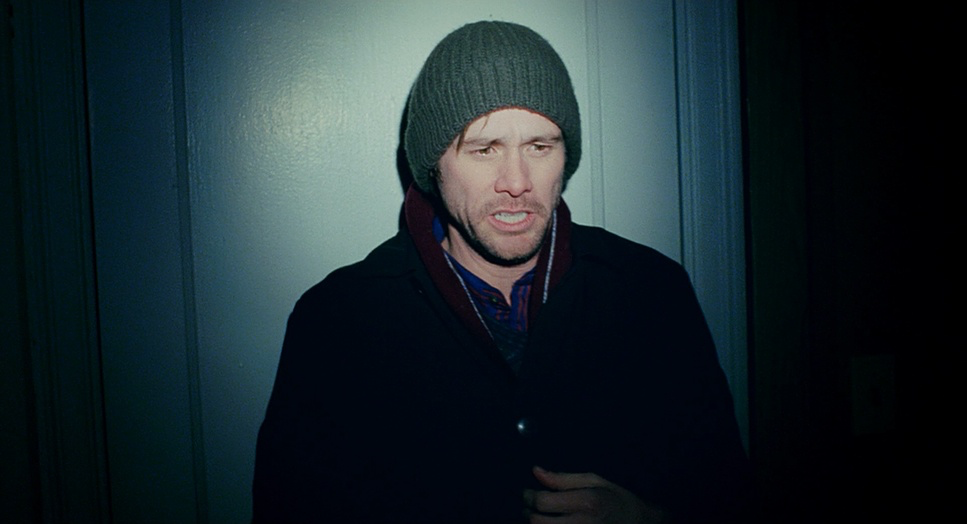
Ah, my territory. The grade in Eternal Sunshine is doing so much heavy lifting. It isn’t about hyper-realism; it’s about mood. The film was finished as a 2K DI, so the 4K version is an upscale, but the HDR grading (Dolby Vision) adds a layer of depth that I think enhances the original intent.
The palette is heavily desaturated, specifically in the “present day” scenes. It leans into cool blues and grays, reflecting Joel’s depression. But then you have the hue separation of Clementine’s hair. In a muted world, she is the only thing that pops. Looking at the scopes, her hair—whether it’s Blue Ruin or Agent Orange—cuts through the desaturation. It’s the visual anchor for the timeline.
Contrast shaping is vital here. The blacks are crushed, giving it a dense, print-film feel, while the mid-tones retain a rich texture despite the lack of saturation. It avoids that “thin” look you sometimes get with digital desaturation. Flashbacks are warmer, but still hazy, evoking nostalgia. The highlight roll-off is gentle, maintaining that organic, dreamlike feel. It’s a grade that isn’t trying to be clean; the noise and the grit are part of the charm. It tells us we are inside a subjective, messy experience.
Technical Aspects & Tools
Eternal Sunshine of the Spotless Mind
Technical Specifications| Genre | Drama, Romance, Science Fiction, Magical Realism, Psychedelic, Soft Sci-Fi, Lo-Fi Sci-Fi, Fantasy |
|---|---|
| Director | Michel Gondry |
| Cinematographer | Ellen Kuras |
| Production Designer | Dan Leigh |
| Costume Designer | Melissa Toth |
| Editor | Valdís Óskarsdóttir |
| Colorist | Kenny Becker |
| Time Period | 2000s |
| Color | Cool, Desaturated, Blue |
| Aspect Ratio | 1.85 – Spherical |
| Format | Film – 35mm |
| Lighting | Soft light |
| Lighting Type | Artificial light |
| Story Location | New York > Rockland Park |
| Filming Location | New York > Yonkers |
| Camera | Arricam LT |
| Lens | Arri Macro, Zeiss Super Speed |
| Film Stock / Resolution | 8592/8692 Reala 500D |
For a 2004 film, Eternal Sunshine pushed practical effects to the limit and blended them with early digital tools. Some of the CGI shows its age, but honestly, that slight imperfection works in the film’s favor. It adds to the dreamlike unreality.
It was shot on 35mm, which gives us that beautiful “medium density” grain structure. In darker scenes, the grain is heavy, and I love that the remaster didn’t scrub it away with DNR (Digital Noise Reduction). That texture is vital. While the 4K disc is an upscale from the 2K master, the wider color gamut and contrast allow for better detail retrieval in the shadows compared to the old Blu-ray. The Dolby Vision pass deepens those blacks without crushing the life out of them. The audio mix, while standard DTS 5.1, does a great job of swirling voices and effects around the room during the erasure scenes, matching the visual chaos perfectly.
- Also Read: STAR WARS: RETURN OF THE JEDI (1983) – CINEMATOGRAPHY ANALYSIS
- Also Read: AMERICAN BEAUTY (1999) – CINEMATOGRAPHY ANALYSIS
Browse Our Cinematography Analysis Glossary
Explore directors, cinematographers, cameras, lenses, lighting styles, genres, and the visual techniques that shape iconic films.
Explore Glossary →