Cinema Paradiso is often hailed as a “love letter to cinema,” but from a production perspective, it is a masterclass in visual memory. For those of us working in post-production, particularly at Color Culture where we obsess over image texture, this film is a reference point not just for its story, but for how it differentiates timelines through visual language. Tornatore’s masterpiece captures the essence of passion and the bittersweet passage of time by creating two distinct optical worlds: the warm, halated nostalgia of the past, and the cold, desaturated reality of the present. Analyzing its cinematography isn’t just an academic exercise; it is a study in how intuition and craft can make a story feel profoundly human.
About the Cinematographer

The visual soul of the film was engineered by cinematographer Blasco Giurato. A veteran of Italian cinema, Giurato avoids the flashy, aggressive stylization common in modern commercials. His strength lies in a robust, classical approach that prioritizes narrative clarity. He understands that the best shot is often the one that simply lets the story breathe. For Cinema Paradiso, Giurato grounded Tornatore’s personal vision of Sicily—specifically locations like Bagheria and Cefalù—in a tangible reality. He transformed the village into a vibrant backdrop for Salvatore’s coming-of-age without turning it into a travelogue. It is a testament to a cinematographer’s ability to execute a director’s vision while imbuing it with a deep understanding of natural light and texture.
Inspiration Behind the Cinematography
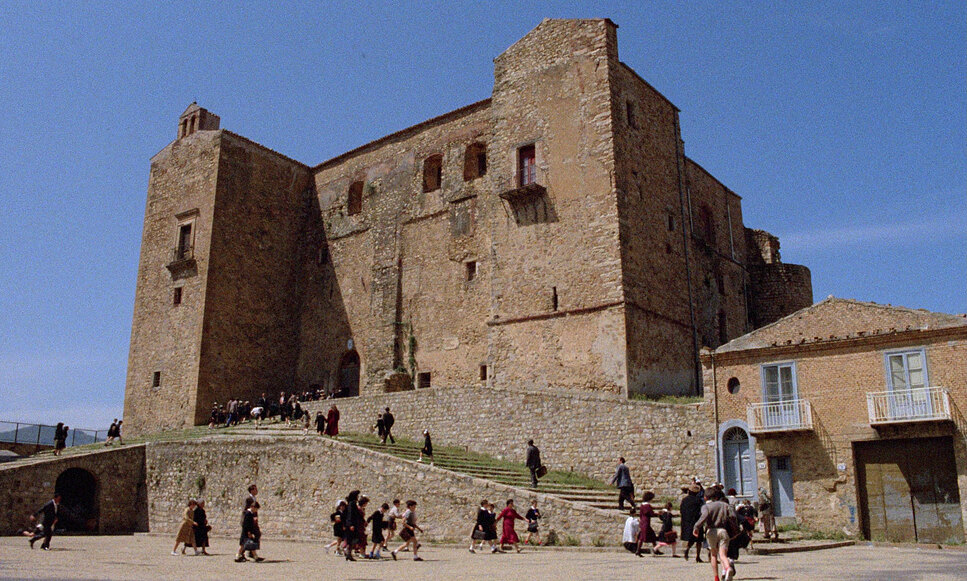
The core cinematic inspiration was the concept of the “death of the movie theater.” Tornatore initially intended the film as an obituary for the traditional industry, and while that sentiment softened, it profoundly shaped the visual approach. The cinematography had to embody nostalgia.
Giurato achieved this by treating the town square and the cinema itself as characters. The aesthetic bridges the gap between Salvatore’s idealized childhood memories and the harsher realities he faces as an adult. The visuals distinguish the “safe haven” of the cinema from the intimidating “real world.” The town square is shot with a romanticized realism—a “postcard perfect” image of Italy that feels curated by memory. This contrasts sharply with the adult sequences, where the visual storytelling conveys Salvatore’s journey from a boy finding comfort in movies to a man confronting a world that isn’t as high-contrast and clear-cut as the black-and-white films he grew up watching.
Camera Movements
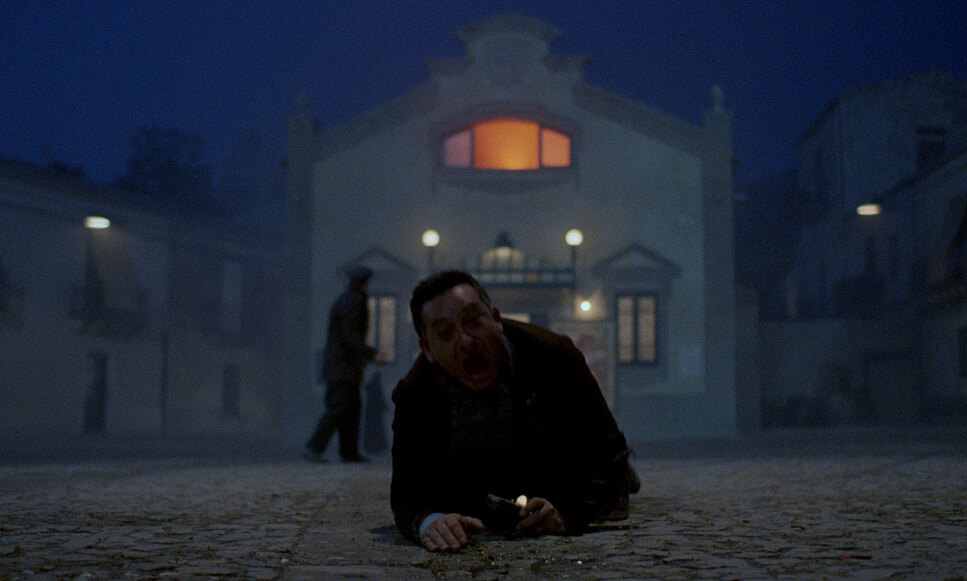
The camera movements in Cinema Paradiso are observational rather than participatory. You won’t find the restless gimbal work common in contemporary films. Instead, Giurato’s camera mimics the unhurried pace of life in a Sicilian village.
Most of the time, the camera is grounded. Pans and tilts are used with restraint to reveal details or follow a gaze. The camera often pans slowly across faces in the crowded cinema, capturing the collective reaction to the screen—a technique that humanizes the audience. There is a warmth to these movements, a sense that the camera is lingering on the moment.
Dolly shots are employed specifically for emotional weight rather than kinetic energy. They push in to emphasize an internal realization or pull back to reveal isolation. For instance, a subtle push-in on Alfredo as he imparts wisdom to Toto creates a connection, while a slow pull-out showing Salvatore alone underscores his solitude. The movement is always motivated by the character’s emotional state, ensuring the technique never overshadows the narrative.
Compositional Choices
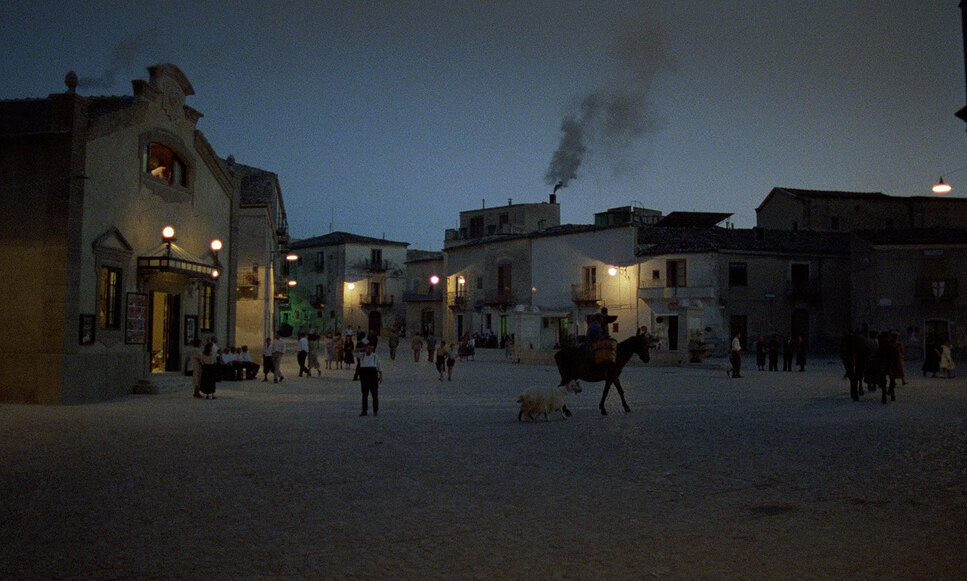
Giurato balances sweeping grandeur with intimate detail through his framing. He consistently employs classical composition, using depth cues to establish scale. The expansive wide shots of the Piazza Umberto place Salvatore within a vibrant community, using archways and buildings to frame the action almost theatrically.
This transitions seamlessly to tight, claustrophobic compositions within the projection booth. Here, the camera uses close-ups and medium shots, framing Alfredo and Toto amidst the machinery, film cans, and posters. This shift in scale—from the open piazza to the cramped booth—visually reinforces the projection room as a sanctuary.
Giurato also uses negative space effectively. In Salvatore’s childhood, compositions are contained, reflecting his dependence. As he enters his teenage romance with Elena, the frames open up, conveying his independence. In the adult sequences, Salvatore is often framed looking out of windows or across vast, empty spaces in his Rome apartment, using the edges of the frame to suggest distance and unfulfilled desire.
Lighting Style
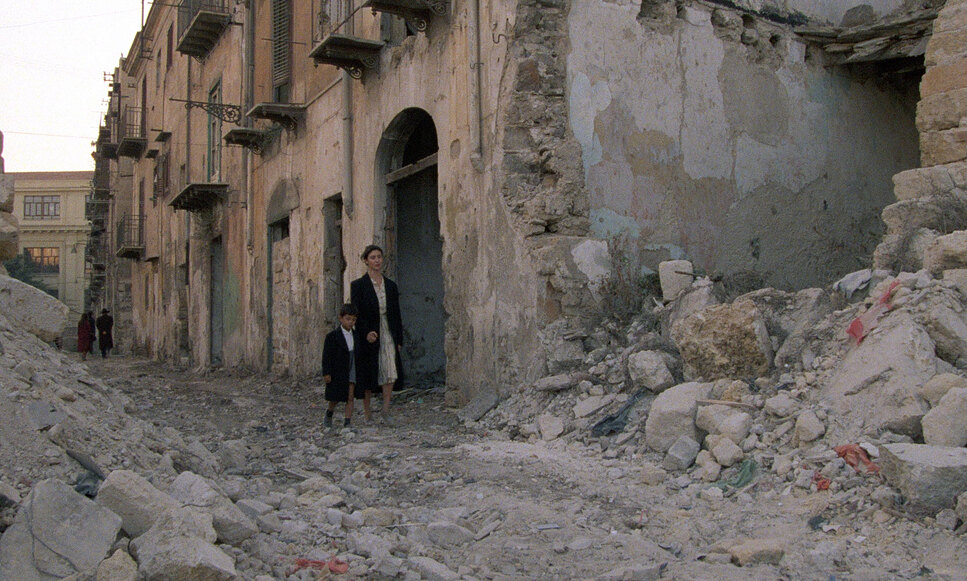
The lighting strategy is built on a strict duality that separates the two timelines. The childhood sequences in Sicily are bathed in a high-key, warm glow. Giurato utilizes hard light to mimic the Mediterranean sun, creating distinct shadows and a high-contrast look that feels vibrant and alive. The interiors of the cinema are lit by the motivated source of the projector beam, creating a dramatic chiaroscuro effect. The flickering light on the audience’s faces connects them physically to the movie they are watching.
However, the “frame story”—featuring the adult Salvatore in Rome—employs a completely different lighting logic. Consistent with the sombre mood of the 1980s timeline, scenes like the bedroom sequence are lit with soft, cool top-light. The atmosphere is desaturated and dim, often taking place at night. This shift from the warm, directional light of the past to the flat, cool light of the present visualizes Salvatore’s emotional stagnation and the melancholy of success without connection.
Lensing and Blocking
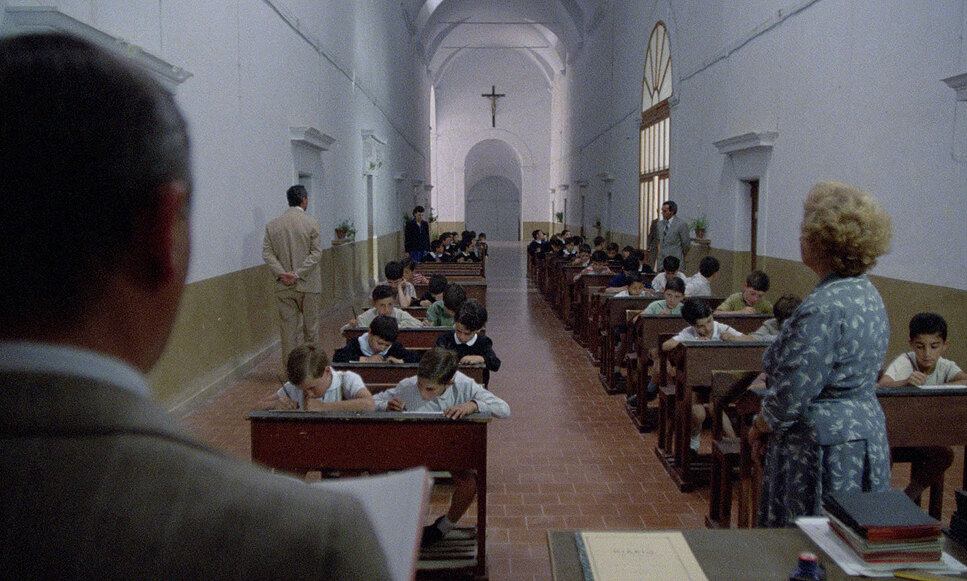
Giurato’s lens choices prioritize a naturalistic field of view. He favors standard focal lengths (likely 35mm, 50mm, and 85mm on Super 35 format) which avoid the distortion of extreme wide angles or the detachment of super-telephotos.
For establishing shots, wider lenses capture the communal context of the piazza. For the intimate scenes in the booth, he relies on tighter focal lengths. This compresses the perspective slightly, bringing the background of the booth closer to the characters and emphasizing the clutter of their shared world.
The blocking is equally deliberate. In the booth, Alfredo is often positioned physically higher or seated while Toto stands, reinforcing the mentor-student dynamic. Later, in the romantic sequences with Elena, the blocking often places physical barriers or distance between them even when they are in the same frame, foreshadowing their eventual separation. It is a precise use of space to dictate emotional relationships.
Color Grading Approach
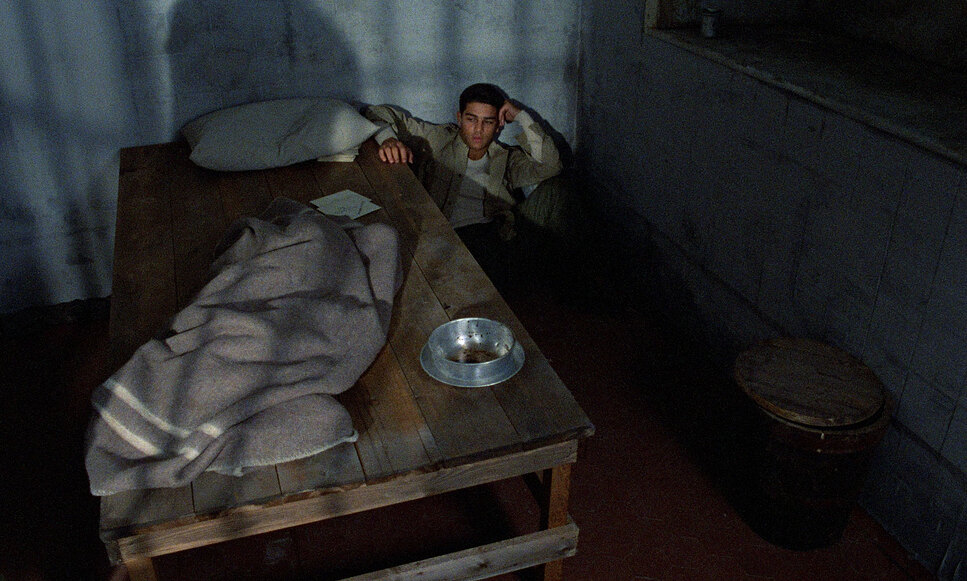
The color grading of Cinema Paradiso, particularly in the 4K restoration, offers a perfect example of print emulation. The aesthetic relies on a subtractive color model typical of the film stocks of that era.
The flashback sequences are defined by a dominant warm palette. The yellows and oranges are dense and saturated, but crucially, the shadows retain their depth without lifting into a muddy brown. This creates a “golden” look that feels organic to the emulsion rather than a digital tint. The highlight roll-off is gentle, preventing the bright Sicilian skies from clipping harshly—a characteristic of 35mm acquisition that digital formats often struggle to replicate.
In contrast, the present-day scenes in Rome feature a cooler, blue-leaning palette. The skin tones here are less vibrant, and the overall saturation is pulled back, creating a visual separation between the “alive” past and the “cold” present. The separation in the hues is distinct; the blues of the sky in the past have a slight teal shift (a natural reaction of tungsten-balanced print stock to daylight), which contrasts beautifully with the warm skin tones. The film grain is prominent and preserved in the restoration, adding a texture that reminds the viewer of the medium itself.
Technical Aspects & Tools
Cinema Paradiso — Technical Specifications
| Genre | Drama, Romance |
| Director | Giuseppe Tornatore |
| Cinematographer | Blasco Giurato |
| Production Designer | Andrea Crisanti |
| Costume Designer | Beatrice Bordone |
| Editor | Mario Morra |
| Time Period | 1980s |
| Aspect Ratio | 1.66 – Spherical |
| Format | Film – 35mm |
| Lighting | Hard light, Top light |
| Lighting Type | Daylight, Artificial light, Tungsten |
| Story Location | … Sicily > Palermo |
| Filming Location | … Sicily > Palermo |
While specific camera logs aren’t available, the film was shot on 35mm celluloid, which is the foundation of its look. The chemical response of the film stock to light provides the halation and texture that defines the nostalgic sequences.
The aspect ratio is 1.66:1, a common European widescreen standard of the time. This is slightly taller than the American 1.85:1, offering more vertical information. This creates a frame that feels closer to classic portraiture, allowing for compositions that don’t feel aggressively wide.
Sound-wise, the film was originally mixed in mono. While modern releases include a 5.1 upmix, the mono track remains the most authentic representation of the era. The technical limitation of mono focuses the audience’s attention centrally, much like the single beam of the projector. These choices—the aspect ratio, the film stock, and the sound mix—were not defaults, but deliberate artistic decisions that shaped the film’s enduring identity.
A Lingering Embrace
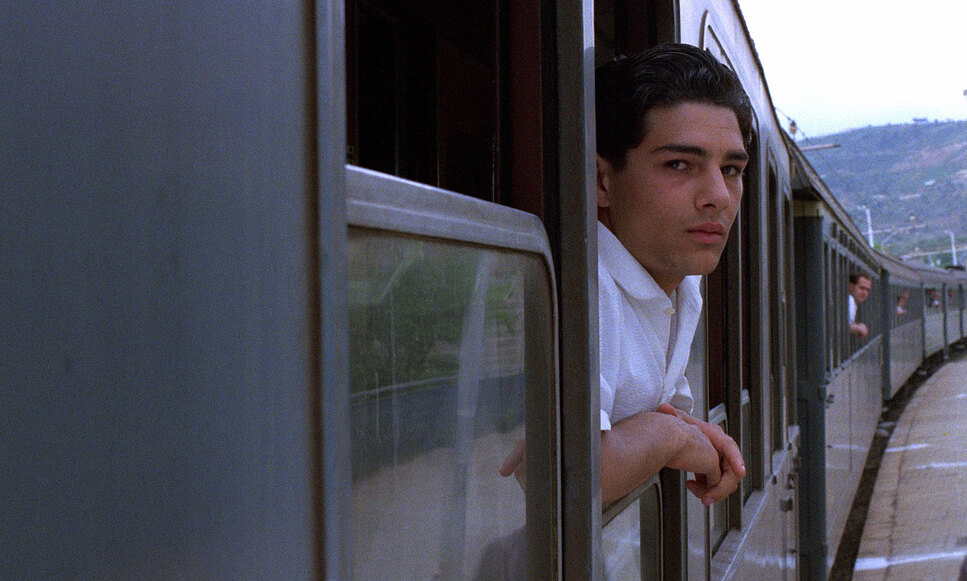
Revisiting Cinema Paradiso through a technical lens confirms why it remains a benchmark. It is not just a beautiful film; it is a cohesive marriage of narrative and craft. Every camera movement and lighting cue serves the story of memory.
As a colorist, I appreciate how the film embraces the inherent qualities of the medium. The warmth, the softness of the optical glass, and the heavy grain structure are not flaws; they are the texture of memory. It serves as a reminder that sophisticated visual storytelling isn’t about perfect sharpness or dynamic range, but about using the tools of cinematography to evoke a specific emotional response. Cinema Paradiso demonstrates that we are not just capturing images; we are preserving time.
- Also read: GRAVE OF THE FIREFLIES (1988) – CINEMATOGRAPHY ANALYSIS
- Also read: AVENGERS: INFINITY WAR (2018) – CINEMATOGRAPHY ANALYSIS
Browse Our Cinematography Analysis Glossary
Explore directors, cinematographers, cameras, lenses, lighting styles, genres, and the visual techniques that shape iconic films.
Explore Glossary →