It takes a lot to pull me out of “analysis mode” and just let me enjoy a film, but Denis Villeneuve’s Blade Runner 2049 managed it. It’s not just a sequel; it’s a benchmark. It’s the kind of movie that reminds me why I got into this industry, while simultaneously making me look at my own work and wonder, “How on earth did they pull that off?”
About the Cinematographer
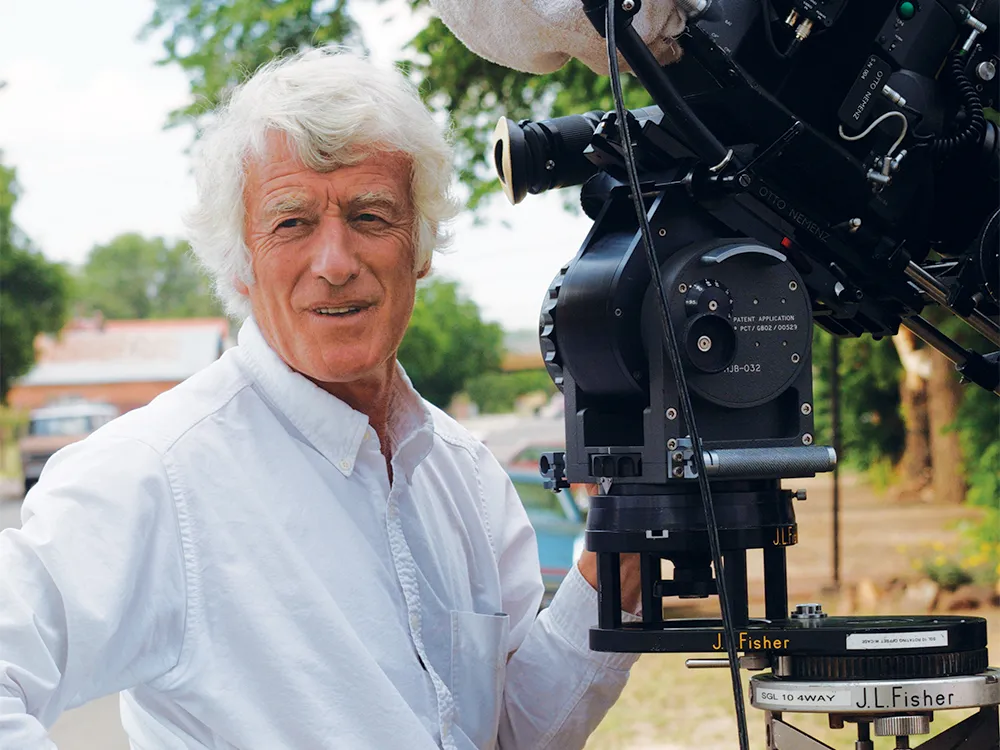
At the helm was Roger Deakins, and frankly, if anyone was going to succeed Ridley Scott’s original vision, it had to be him. By the time 2049 landed, the industry chatter wasn’t just about whether it would be good it was about whether this would finally be the film to get Deakins his Oscar. (It was). What I respect most about Deakins isn’t just his “eye” it’s his discipline. He doesn’t do “flashy” for the sake of it. Even in a sci-fi setting, his lighting remains grounded and motivated. He treats a flying spinner the same way he treats a farmhouse in Sicario: with a quiet, confident naturalism that makes the impossible feel tangible.
Inspiration Behind the Cinematography
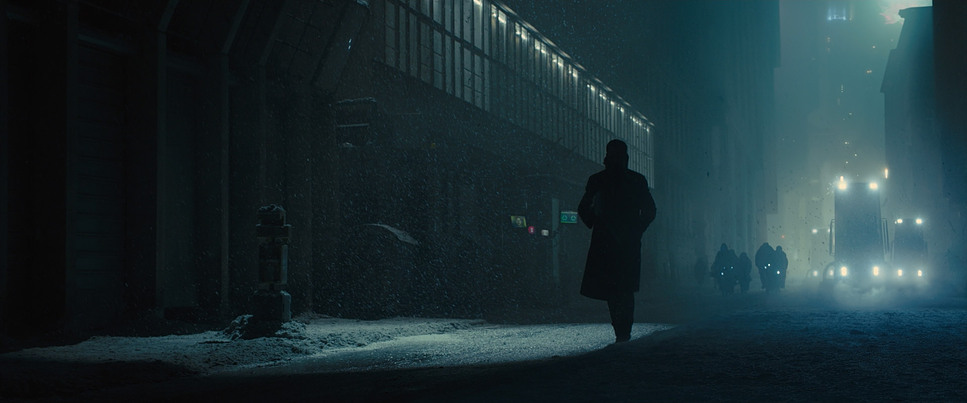
Villeneuve had the terrifying task of following a film that literally defined the cyberpunk aesthetic. But rather than just copying the neon-noir look of the 1982 original, the team evolved it. The first film was a vision of a future built on analog tech CRTs and rain. 2049 asks: what happens when that analog future rots?
The aesthetic here is brutalist and toxic. It’s not just rain anymore; it’s snow, dust, and radiation. The visual philosophy builds on the density of the original but expands the palette. We move from the claustrophobic city streets to vast, irradiated landscapes that feel empty and hollow. It’s a brilliant narrative choice reflected in the image: the world has moved on, and it’s leaving humanity behind.
Camera Movements
In an era where many blockbusters rely on shaky cam to inject false energy, Blade Runner 2049 is aggressively still. The pacing is deliberate. Deakins moves the camera with the weight of a freight train slow, creeping dolly shots or steady crane moves that let the frame breathe.
There is a specific discipline here: the camera only moves when the character’s perspective shifts or to reveal new information. It never moves just to keep the audience’s attention. This stillness creates a massive amount of tension. It forces you to look at the details the texture of a wall, the rain on a window. It draws you in rather than shouting at you.
Compositional Choices
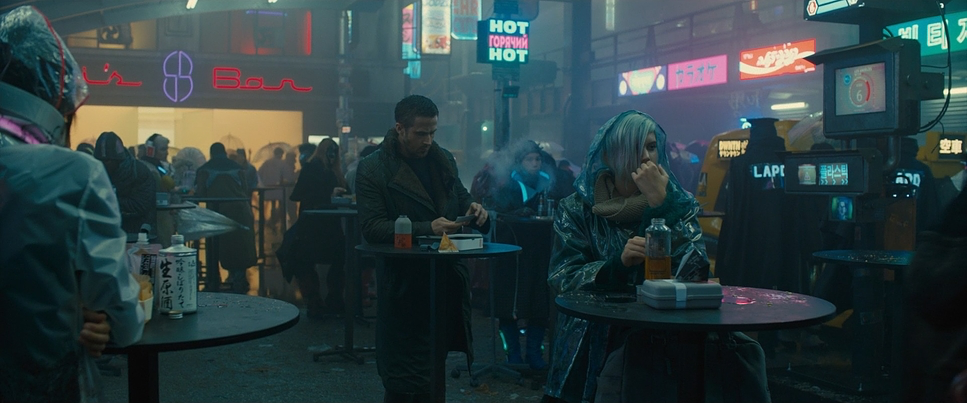
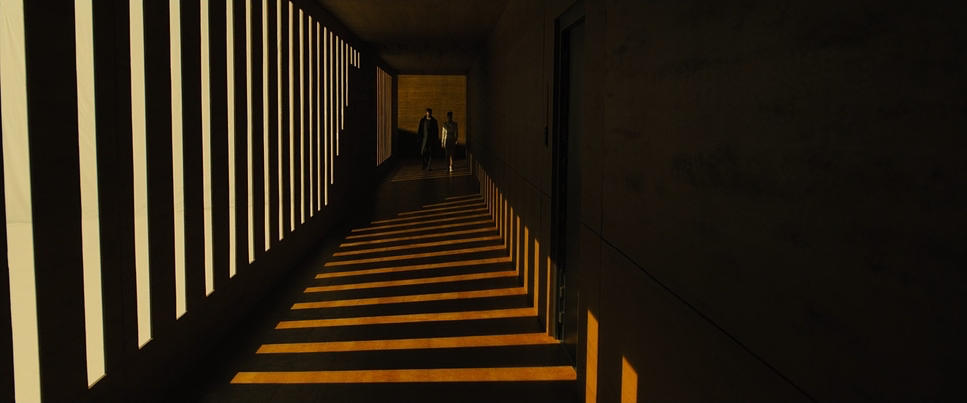
Deakins is famous for his “clean” frames, but here he leans heavily into isolation. He frequently utilizes dead space vast areas of the frame where nothing is happening to crush the protagonist, K.
Think of the shots of K walking into the Wallace Corporation. He is a tiny silhouette against massive, amber-lit walls. Deakins often frames K in the lower third, leaving the space above him empty, emphasizing his insignificance in this world. He also uses architectural leading lines to drive your eye exactly where he wants it. It’s not just about making a pretty picture; it’s about making the audience feel the weight of the system that K is fighting against.
Lighting Style
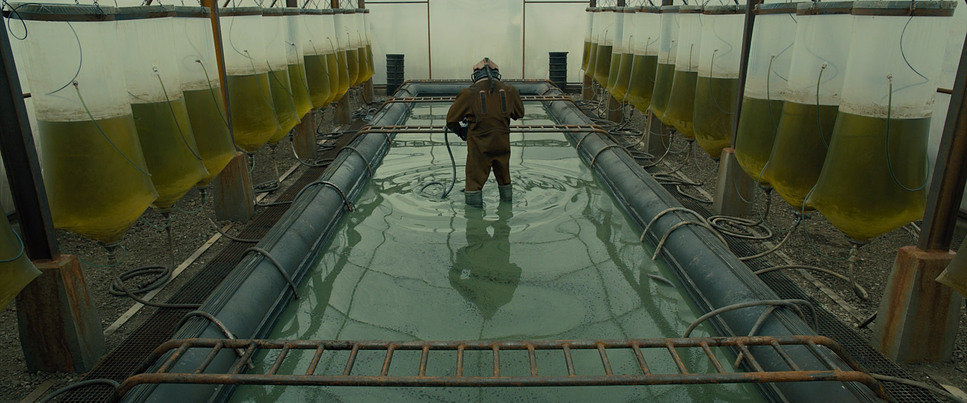
This is where the magic happens. Deakins is a master of the “single source” look. Even in complex scenes, the lighting feels like it’s coming from a logical place a giant advertisement, a window, or the caustic reflection of water.
The “Wallace Corporation” scenes are a standout for me. Those moving caustics (the water reflections) bouncing around the room? That’s practical lighting, not CGI. It creates a hypnotic, rhythmic atmosphere. Then you have the Las Vegas sequence. Bathing a scene in monochromatic orange is risky it can flatten the image and kill depth cues. But Deakins uses silhouette and heavy atmospheric haze to keep the separation between foreground and background. He lights for shape and texture, letting the color do the emotional heavy lifting.
Lensing and Blocking
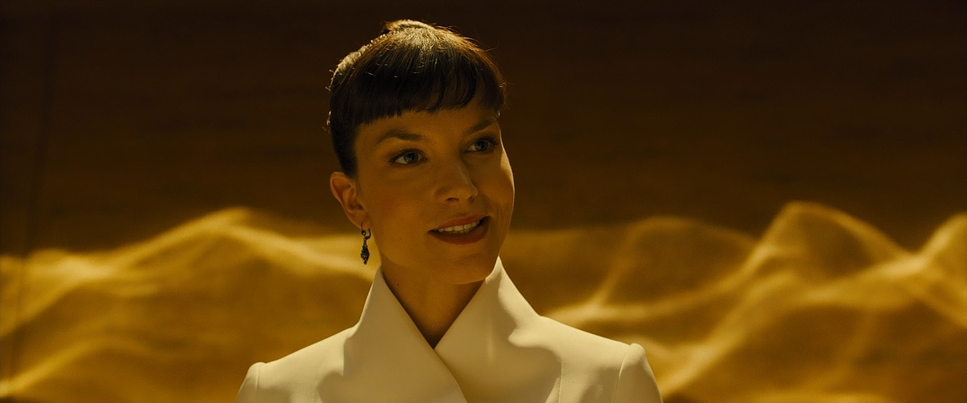
Contrary to some assumptions about “large format” being the only way to get this look, Deakins actually shot this on the Arri Alexa XT and Mini (Super 35mm), paired with Zeiss Master Primes. He didn’t chase the “vintage glass” trend that is so popular right now. He wanted optical perfection. The Master Primes are clinically sharp, with zero distortion.
This choice matters because it renders the world without nostalgia. It’s crisp, cold, and unforgiving. The blocking reinforces this. Characters are often static, positioned far apart from each other, emphasizing the emotional distance. When K visits Deckard, the blocking in the casino is a dance of shadows they move in and out of the light, hiding and revealing themselves. It’s visual storytelling at its finest.
Color Grading Approach
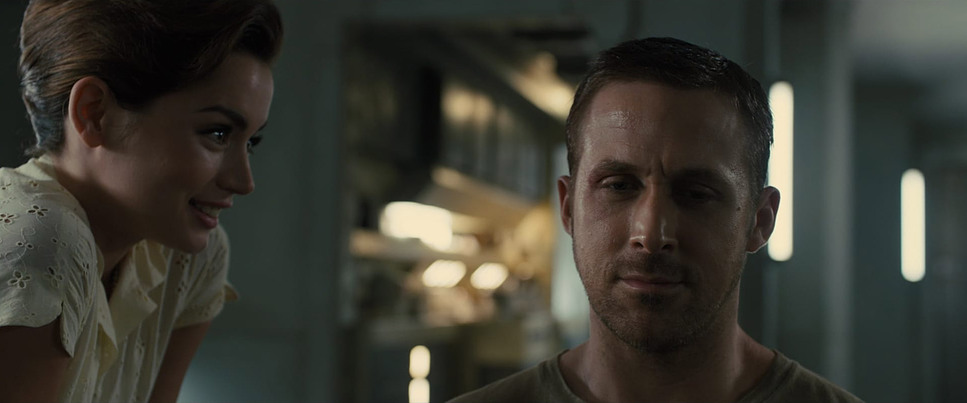
As a colorist, this is the part that makes me lean in. The grade was handled by Mitch Paulson at Company 3, working closely with Deakins. The look is surprisingly restrained. It’s not a heavy-handed “Instagram filter” grade.
They use a sophisticated method of hue separation. In the LA scenes, it’s not just “blue” it’s a mix of cyans, teals, and desaturated greens. This allows skin tones (even K’s pale complexion) to sit naturally without looking monochromatic.
The contrast curve is where the pro work really shows. The blacks are deep Deakins loves a solid black but the shadows aren’t “crushed” to the point of data loss. There is density there. And the highlights? The roll-off is incredibly smooth. Even when looking at bright neon or the sun in the Vegas scenes, the transition from color to white is gradual, mimicking the response of film stock. The Vegas sequence is particularly impressive because maintaining texture in a scene that is 90% saturated red/orange is a technical nightmare for a codec, yet they managed to keep the details in the sand and the statues perfectly crisp.
Technical Aspects & Tools
Blade Runner 2049: Technical Specifications
| Genre | Cyberpunk, Dystopian, Epic, Mystery, Science Fiction, Thriller, Psychedelic, Satire, Technology, AI, Hard Sci-Fi, Political, Neo-Noir, Crime |
|---|---|
| Director | Denis Villeneuve |
| Cinematographer | Roger Deakins |
| Production Designer | Dennis Gassner |
| Costume Designer | Renée April |
| Editor | Joe Walker |
| Colorist | Mitch Paulson |
| Time Period | Future |
| Color | Mixed, Saturated, Purple, Magenta, Pink |
| Aspect Ratio | 2.39 – Spherical |
| Format | Digital |
| Lighting | Soft light, Side light |
| Lighting Type | Artificial light |
| Story Location | California > Los Angeles |
| Filming Location | Budapest > Origo Film Studios |
| Camera | ARRI ALEXA M, ARRI ALEXA XT / XTplus |
| Lens | Zeiss Master Primes |
| Film Stock / Resolution | 3.2K / 3.2K ArriRaw |
The decision to shoot on the Alexa XT Studio and Mini was crucial for the dynamic range. Deakins needed a sensor that could hold the details in the darkest corners of K’s apartment while not clipping the bright holographic ads outside.
But the real MVP here is the practical workflow. They built miniatures. They used giant LED screens to light the actors so that the reflections in their eyes were real, not added in post. This “in-camera” philosophy means the light wraps around the subjects correctly. You can feel the difference. When K walks through the orange fog, that’s real light scattering through real atmosphere, not a digital overlay. It grounds the CGI elements, making the VFX invisible because the lighting reference is authentic.
- Also read: SIN CITY (2005) – CINEMATOGRAPHY ANALYSIS
- Also read: KILL BILL: VOL. 2 (2004) – CINEMATOGRAPHY ANALYSIS
Browse Our Cinematography Analysis Glossary
Explore directors, cinematographers, cameras, lenses, lighting styles, genres, and the visual techniques that shape iconic films.
Explore Glossary →