For a film colorist, watching Avengers: Infinity War isn’t just entertainment; it’s a stress test. When you spend your life staring at scopes and tweaking curves, you understand the sheer logistical nightmare of a project this size. It’s a masterclass in managing scale without losing visual coherence. From the moment Thanos enters the frame, it was clear this wasn’t just another Marvel sequel. It was the culmination of a decade of visual language, requiring a look that could bridge the gap between grounded earth-tones and cosmic psychedelia.
About the Cinematographer
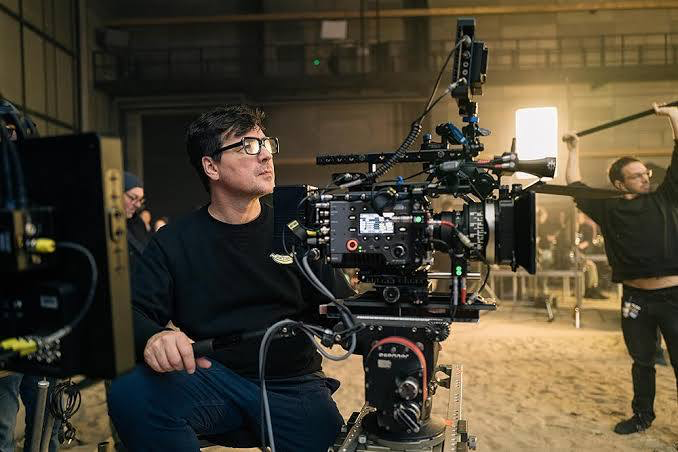
Cinematographer Trent Opaloch returned to work with the Russo brothers, and that existing shorthand was likely the only thing that kept this production moving. Opaloch and the Russos had already established a gritty, political-thriller aesthetic in The Winter Soldier and Civil War. But Infinity War required them to abandon that “street-level” grit for something operatic. Opaloch had to pivot from shaky-cam car chases to lighting purple aliens on CGI planets. His ability to ground the action in reality—even when that reality involves magic stones—is what keeps the film from looking like a video game. He understands that even in a VFX-heavy environment, the light source still needs to feel motivated.
Inspiration Behind the Cinematography

The core challenge here was unification. You have the Guardians of the Galaxy (usually bathed in James Gunn’s neon pop-colors) colliding with the texture of Black Panther and the tech-heavy look of Iron Man. If you just pasted those looks together, the movie would be a visual mess.
The solution was to bend all these pre-existing palettes toward a darker, heavier tone. It’s not just about making it “dark” for the sake of drama; it’s about weight. When the Guardians show up, you still get their distinct colors, but the contrast is crunched, and the saturation is reined in to match the impending doom of Thanos. It feels less like a crossover episode and more like a singular, cohesive event where the atmosphere itself is pressing down on the characters.
Camera Movements
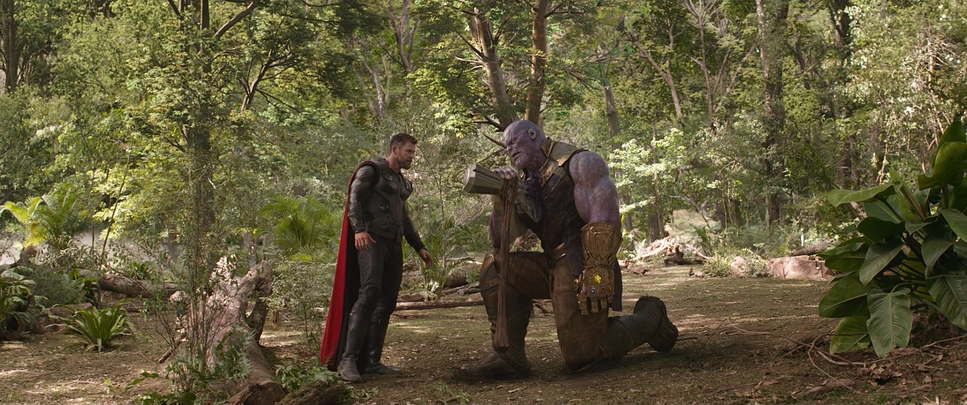
In previous Russo films, the camera was kinetic and handheld—very Bourne Identity. It put you in the fight. But for Infinity War, Opaloch dialed that back significantly. When you have armies clashing and moons being thrown, a shaky camera just creates confusion.
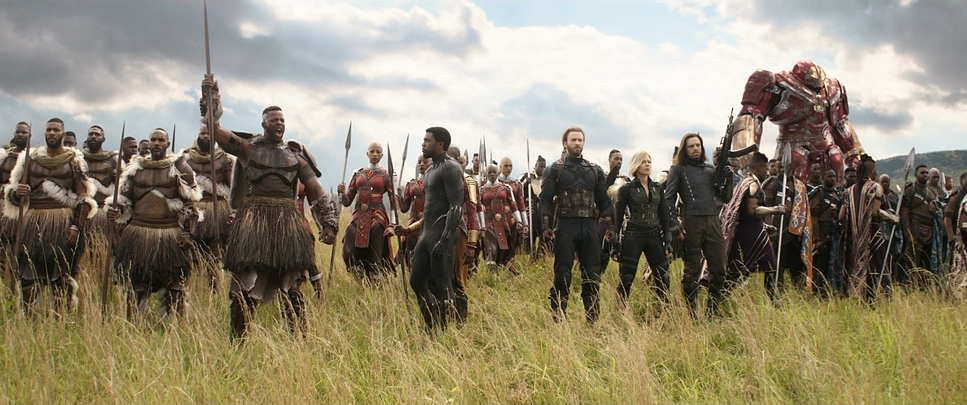
Instead, the team opted for a more “locked down” approach. We see distinct dolly moves, crane shots, and stabilized Steadicam work. This stability allows the audience to actually read the geography of the battle. Look at the Wakanda sequence: the camera pulls back to show the sheer volume of the Outrider army. Even in the tight fights, the movement is precise rather than chaotic. It captures the elegance of Thanos’s brutality rather than just the frenzy of combat.
Compositional Choices
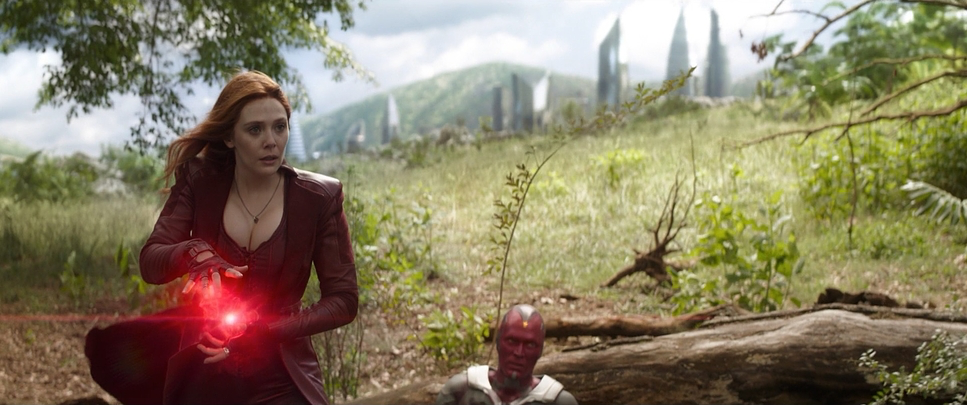
Managing an ensemble cast this large is a nightmare for framing. You aren’t just framing a hero; you’re framing relationships. Opaloch used composition to establish a hierarchy of power.
Wide shots were essential here, specifically to minimize the heroes. By layering foreground elements against massive mid-ground action and distant backdrops (like on Titan), the composition physically reinforces the narrative: the Avengers are small, and the threat is overwhelming. But the intimacy is where the film surprises you. The shots on Vormir between Thanos and Gamora are framed tight, focusing entirely on the emotional micro-expressions. It’s a smart use of negative space—isolating characters to show their loneliness even when they are standing next to allies.
Lighting Style
The lighting is where the “hopeless” tone really lives. This isn’t the flat, high-key lighting of the early MCU. Opaloch leaned into high-contrast ratios. On Titan, the light is harsh, casting deep shadows that hide information, mirroring the heroes’ confusion and desperation. The “beauty light” is effectively gone; the characters look tired, dirty, and worn down.
Thanos, specifically, is often lit with a strong directional key light. This gives his CGI model sculptural weight, making him feel physically present in the scene rather than just pasted in. There is a brutality to the lighting—hard shadows and rim lights that separate characters from the background without making them pop too cheerfully. It feels stark, perfectly serving a story about failure.
Lensing and Blocking

Shooting nearly the entire film on the ARRI ALEXA 65 (IMAX) was a technical flex that dictated the blocking. The sensor size on the Alexa 65 is massive—roughly three times the size of a standard Super 35 sensor. This gives you an incredibly wide field of view with a shallower depth of field.
Because the canvas was so large, Opaloch and the Russos could block scenes with depth. They didn’t need to cut constantly to show different characters; they could arrange them in the foreground, mid-ground, and background within a single frame. In the Battle of Wakanda, you can see Captain America and Black Panther leading the charge while clearly tracking the chaotic skirmishes happening fifty feet behind them. It allowed for “complex staging”—keeping the audience oriented without relying on a thousand quick cuts.
Color Grading Approach

This is where the movie is made or broken. The colorist, Steven J. Scott, had the impossible task of grading a film that jumps from the orange dust of Titan to the lush greens of Wakanda to the cold steel of space, all while maintaining a singular emotional thread.
The grade is surprisingly sophisticated. It’s not just a blanket desaturation. It’s a selective tonal compression. The blacks are rich but retain detail (crucial for projection), and the highlights—like the Infinity Stones or Thor’s lightning—are allowed to push high without clipping into digital white.
From a technical standpoint, the skin tone work is top-tier. Even with heavy color casts from the environments (like the purple haze of the Power Stone), the human skin tones remain natural, which requires extensive keying and tracking. And then there’s Thanos. Grading purple skin is risky; it can easily look like a cartoon. Scott managed to give his skin texture and variation—shifting hues in the shadows vs. the highlights—to make the CGI feel organic. The grade unifies the film by cooling down the shadows across the board, subtly telling the audience that no matter what planet we’re on, the mood is the same.
Technical Aspects & Tools
Avengers: Infinity War — Technical Specs
| Genre | Action, Adventure, Marvel Cinematic Universe, Science Fiction, Superhero |
|---|---|
| Director | Anthony Russo, Joe Russo |
| Cinematographer | Trent Opaloch |
| Production Designer | Charles Wood |
| Costume Designer | Judianna Makovsky |
| Editor | Jeffrey Ford, Matthew Schmidt |
| Colorist | Steven J. Scott |
| Time Period | 2010s |
| Color | Cool, Saturated, Blue, Purple |
| Aspect Ratio | 2.39 – Spherical |
| Format | Digital |
| Lighting | Hard light, High contrast, Top light, Edge light |
| Lighting Type | Daylight, Sunny |
| VFX | Blue or Green Screen, CGI, Digital Composite, Digital Rotoscope, Set Extension |
| Story Location | … Africa > Wakanda |
| Filming Location | … Georgia > Atlanta |
| Camera | ARRI ALEXA 65 |
| Lens | Panavision Primo 70s, Leica Summilux-C, Angenieux Optimo Zooms |
| Film Stock / Resolution | ARRIRAW (6.5K) |
The workflow for Infinity War was a beast. Shooting on the Alexa 65 meant wrangling massive amounts of data. We’re talking about 6.5K resolution files that demand immense processing power. This resolution wasn’t just for show; it was critical for the VFX pipeline. The more pixel data you have, the better the tracking and compositing for characters like Thanos.
The film was finished in a High Dynamic Range (HDR) workflow, which is a playground for a colorist on a sci-fi film. HDR allows for specularity that you just can’t get in standard dynamic range—the glow of the stones or the reflection in Iron Man’s suit hits the eye with genuine intensity. The success of the film’s visual legacy lies in this technical precision. It didn’t rely on the “Marvel look” of the past. It pushed the technology to handle a scope that genuinely felt like the end of the world. It’s a rare example of a blockbuster where the tech didn’t overshadow the story; it enabled it.
- Also read: AVENGERS: ENDGAME (2019) – CINEMATOGRAPHY ANALYSIS
- Also read: THE CHAOS CLASS (1975) – CINEMATOGRAPHY ANALYSIS
Browse Our Cinematography Analysis Glossary
Explore directors, cinematographers, cameras, lenses, lighting styles, genres, and the visual techniques that shape iconic films.
Explore Glossary →