Alright, let’s talk Amadeus. I spend most of my days grading digital footage at Color Culture, so revisiting a film like this is a stark reminder of what we’ve lost and gained in the shift from celluloid to digital. There are some movies that stick with you, not just for the story, but for how every element of the craft coalesces into something distinct. Amadeus is absolutely one of them. I find myself revisiting it constantly, not just for the sheer brilliance of Mozart’s music, but for the profound lessons it offers in visual storytelling.
This isn’t just a biopic; it’s a grand-scale drama depicting the fictional rivalry between Antonio Salieri and Wolfgang Amadeus Mozart. It delves into envy, genius, and divine favor in a way that feels timeless. And what fascinates me most beyond the performances by F. Murray Abraham and Tom Hulce is how the cinematography amplifies these themes. It’s a case study in how visuals don’t just decorate a story, but actively shape our understanding of Salieri’s internal torment and Mozart’s chaotic brilliance.
About the Cinematographer
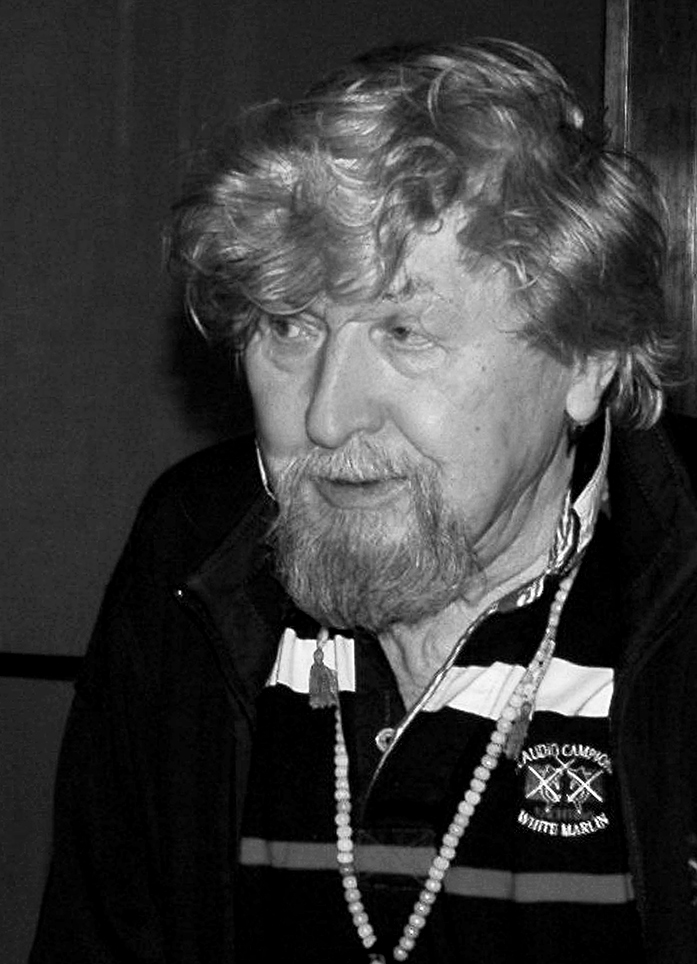
The man behind the lens was Miroslav Ondříček, a Czech cinematographer whose name is synonymous with Miloš Forman’s most iconic works. Their partnership blossomed on films like One Flew Over the Cuckoo’s Nest and Ragtime, establishing a trust that is palpable here. Ondříček wasn’t just technically proficient; he possessed an incredible sensitivity to light and atmosphere, rooted in a European sensibility that felt more painterly than the high-gloss Hollywood style of the 80s. He brought a grounded realism, a commitment to motivated light, while simultaneously achieving the theatrical grandeur required for a film about opera and court life.
Inspiration Behind the Cinematography
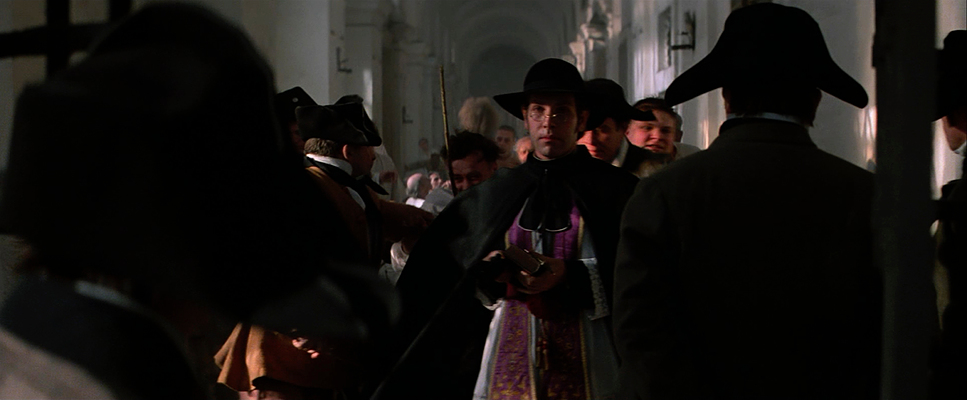
The visual design of Amadeus feels like a direct response to its 18th-century Viennese setting. The filmmakers weren’t just aiming for historical accuracy in the costumes and sets though they are gorgeous they were aiming for authenticity in the feeling of the era. A crucial anchor point for this visual language was the commitment to “mostly candlelit” interiors. This decision informed everything from lighting setups to color choices.
Beyond the historical aesthetic, the cinematography had to visually articulate Salieri’s internal struggle a divide breaking his soul. Mozart’s music needed to feel like a tangible, physical presence, while Salieri’s descent into envy had to be reflected in the visual texture. Filming in Prague allowed the production to leverage actual historical architecture rather than relying solely on constructed sets. This gave the film an unparalleled sense of scale and realism, grounding the often fantastical story in a breathing world. The location becomes a character in itself, echoing the rigid society that both elevates and ultimately suffocates Mozart.
Camera Movements
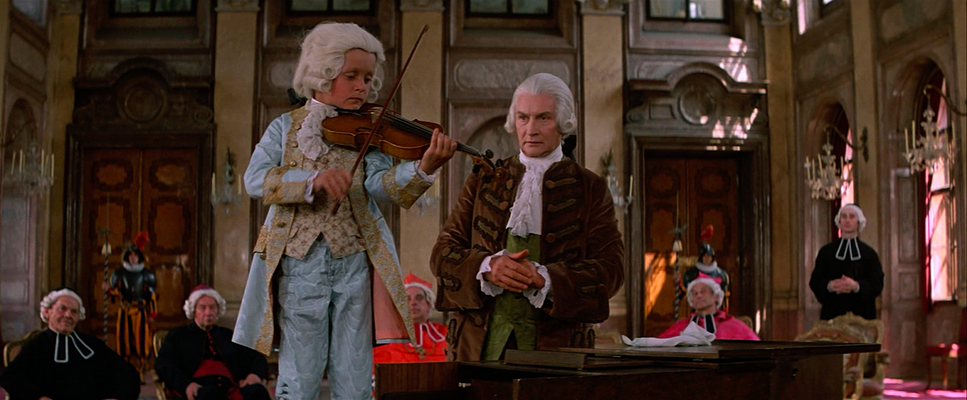
When you think of Amadeus, you don’t immediately recall flashy, acrobatic camera work, and that’s precisely the point. The camera movements here are like a well-trained orchestra conductor: precise, purposeful, and always in service of the narrative.
They’re largely observational, employing smooth, deliberate dolly shots or gentle tracking movements that glide through the opulent palaces. These aren’t just aesthetic choices; they establish the expansive world in which Mozart and Salieri exist. Imagine the camera tracking Salieri through a lavish court gathering it follows him, but also takes in the periphery, showcasing the society he desperately wants to impress, yet never quite feels a part of.
Conversely, for Mozart, the camera can feel more dynamic, sometimes even playfully chaotic in his earlier scenes. But as his life spirals, the movements become more confining, emphasizing his isolation. The transitions between the aged Salieri in the asylum and his younger self are a prime example of this flow. The camera plays a pivotal role here, often moving us from a close-up of old Salieri directly into a memory a subtle push-in bridging decades without jarring cuts. It’s an elegant, almost invisible way to navigate Salieri’s fractured mind.
Compositional Choices
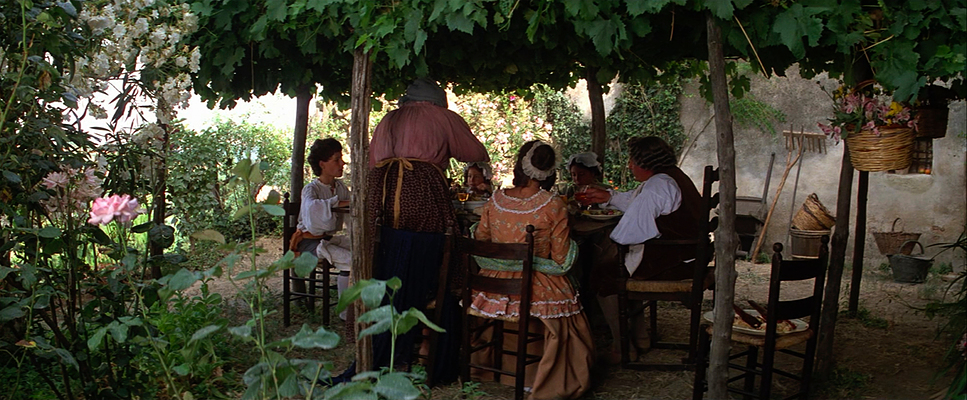
The compositional choices are a lesson in classical framing infused with psychological depth. Ondříček’s frames often feel perfectly balanced, referencing 18th-century painting traditions, but within that balance lies a specific character logic.
For Salieri, compositions often emphasize isolation. He might be subtly off-center, or framed by architectural elements that seem to dwarf him. When he’s observing Mozart, he’s often placed in the background, peering from the shadows a voyeur to the genius he resents. His power is sometimes captured with low angles, giving him gravitas, only to be undercut by high angles later, making him appear defeated by his own bitterness.
Mozart, by contrast, often commands the center of the frame in his early scenes vibrant and surrounded by light. However, as the story progresses, his compositions shift. He becomes smaller within the frame, visually “trapped” by elements around him. The use of deep focus is also prevalent, particularly in the opera scenes. This allows the opulent sets and the multitude of characters to exist in sharp detail, creating powerful depth cues that invite the viewer to explore the intricate layers of the mise-en-scène.
Lighting Style
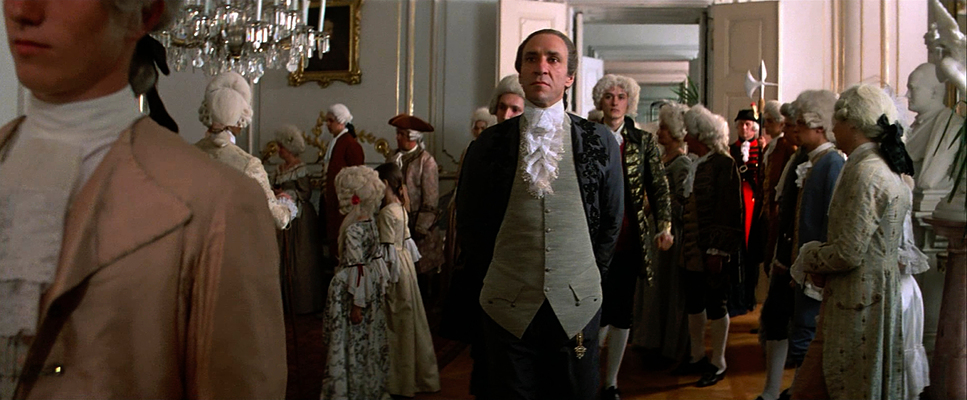
This is where Amadeus truly separates itself. The lighting style is one of the film’s most remarkable achievements. Ondříček and Forman embraced motivated lighting with a fervor that was revolutionary for its time. Every flicker of a candle, every shaft of sunlight through a window feels authentic and earned.
This dedication results in dramatically lower-key scenes, particularly in night interiors, with deep shadows and warm sources. The contrast ratios evoke the chiaroscuro effect of Old Masters. Faces emerge from the darkness, illuminated with a soft glow that feels incredibly intimate.
Think about Salieri’s confession scenes in the asylum; the light is stark, often cool, contrasting sharply with the warm, rich flashbacks. In those flashbacks, especially his private moments analyzing Mozart’s scores, the candlelight wraps around him. Looking at these scenes now, I’m always impressed by the dynamic range. Film stock handles highlight roll-off beautifully much softer than digital sensors do without heavy manipulation. That soft clipping in the candle flames and the gentle bloom into the shadows gives the image a texture that modern films struggle to emulate authentically.
Lensing and Blocking
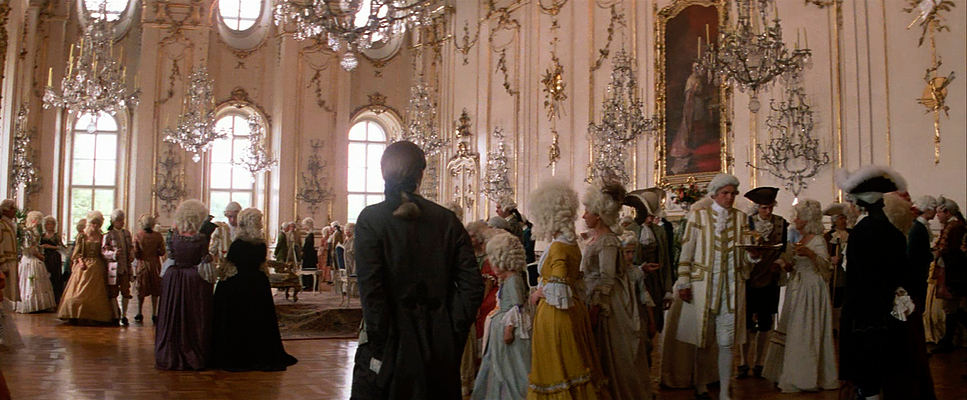
The choices in lensing and blocking work hand-in-glove here. Ondříček utilized Panavision Primo Primes, a choice that provided the sharpness and consistent optical performance necessary for the film’s detailed compositions. He employed wider focal lengths to capture the vastness of the Viennese court, subtly commenting on the characters’ smallness within the social structure. Yet, he deftly switched to medium and longer lenses for intimate character studies, isolating F. Murray Abraham’s tormented expressions from the busy backgrounds.
Blocking the movement of actors within the frame is equally sophisticated. In the court scenes, we see elaborate choreography reflecting the strictures of the era. Salieri is often blocked in positions that allow him to observe Mozart from a distance, or to subtly impede him. Conversely, Mozart’s blocking initially shows him moving freely, almost dancing through spaces, until his life deteriorates and he becomes physically constrained.
Color Grading Approach
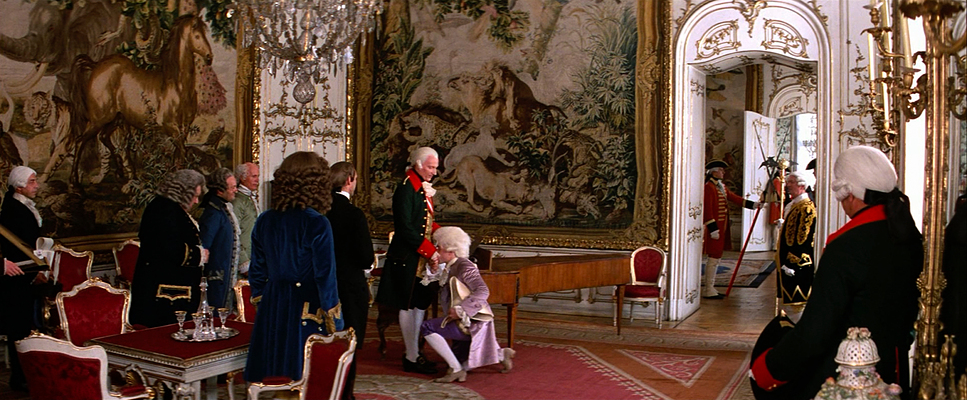
Looking at this through a colorist’s lens, understanding the look of a 1984 film means understanding the photochemical process. We aren’t talking about DaVinci Resolve windows here; we’re talking about printer lights and chemical timing.
The palette is rich and warm, leaning into an autumnal feel that encapsulates the period while hinting at decay. The colors feel lived-in and earthy. The contrast shaping is distinctly analog—those candlelit scenes with their deep, dense blacks and luminous highlights are a hallmark of the Kodak 5293 stock used on the production. The way the shadows wrap around faces creates a sculptural depth that film negative just has.
I sometimes wonder if the warmth was pushed, but it feels motivated. The yellow-orange glow of candle flames would naturally tint skin tones. Hue separation is also beautiful the reds and golds of the costumes hold their integrity even in low light, never bleeding into a muddy mess. It’s a masterclass in how much mood can be conveyed through a considered color approach, even with the limitations of the era.
Technical Aspects & Tools
Amadeus – Technical Specifications
| Genre | Drama, History, Music, Stage Adaptation, Musical, Biopic |
| Director | Miloš Forman |
| Cinematographer | Miroslav Ondricek |
| Production Designer | Patrizia von Brandenstein |
| Costume Designer | Theodor Pistek |
| Editor | Michael Chandler, Nena Danevic |
| Colorist | Aubrey Head, Bob Putynkowski |
| Time Period | 1800s |
| Aspect Ratio | 2.39 – Anamorphic |
| Format | Film – 35mm |
| Lighting | Underlight |
| Lighting Type | Practical light, Firelight |
| Story Location | Austria > Vienna |
| Filming Location | Prague > Maltézské pomoc, Lazenska 2, Malá Strana |
| Camera | Panavision Platinum |
| Lens | Panavision Primo Primes |
| Film Stock / Resolution | 5293/7293 EXR 200T |
To achieve this visual grandeur, Ondříček relied on the best tools available in the mid-80s. The production was shot on the Panavision Platinum, a workhorse camera known for its reliability, paired with those Panavision Primo Primes. These lenses were essential for maintaining clarity across the frame, especially in the wide shots of the opera house.
Film stock selection was paramount. They utilized Kodak 5293 (EXR 200T). This was a Tungsten-balanced stock that allowed them to dig into the shadows of those dimly lit environments without resorting to excessive artificial light. The inherent grain structure of the 5293 contributes to the film’s organic texture rather than distracting from it.
For lighting, while HMIs handled the day exteriors, the magic happened with practicals countless candles and oil lamps, likely augmented by small tungsten units on dimmers to control the spill. And, of course, we have to mention the practical effects. The aging of Salieri wasn’t CGI; it was the work of the legendary Dick Smith. His makeup application, which reportedly took over four hours daily, provided an undeniable authenticity to Abraham’s performance that digital de-aging still struggles to match. It’s a reminder that sometimes the old tools, used with skill, remain the most powerful.
A Lasting Resonance
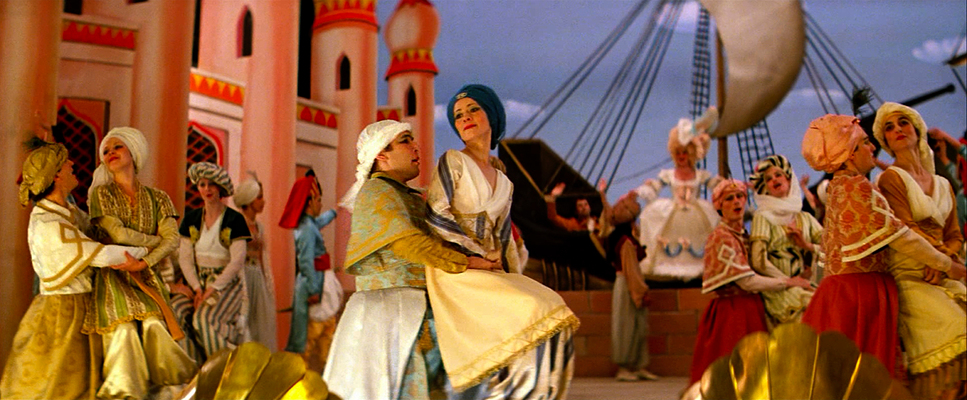
Amadeus is a visual symphony that explores the human condition through the lens of artistry and envy. The cinematography doesn’t merely document the story; it is the story. From Ondříček’s naturalistic lighting to his classical compositions, every choice guides our emotions regarding Salieri’s tortured soul and Mozart’s fleeting brilliance. As a professional in this field, I’m constantly inspired by how the craft here serves the emotional logic. It’s a film that reminds me of the true power of intuition and visual storytelling. And if you take one thing from Amadeus beyond the music it’s perhaps this: “Don’t become a Salieri.” Let the genius of others inspire, rather than diminish, your own path.
- Also read: DR. STRANGELOVE OR: HOW I LEARNED TO STOP WORRYING AND LOVE THE BOMB- CINEMATOGRAPHY ANALYSIS
- Also read: OLDBOY (2003) – CINEMATOGRAPHY ANALYSIS
Browse Our Cinematography Analysis Glossary
Explore directors, cinematographers, cameras, lenses, lighting styles, genres, and the visual techniques that shape iconic films.
Explore Glossary →