Some films capture a moment; Free Solo (2018) captures the human spirit when it’s pushed right to the edge of a cliff literally. Alex Honnold’s ascent of El Capitan’s Freerider route is a physical miracle, sure, but for those of us behind the lens or sitting in the color suite, it’s a psychological puzzle. How do you visually respect the sheer, 3,000-foot scale of that granite monolith while staying locked into the quiet, almost claustrophobic headspace of a man climbing without a rope? As director Chai Vasarhelyi put it, you’re filming “perfect execution or certain death.” The stakes aren’t just high; they’re absolute. This isn’t just a climbing doc; it’s a character study that happens to be wrapped in some of the most stressful visual storytelling ever put to screen.
About the Cinematographer
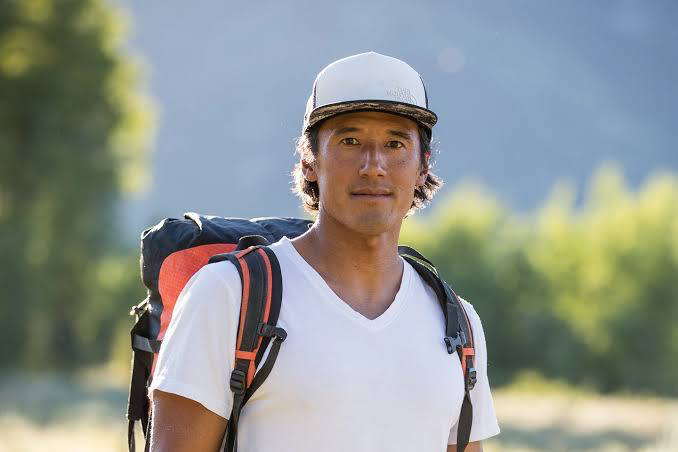
When your subject is doing something where a single foot-slip means oblivion, you don’t just hire a “good” DP. You hire someone who lives in that world. That’s why Jimmy Chin who co-directed with Chai is the only person for this job. Jimmy isn’t some director barking orders from a heated tent on the valley floor; he’s an elite climber. He knows the rock, the fear, and the rhythm of the mountain because he’s lived it.
The crew he put together wasn’t your typical film set. Jimmy basically had to find the only three or four people on the planet who are world-class climbers and incredible cinematographers. Imagine hauling 50 pounds of gear and 1,000 feet of rope while trying to pull focus. They weren’t just operating cameras; they were managing lines and clipping off to themselves in a vertical world. That athletic grit is baked into the film’s DNA. Plus, because they were Alex’s friends, there was a level of trust there that you just can’t manufacture.
Inspiration Behind the Cinematography
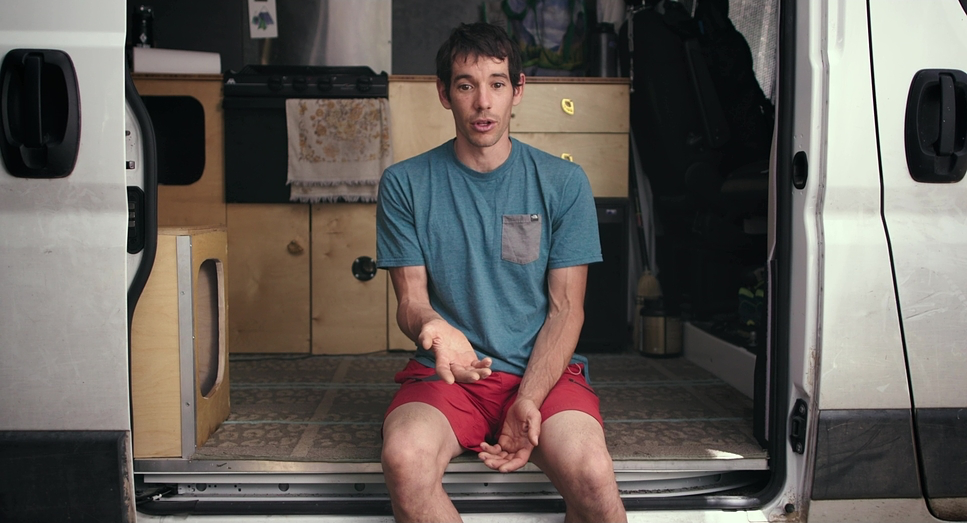
The real engine behind the look of this film wasn’t the climb it was Alex himself. The filmmakers were always more interested in a character study than just “action sports.” This forced the visuals to constantly oscillate. You go from these abstract, massive wide shots of El Cap to these painfully intimate, guarded moments in Alex’s van.
Then there’s the ethical elephant in the room: Is our presence going to kill him? That’s a heavy question for a DP to carry. It dictated everything, especially the decision to use remote cameras for the “Boulder Problem.” They didn’t do it because it was easier they did it because they couldn’t live with themselves if a cameraman’s sneeze caused a fall. They wanted Alex to have the “purity” of the experience, which turned the act of filming into something almost reverent and observational.
Camera Movements
On a vertical rock face, you can forget about dollies, cranes, or fancy handheld tracking. The movements are “motivated” by one thing: survival. Most of the work on the wall is static or involves very subtle, precise pans and tilts to follow Alex’s upward trajectory.
Sometimes you’ll see a “lower out,” where a cameraman drops slowly to create a vertical track, which really helps ground the viewer in how much rock is actually being covered. But for the most part, it’s about stillness. In the “Boulder Problem,” the camera doesn’t move at all. Alex just enters and exits the frame. Paradoxically, that lack of movement makes the tension unbearable. You’re just waiting. It’s a total contrast to the ground footage or the interviews, where things loosen up into a handheld verité style.
Compositional Choices
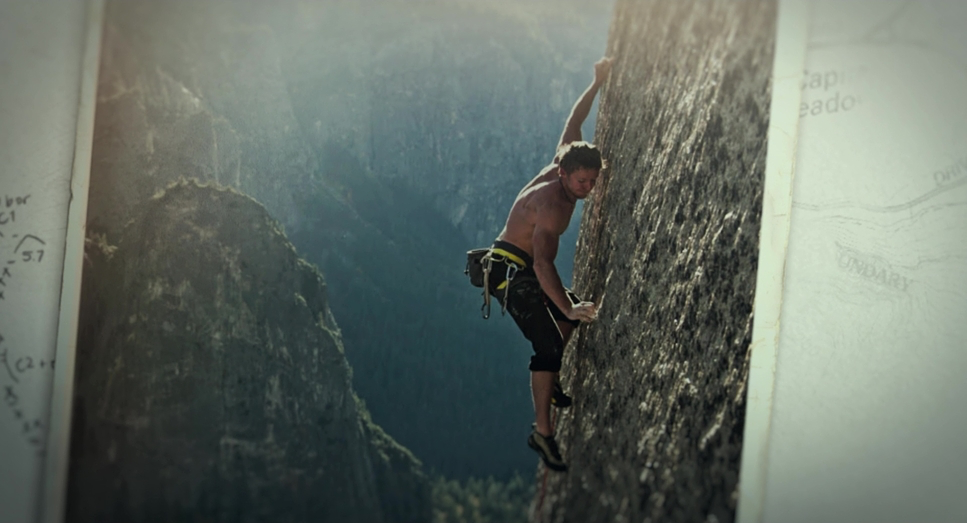
The framing in Free Solo is a lesson in scale. Most of the time, the film treats El Capitan like a god and Alex like a speck. By using extreme long shots and tons of negative space, the 3,000-foot drop becomes visceral. You don’t just see the height; you feel it in your stomach.
But then, they punch in. You get these tight shots of chalky fingers searching for a hold that’s barely there. It grounds the epic scale in something human and vulnerable. They also used what Jimmy calls “down the barrel” shots placing the camera directly above Alex so he’s climbing straight at the lens. It’s aggressive, dramatic, and forces you to confront the ascent head-on. Even in those crazy conditions, they’re still using the rule of thirds and atmospheric perspective to make the valley floor look miles away (which, to be fair, it was).
Lighting Style
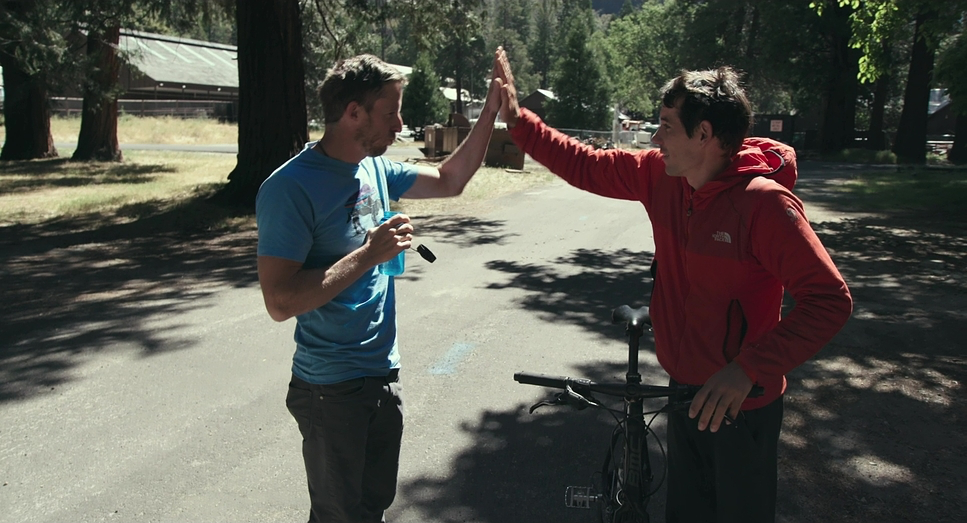
On El Cap, your “Gaffer” is the sun. Period. The lighting is purely naturalistic, and it looks like they often dealt with that flat, overcast daylight that Yosemite is famous for. As a colorist, I love that soft, low-contrast light because it lets the texture of the granite really speak without being buried in heavy, “crunchy” shadows.
The film uses the time of day to tell the story. You have that soft, diffused morning haze when he starts, which feels almost peaceful. But as the day moves, the light gets sharper, revealing every crack and pore in the rock. We’re not talking about a sculpted studio look here; we’re talking about the raw reality of the Sierras. The goal was clearly authenticity making the viewer feel the cold, thin air and the grit of the stone.
Lensing and Blocking
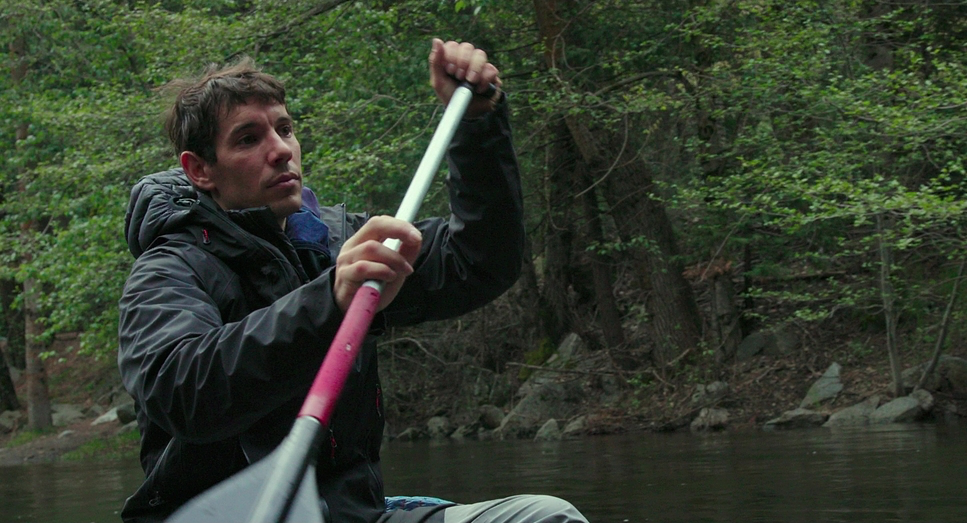
Technically, they leaned on “long lands” telephoto lenses to stay out of Alex’s head. They’d be hundreds of feet away, zoomed in tight, so Alex could stay in his bubble. Telephoto compression also does this cool thing where it makes the granite layers look like they’re stacking on top of each other, making the climb look even more relentless.
The “blocking” was basically a high-stakes choreography of rappelling. The crew knew the critical pitches the Free Blast slabs, the Boulder Problem, the Dano Corner and they’d scramble between these spots with their gear. For the Dano Corner, Jimmy was off to the side while another guy shot “down the barrel.” It’s basically a multi-cam setup on a cliffside. And that remote camera for the Boulder Problem? That was a pure “set it and forget it” gamble that paid off with that iconic shot of Alex’s “karate kick.”
Color Grading Approach
If I were the one sitting at the DaVinci Resolve panel for this, I’d go for “enhanced naturalism.” You don’t want to over-stylize a story this real, but you want to elevate the truth of it.
- Contrast & Texture: I’d spend a lot of time on contrast shaping. The granite needs to feel tactile. I’d want the viewer to feel the friction of the rubber on the rock. That means keeping the mid-tones rich and the blacks deep in the crevices without losing detail.
- The “Canon Look”: Since they shot on the C300 MKII, you’re working with 4K Canon Cinema Raw. It’s got a great, organic feel. My big focus would be the highlight roll-off. In those bright, overcast skies, you want the highlights to “bloom” gently like film, not clip like a cheap digital sensor. It makes the scale feel grand rather than clinical.
- Hue Separation: Yosemite has this beautiful palette of sage greens, granite greys, and those punchy magentas and blues in the sky. I’d make sure those hues are separated so the image doesn’t get muddy. Alex’s red shirt against the cool grey rock is a classic color pop that guides the eye instantly.
Technical Aspects & Tools
Free Solo | 1.85:1 • Digital 4K • Canon C300 MKII
| Genre | Adventure, Documentary, Nature Documentary, Action, Climbing, Drama, Sports |
| Director | Elizabeth Chai Vasarhelyi, Jimmy Chin |
| Cinematographer | Mikey Schaefer, Jimmy Chin, Clair Popkin |
| Editor | Bob Eisenhardt |
| Colorist | Stefan Sonnenfeld |
| Time Period | 2010s |
| Color | Cool, Saturated, Green, Magenta |
| Aspect Ratio | 1.85 |
| Format | Digital |
| Lighting | Soft light, Low contrast |
| Lighting Type | Daylight, Overcast |
| Story Location | California > Yosemite National Park |
| Filming Location | California > Yosemite National Park |
| Camera | Canon C300 MKII |
| Film Stock / Resolution | 4K, Canon Cinema Raw |
The technical side of Free Solo is just as impressive as the climb. Shooting 4K on Canon C300 MKIIs in those conditions is no joke. They needed cameras with high dynamic range but small enough to be rigged to a harness. They even had still cameras bolted to the top of the cinema rigs.
The real “tech” was the rigging. They used self-locking belay systems so the cameramen could actually let go of the ropes to pull focus or swap a battery. Every piece of kit was chosen for reliability under stress. When they downloaded the footage from the remote cameras at the Boulder Problem, it wasn’t just a “check the gate” moment it was a collective sigh of relief that the tech actually worked when it mattered most.
- Also read: THE GENERAL (1926) – CINEMATOGRAPHY ANALYSIS
- Also read: THE STRAIGHT STORY (1999) – CINEMATOGRAPHY ANALYSIS
Browse Our Cinematography Analysis Glossary
Explore directors, cinematographers, cameras, lenses, lighting styles, genres, and the visual techniques that shape iconic films.
Explore Glossary →