I remember walking into the theater with zero expectations. I’d just seen Oblivion, which looked beautiful but felt sterile. But Edge of Tomorrow (2014) it had grit. It wasn’t just the clever Groundhog Day mechanics; it was the visceral, grounded way it was shot. It felt like a war film that happened to have aliens in it, not a CGI fest. It dared to be intelligent and surprisingly funny, but visually, it never broke character.
About the Cinematographer

The guy responsible for this look is the veteran Australian DP Dion Beebe. If you know his resume Collateral, Memoirs of a Geisha, Miami Vice you know he’s versatile, but he has a specific talent for texture. Collateral was revolutionary for how it embraced the noise and sensitivity of early digital cameras to capture LA at night.
But for Edge of Tomorrow, Beebe went the other way. He didn’t want that clean, digital sci-fi look. He specifically wanted a “world under siege, but not a bleak, dark, post-apocalyptic landscape.” That is a tough brief. It’s easy to make a dystopia look “cool” by just crushing the blacks and desaturating everything. Beebe did something harder: he kept the life in the image. He opted for 35mm film, which, in 2014, was a deliberate statement. He wasn’t chasing pixels; he was chasing grain, texture, and a chemical unpredictability that digital sensors back then just couldn’t emulate.
Inspiration Behind the Cinematography
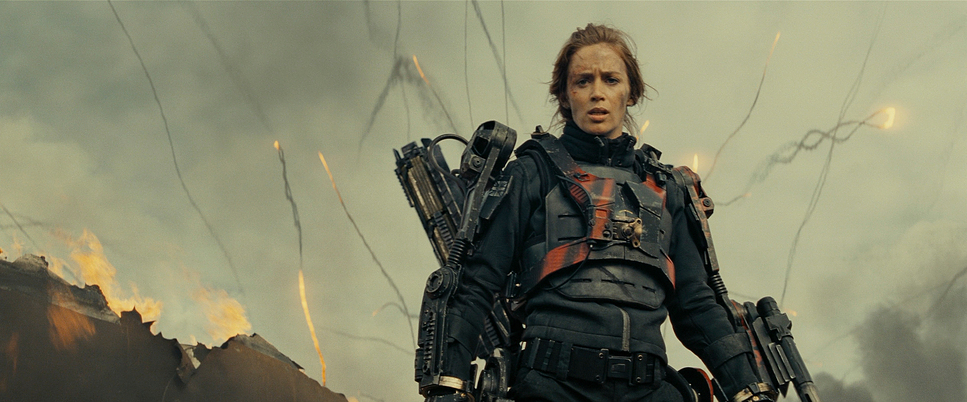
That choice of 35mm wasn’t just for nostalgia; it was about matching the reference material: World War II combat footage. Beebe was pretty open about using newsreels from the Normandy landings as his visual bible. And you can feel it.
Think about those old 16mm war reels grainy, high-contrast, shaky, terrified. That’s the visual language here. The beach battle isn’t shot like a superhero movie; it’s shot like Saving Private Ryan. The camera shakes not because it’s a “style,” but because it feels like the operator is scared. By rooting a time-travel alien movie in the visual vernacular of WWII, the film bypasses your “this is fake” filter. The sheer scale of that beach set a massive backlot surrounded by green screen wasn’t just for VFX extension; it was to make the actors feel small, like tiny cogs in a terrifying machine.
Camera Movements
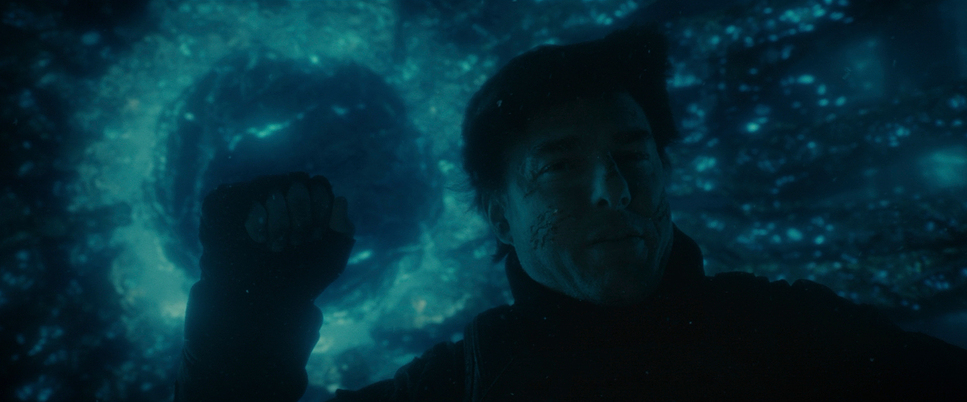
One thing I really appreciate here is how Liman pivoted from his Bourne Identity style. We all know the “shaky cam” trope, and while it worked for Bourne’s frantic hand-to-hand stuff, it would have been a mess here. A reviewer at the time noted that Liman “does not use that type of editing style in this movie,” and thank god for that.
Instead, we get these sweeping, wide panning shots and long takes. This is where the practical limitations actually helped the filmmaking. The actors were wearing Exo-Suits weighing anywhere from 40 to 110 pounds. You can’t fake the physics of that. The camera moves with a heavy, industrial fluidity to match them. When Cage is navigating the beach, we aren’t lost in motion blur; we are tracking him through the geography of the fight. The camera establishes the environment the “United Defense Force” drop ships, the smoke, the debris giving us context rather than just chaos.
Compositional Choices
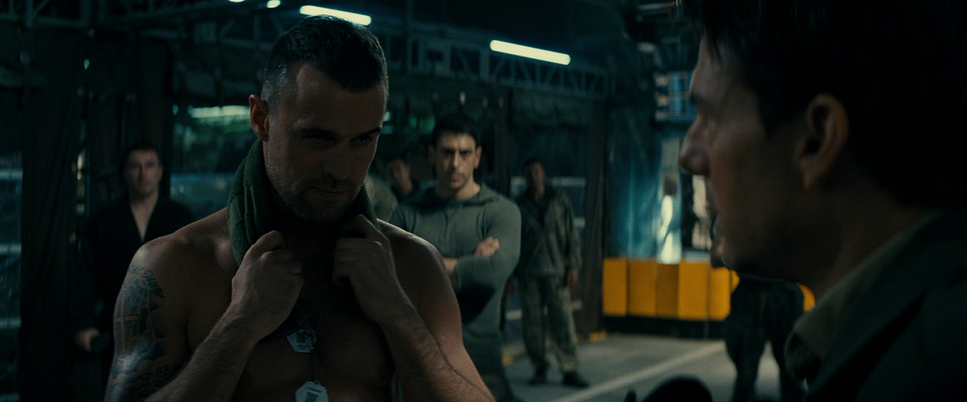
Compositionally, this film loves the 2.39:1 anamorphic frame. It constantly uses that width to isolate Cage. In the early scenes, look at how he is framed often “short-sided” or pushed into the bottom third, dominated by the military machinery around him. It’s a textbook use of negative space to show vulnerability.
As Cage gets better at being a soldier, his relationship with the frame changes. He starts controlling the space. But what’s really interesting is the framing of the Mimics. These things are erratic, glitchy, obsidian monsters. Beebe uses depth cues to place them in the mid-ground, making them feel like physical objects rather than digital overlays. And then there’s Rita. The “Full Metal Bitch” introduction is iconic because of the low-angle framing. It creates a hero shot that immediately tells you she is the dominant force in this world, contrasting sharply with Cage’s clumsy, center-punched framing in the early loops.
Lighting Style
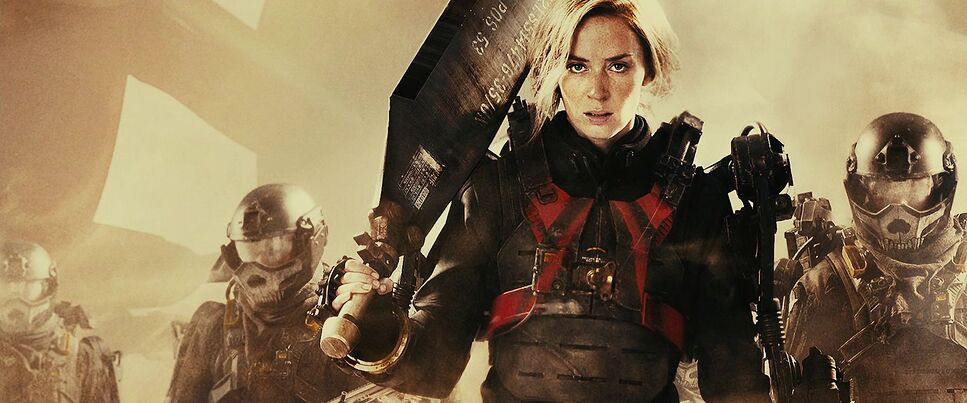
Beebe’s lighting philosophy here is fascinating because he avoids the “muddy” trap. A lot of modern blockbusters look like they were lit with a dimmer switch. Here, the world is “fighting for light.”
On the beach, the lighting is motivated by chaos flares, muzzle flashes, and explosions. It’s soft, top-heavy daylight diffused through smoke and dust. It feels like a cloudy day in London (which, technically, it was, as they shot in the UK), but punched up with these violent transients of orange fire.
Interiors are different. Inside the UDF base or the bunker, it’s all practicals fluorescent tubes, industrial fixtures. It feels sterile and cold, specifically utilizing Cyan and cool white tones. It creates a great visual separation: the safe zones are cold and static, the war zones are chaotic and warm. Beebe isn’t afraid to let the highlights blow out a bit, either. Because they shot on film, those blown-out skies and explosions have a soft, creamy roll-off rather than the harsh digital clipping you see in cheaper productions.
Lensing and Blocking
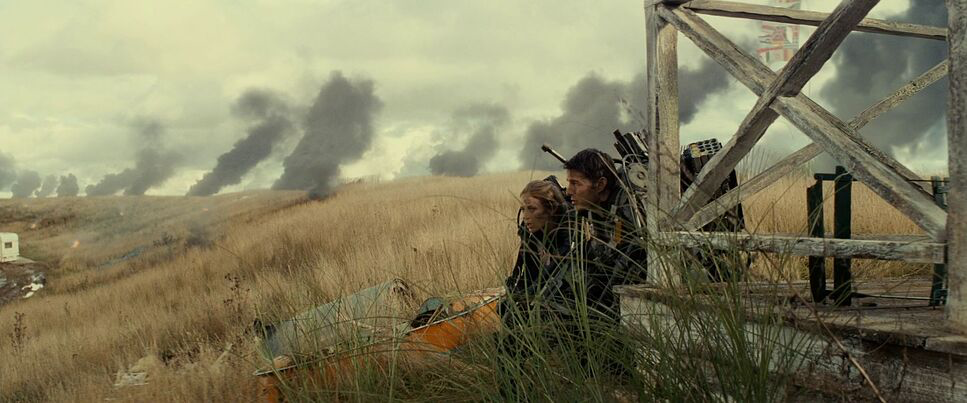
We have to talk about the glass. Beebe used Panavision Millennium cameras with C-Series and E-Series anamorphic lenses. These aren’t perfect, clinically sharp lenses. They have character. They flare horizontally. They distort the edges slightly. This adds to that “out of time” feel.
For the big establishing shots, he’s on the wider end of the focal lengths, emphasizing the scale of the invasion. But notice the shift during the training montages in the barn/bunker settings. The lens gets longer (likely the Panavision ATZ or AWZ2 zooms mentioned in the technical specs). This compresses the background, bringing Rita and Cage closer together visually, increasing the intimacy.
The blocking is also dictated by the suits. You can see the actors laboring. Cage doesn’t glide; he stomps. The blocking has to account for that weight. In the early loops, Cage is bumping into extras, tripping over gear it’s brilliant physical comedy. As the loops progress, his movement becomes economical, almost robotic. The camera placement evolves with him, moving from reactive (following him) to proactive (anticipating him), mirroring his knowledge of the future.
Color Grading Approach
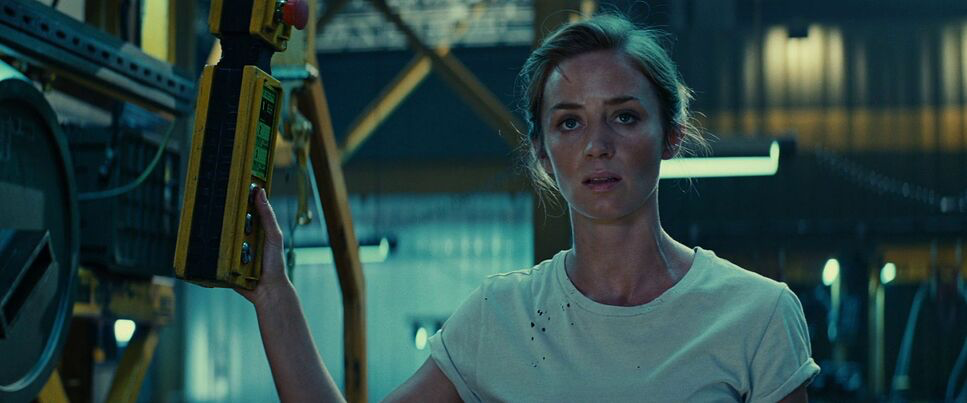
Okay, as a colorist, this is the part I nerd out on. The grade was handled by Peter Doyle, a legend in the industry (he did The Matrix and Lord of the Rings). You can feel his hand here.
The palette is strictly controlled cool, desaturated, heavy on the cyans and greens. It’s that classic “bleach bypass” look that Spielberg popularized with Saving Private Ryan, but updated for sci-fi. Doyle didn’t just slap a teal-and-orange LUT on it. The key is in the separation. The Mimics have this weird, electric blue/purple sheen to their obsidian texture. If the grade wasn’t precise, that blue would bleed into the cool, grey daylight and turn into mush. Doyle keeps the separation clean.
Also, look at the shadows. They aren’t crushed to total black. There’s detail in the toe of the curve. You can see into the dark corners of the drop ship. This is crucial for maintaining that “documentary” feel. If you crush the blacks too hard, it looks stylized and fake. By lifting them slightly, it feels more like raw footage. The skin tones are kept relatively neutral but pale, reinforcing the exhaustion of the characters. It’s a grade that supports the story rather than trying to distract you from it.
Technical Aspects & Tools
Edge of Tomorrow: Technical Specifications
| Genre | Action, Science Fiction, Time Travel, Hard Sci-Fi, Military, War, History |
| Director | Doug Liman |
| Cinematographer | Dion Beebe |
| Production Designer | Oliver Scholl |
| Costume Designer | Kate Hawley |
| Editor | James Herbert |
| Colorist | Peter Doyle |
| Time Period | Future |
| Color Palette | Cool, Desaturated, Cyan, Blue |
| Aspect Ratio | 2.39 – Anamorphic |
| Format | Film – 35mm |
| Lighting Style | Soft light, Top light, Side light |
| Lighting Type | Artificial light, Practical light |
| Story Location | United Kingdom, England |
| Filming Location | England, London |
| Camera | Panavision Millennium / Millenium XL / XL2 |
| Lens | Panavision 40-80 (Bailey zoom – AWZ2), Panavision 70-200mm (ATZ), Panavision C series, Panavision E series |
The technical workflow on this film was a beast. Shooting 35mm provided the organic base, but the VFX workload was massive. Sony Pictures Imageworks, MPC, and Framestore had to integrate CGI Mimics into grainy film plates, which is a nightmare for compositors.
The Mimics themselves are a technical marvel. They aren’t guys in suits; they are swirling tornados of glass shards. The animation team actually wrote custom code (a Maya plugin) to control the tentacles independently so they would move erratically, like “cocaine addicts.” That jittery movement is terrifying because it doesn’t look biological.
- Also read: SHREK (2001) – CINEMATOGRAPHY ANALYSIS
- Also read: THOR: RAGNAROK (2017) – CINEMATOGRAPHY ANALYSIS
Browse Our Cinematography Analysis Glossary
Explore directors, cinematographers, cameras, lenses, lighting styles, genres, and the visual techniques that shape iconic films.
Explore Glossary →