To call The Bridge on the River Kwai a “war movie” feels like a disservice. It’s a psychological thriller disguised as an epic. While the backdrop is the brutal reality of a World War II Japanese POW camp, the real battlefield is the internal struggle between Colonel Saito and Colonel Nicholson. It’s a multi-faceted narrative that dissects the absurdity of blind loyalty and the existential crisis of men trying to impose order on chaos.
From a visual standpoint, the film is a paradox. It balances the sweeping, untamed landscapes of the Burmese jungle (filmed in Sri Lanka) with the rigid, geometric obsession of the bridge itself. Every frame feels meticulously considered, serving to communicate the shifting power dynamics and the protagonists’ descent into a kind of “Stockholm syndrome” regarding their captors and their task. It demands your attention not just for its scope, but for the subtle ways the cinematography foreshadows the tragic, inevitable conclusion.
About the Cinematographer
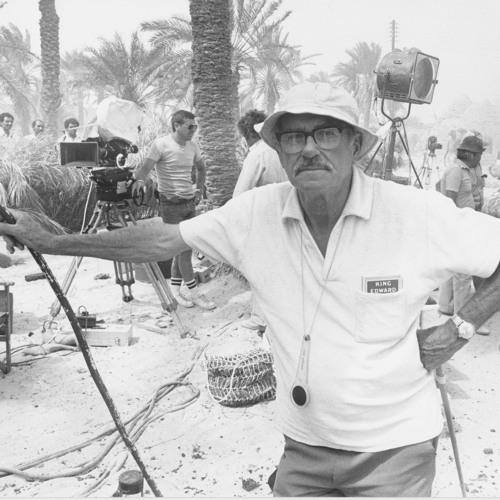
The visual architect behind this masterpiece was Jack Hildyard. While he might not always be the first name dropped in casual film school conversations, true students of cinema recognize him as a giant of the era. Hildyard was a master of the “pre-digital” epic. He understood how to fill a massive frame without losing the human element, making him the perfect collaborator for David Lean’s ambitious vision.
Hildyard’s work on Kwai earned him an Academy Award, and rightly so. He possessed an innate understanding of how to exploit the anamorphic format which was still relatively new at the time to tell a story that was simultaneously vast and claustrophobic. His ability to capture the texture of the environment while maintaining the dignity of the actors is a testament to the patience and craft required in the photochemical era.
Inspiration Behind the Cinematography
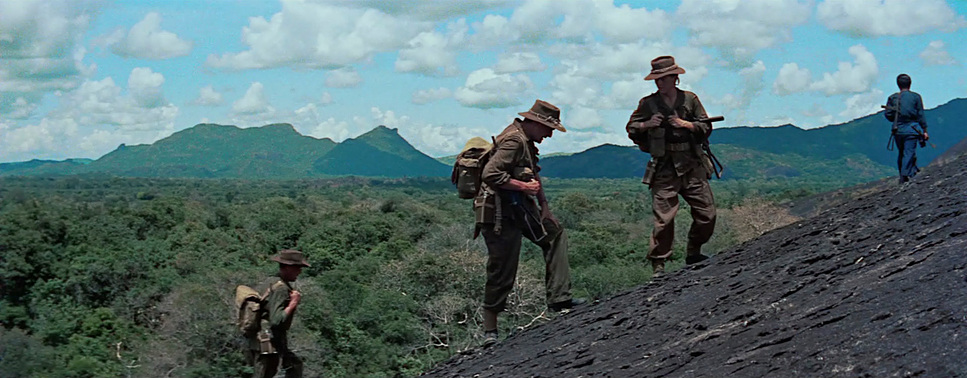
The cinematography is driven by a central visual conflict: the organic vs. the man-made. The inspiration seems to stem from Lean’s desire to mirror the narrative conflict the stubborn mental warfare between Saito and Nicholson in the environment itself. The jungle is chaotic, green, and indifferent; the bridge is linear, wooden, and structured.
Shooting in the 2.55:1 CinemaScope aspect ratio wasn’t just a technical flex; it was a narrative necessity. It allowed the filmmakers to isolate characters within vast negative space, emphasizing their insignificance against nature. The “epic scale” amplifies the emotional weight, turning the environment into a silent observer. The bridge becomes more than a set piece; it evolves into a character, a symbol of Nicholson’s misplaced pride rising from the chaotic river. The imagery constantly reminds us of the stakes, visually contrasting the individual’s rigid principles against a sprawling, uncaring world.
Camera Movements
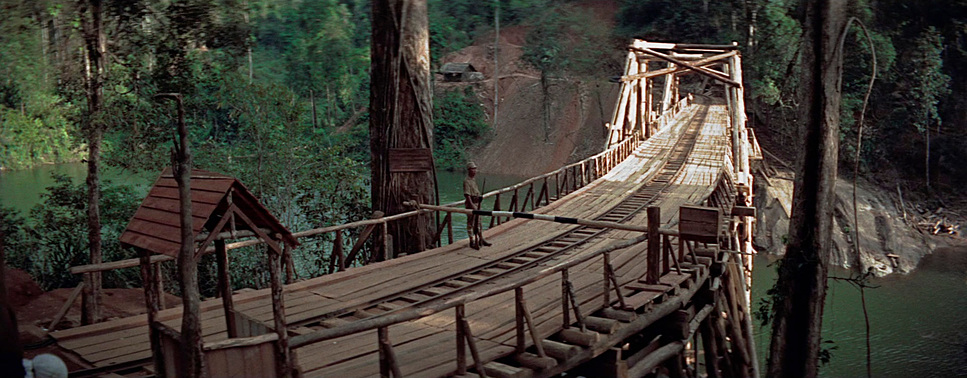
Lean’s camera is rarely restless. He wasn’t one for flashy, unmotivated movement. In Kwai, the camera movement is deliberate, heavy, and purposeful. It mimics the grueling labor of the POWs.
We see this in the establishing shots that slowly pan across the jungle canopy, or the tracking shots that move parallel to the soldiers marching or working. These lateral movements emphasize the repetitive, Sisyphus-like nature of their existence. When the camera cranes up, revealing the growing structure of the bridge against the sky, it lends the construction a monumental, almost religious quality. Conversely, when the camera pushes in on Nicholson, it’s a slow, creeping movement, highlighting his internal obsession. It’s a calculated dance between revealing the vastness of the geography and the narrowness of Nicholson’s mind.
Compositional Choices
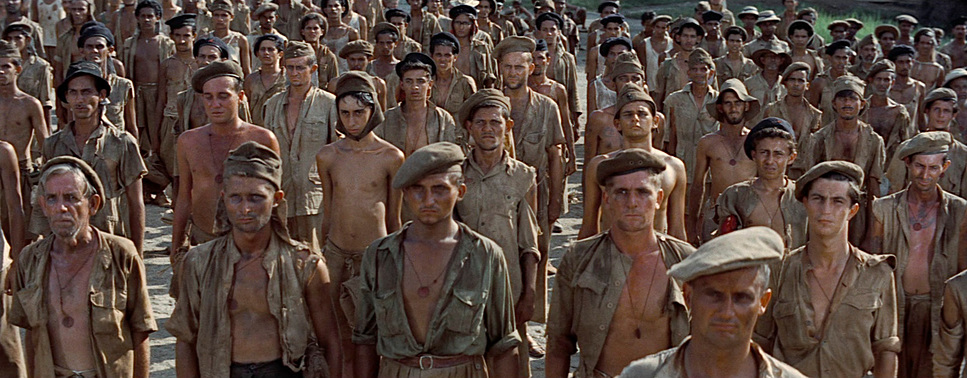
The 2.55:1 aspect ratio creates a canvas that Hildyard maximizes for deep staging. He frequently layers the frame: foreground foliage, mid-ground actors, and background landscape. This depth makes the heat and humidity feel palpable.
The early confrontations between Nicholson and Saito are a textbook example of power dynamics in composition. They are often framed to highlight their isolation two stubborn men separated by empty space, or positioned to visually dominate one another depending on who holds the upper hand in the moment. As the bridge progresses, the compositions shift to highlight its geometric perfection. The sharp lines of the wooden scaffolding cut through the soft, organic shapes of the jungle, visually representing Nicholson’s imposition of “British order” on the wilderness. It’s a rigorous, linear composition style that underscores the madness of bringing such strict order to a chaotic war zone.
Lighting Style
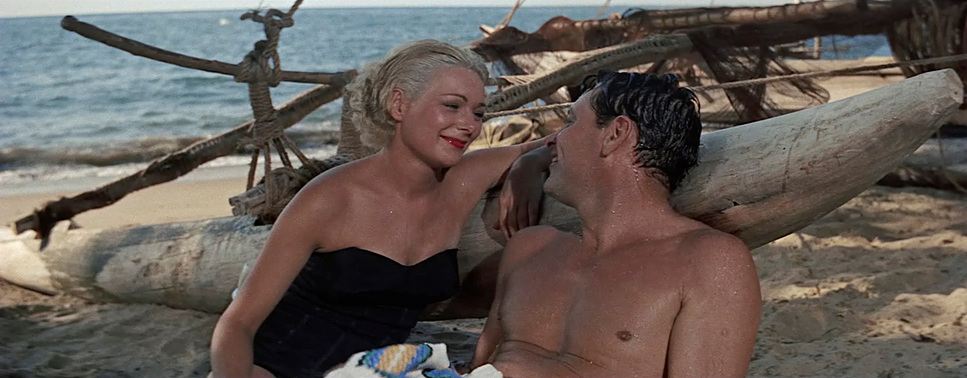
Lighting a film of this magnitude in the late 50s, entirely on location, was a battle against the elements. The lighting style is defined by the hard, high-contrast sunlight of the tropics. This is “hard light” in its truest form unforgiving and exposing.
The sun acts as an oppressor. The exteriors are bright and high-key, conveying the relentless heat that offers no respite for the prisoners. However, the lighting becomes a psychological tool in the interiors, particularly the “Oven” the punishment hut where Nicholson is confined. Here, the film utilizes extreme contrast (chiaroscuro). We see Nicholson in slivers of light cutting through the darkness, or silhouetted against the harsh glare of the open door. It emphasizes his suffering but also his fortitude. The warmth of the light, usually associated with comfort, here feels stifling, a visual representation of the pressure cooker the characters are living in.
Lensing and Blocking
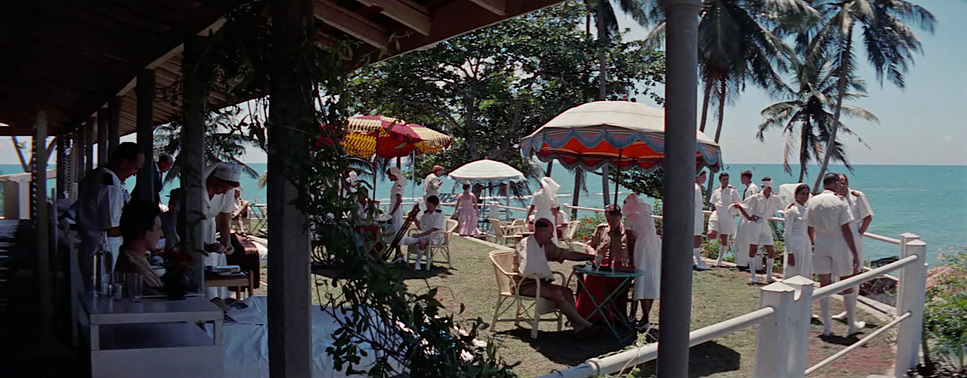
Shot on the massive Mitchell BNC camera using Bausch and Lomb anamorphic lenses, the film carries that distinct vintage anamorphic DNA. You can see it in the subtle barrel distortion at the edges of the wide frames and the way the background falls off. This glass has a specific character that digital sharpness often lacks it softens the reality just enough to make it feel like a fable.
Blocking is where Lean truly exerts control. He treats the actors like pieces on a chessboard. Consider the rigid, upright posture of Nicholson, often placed center-frame, immovable. Contrast this with the mass of soldiers, blocked as a single, fluid entity. As Nicholson gains control over the bridge construction, his blocking becomes more dominant; he strides with purpose, often placed higher in the frame than his Japanese captors. It’s a visual language of power and submission that tells the story before a single line of dialogue is spoken.
Color Grading Approach
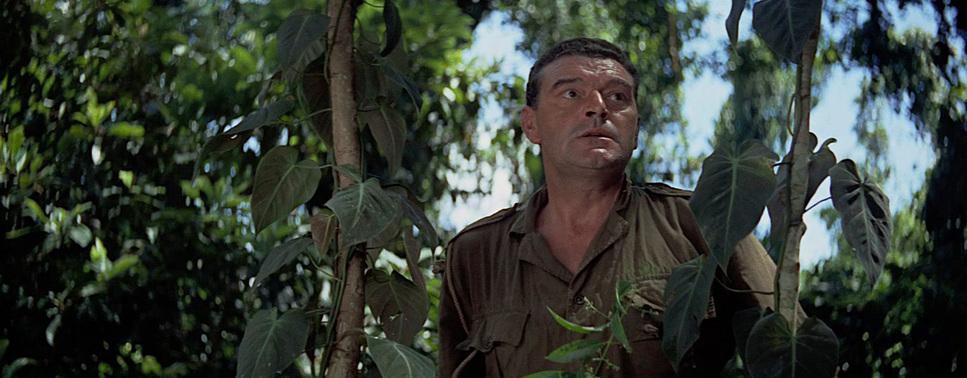
As a colorist, looking at The Bridge on the River Kwai especially in its restored 4K HDR/Dolby Vision format—is fascinating. We are looking at the characteristics of 1950s film stock, likely Eastman Color 5248 (25T). This was a slow stock (ISO 25), meaning it needed massive amounts of light to expose properly.
This technical limitation defines the look. The shadows are dense, and the contrast is naturally high. A modern grade shouldn’t try to “fix” this. My approach would be to honor the density of the print. The “warm” palette mentioned in restoration notes isn’t a mistake; it’s the laterite soil and the tropical sun. The restoration colorist, Sati Tooray, did a fantastic job of retaining the filmic highlight roll-off. You don’t want to recover every detail in the clouds if it flattens the image; you want that creamy, gradual transition to white that makes the heat feel searing.
The greens of the jungle are crucial they need to be separated from the earthy browns of the uniforms and the bridge timbers. It’s about subtractive color mixing: ensuring the skin tones cut through the lush background without looking artificial. The goal is to preserve the organic grain structure and the specific “thick” feel of 50s celluloid.
Technical Aspects & Tools
The Bridge on the River Kwai — Technical Specs
| Genre | Crime, Prison, Drama, Epic, History, Political, Military, War, World War II |
|---|---|
| Director | David Lean |
| Cinematographer | Jack Hildyard |
| Production Designer | Donald M. Ashton |
| Costume Designer | John Wilson-Apperson |
| Editor | Peter Taylor |
| Colorist | Sati Tooray |
| Time Period | 1940s |
| Aspect Ratio | 2.55 – Anamorphic, Cinemascope |
| Format | Film – 35mm |
| Lighting | Hard light, High contrast, Backlight, Edge light |
| Lighting Type | Daylight, Sunny |
| Story Location | Asia > Burma |
| Filming Location | Asia > Sri Lanka |
| Camera | Mitchell BNC |
| Lens | Bausch and Lomb |
| Film Stock / Resolution | 5248 Neg 25T |
The production of Kwai is legendary for being a nightmare, but the technical specs reveal why it looks so good. Shooting on 35mm film with a Mitchell BNC in the humidity of Sri Lanka was a risk. The film stock was fragile, and the anamorphic Bausch and Lomb lenses required precise focus pulling that is incredibly difficult to nail without modern assist tools.
The transfer to 4K Ultra HD Blu-ray reveals the “medium density” grain structure that I love. It proves the image hasn’t been scrubbed of its texture (DNR). The resolution gains allow us to see the texture of the wood and the fabric of the uniforms in a way that previous home video releases couldn’t handle. The audio, remixed in Dolby Atmos, opens up the soundstage adding height to the jungle rain and depth to the explosion but it respects the front-heavy nature of the original mono/stereo stems. It’s a technical triumph that preserves the physical struggle of the filmmaking process.
- Also read: THE IRON GIANT (1999) – CINEMATOGRAPHY ANALYSIS
- Also read: MEMORIES OF MURDER (2003) – CINEMATOGRAPHY ANALYSIS
Browse Our Cinematography Analysis Glossary
Explore directors, cinematographers, cameras, lenses, lighting styles, genres, and the visual techniques that shape iconic films.
Explore Glossary →