When I first walked out of the theater after seeing The Martian, I had a massive smile on my face. It was one of those rare moments where you realize you’ve witnessed a film that perfectly balances nail-biting suspense with defiant optimism. On Mars, Mark Watney (Matt Damon) is stranded and isolated, yet he remains hilarious, finding the humor in his terrifying reality. The cinematography artfully navigates this unique tone balancing the desolate grandeur of the Red Planet against Watney’s unwavering spirit. It’s a testament to the power of craft to not just show the plot, but to make us feel the isolation.
About the Cinematographer
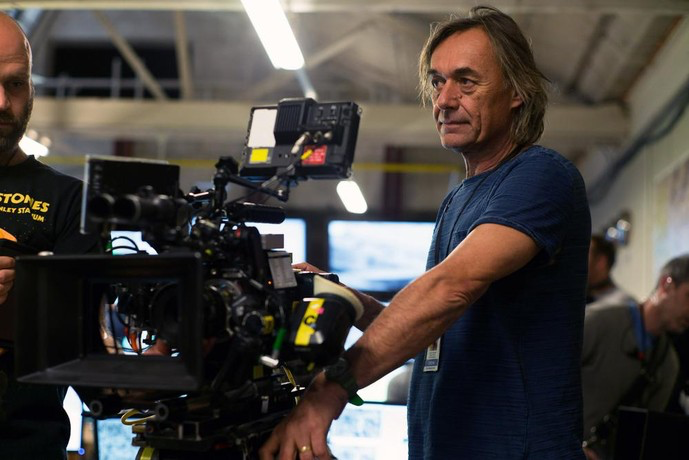
The eye behind the camera for The Martian was Dariusz Wolski, ASC. Wolski is a fascinating DP with a gritty, diverse filmography. He’s a frequent collaborator with Ridley Scott (shooting Prometheus, Exodus, and All the Money in the World) but has also worked with Tim Burton and shot the Pirates of the Caribbean franchise.
What I appreciate about Wolski is his lack of ego regarding “signature styles.” He adapts to the narrative. For The Martian, his challenge was monumental: How do you make a desolate, monochromatic dustbowl feel menacing yet beautiful for two hours, without boring the audience visually?
Inspiration Behind the Cinematography
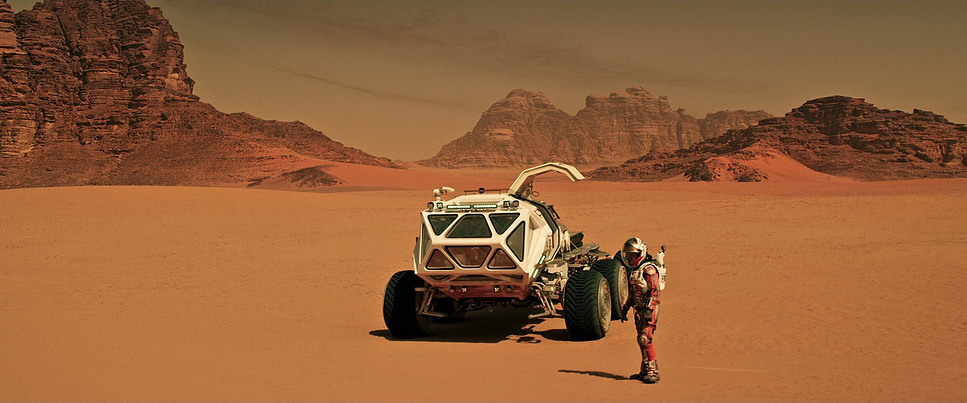
The primary inspiration was twofold: the stark reality of the landscape and the internal resilience of Mark Watney. Ridley Scott has always had a fascination with alien environments he gave us Alien, after all. But unlike the dark, biomechanical horror of that film, The Martian needed to feel grounded and attainable.
Visually, the team aimed for a hyper-realistic depiction of Mars. They shot principal photography in Wadi Rum, Jordan, to capture that vast, indifferent scale. As someone who works with image texture daily, I noticed a deliberate effort to keep the image sharp and legible. The goal was to immerse the audience in Watney’s isolation.
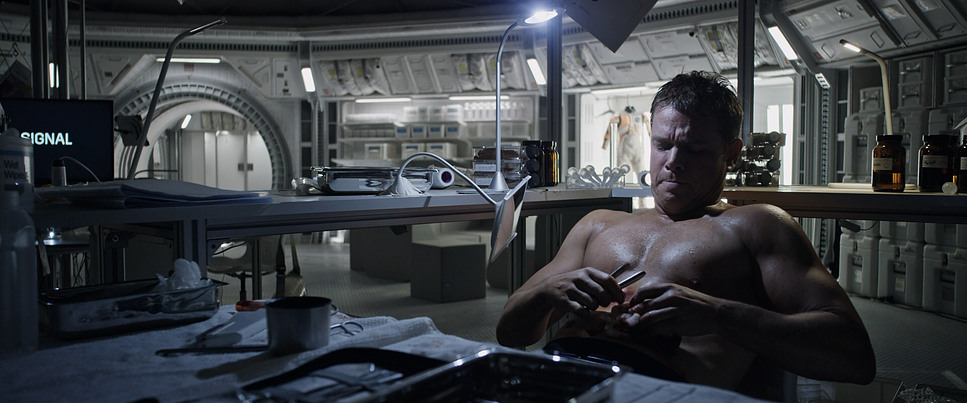
However, the film’s optimistic tone was the guiding light. Watney isn’t wallowing in despair; he’s problem-solving. The cinematography reflects this. It doesn’t hide in the shadows. It emphasizes ingenuity. Even in scenes of suspense, like the self-surgery, the visual information is clear and clinical, mirroring Watney’s methodical approach to survival.
Camera Movements
Wolski’s camera movement in The Martian serves the narrative’s oscillating demands of vastness and intimacy. When we are on the Martian surface, the camera adopts wide, sweeping movements. Often achieved with stabilized heads or aerials, these shots establish the “holy crap, he’s alone” factor. Watney becomes a tiny figure against a majestic, unforgiving backdrop.
Conversely, inside the Habitat (the “Hab”), the camera becomes a silent roommate. We get close-ups that emphasize his focus and the tactile details of his work. There is a lot of handheld work in these confined spaces, but it’s not the shaky-cam “chaos” style often used in action movies. It’s a subtle, breathing handheld that keeps us tethered to Watney’s perspective.
Even during the climactic rescue, the movement retains clarity. We are never lost in the geography of space. The camera always orients us regarding where Watney is relative to the Hermes. It’s a deliberate choice to ensure we are tracking the emotional stakes, even when the physics gets a bit… questionable.
Compositional Choices
Composition here is all about scale. Wolski frequently uses extreme wide shots with a 2.39:1 aspect ratio to place Watney as a mere speck in the frame. The horizon lines are often pushed low or high to create massive negative space, emphasizing that the planet is the dominant character in the scene.
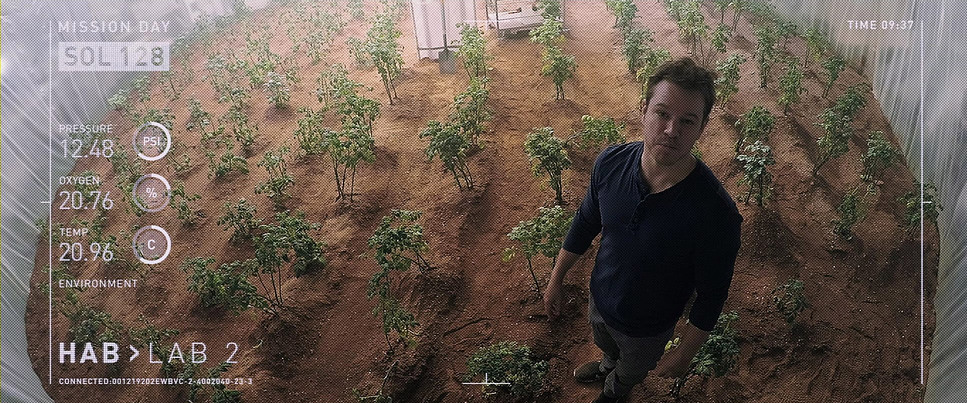
Inside the Hab, the composition shifts to medium shots and close-ups filled with clutter tools, screens, plants. This visual density reinforces the theme of “science-ing the shit” out of the problem. We are forced to look at what he is looking at.
There is also a consistent use of depth. Even in interior shots, the frame is layered with foreground elements (monitor bezels, equipment) and background depth. When the potato farm starts growing, those plants provide a vibrant focal point amidst the metallic, functional background, guiding the eye and adding visual richness to what could have been a very sterile set.
Lighting Style
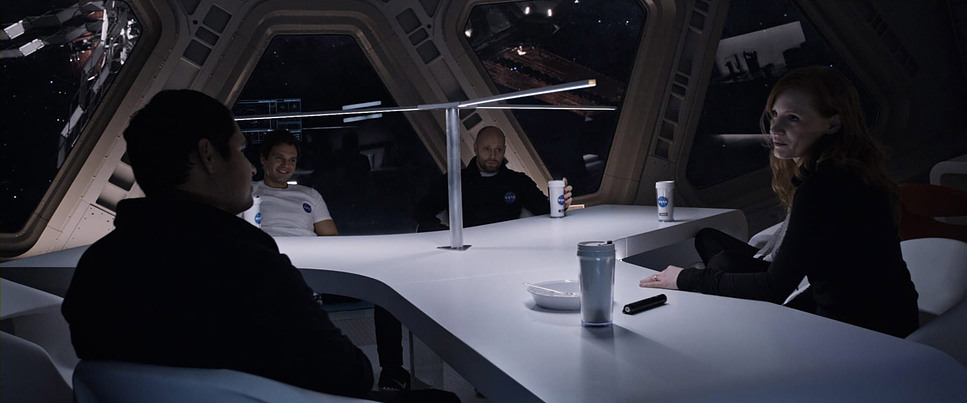
The lighting is one of the film’s most distinct achievements. Wolski opted for a motivated lighting approach rooted in realism. On the surface, the sun is the primary source. To replicate the thin Martian atmosphere, the light is treated as a single, hard source, casting long, sharp shadows. Dr. Neil deGrasse Tyson joked that the film had “San Diego weather,” and while the storms were exaggerated for the plot, the clear, harsh sunlight was a smart visual choice to keep the image crisp.
Inside, the lighting is practical: fluorescent tubes, LED panels, and instrument readouts. It creates a clinical feel, but Wolski softens it with warmer practicals to keep the Hab from feeling like a hospital.
Crucially, the grow lights for the potatoes introduce a specific visual break. The violet/magenta and green hues of the grow lamps cut through the film’s dominant orange/teal palette. From a colorist’s perspective, this is a brilliant way to separate “life” from the “dead” planet outside.
Lensing and Blocking
This is where the film deviates from the standard “cinematic sci-fi” playbook. While many space epics opt for anamorphic lenses to get those horizontal flares, Wolski and Scott shot The Martian on spherical lenses specifically Zeiss Ultra Primes and Angenieux Optimo Zooms.
Why spherical? Because Ridley Scott shot the film in native 3D using 3ality Technica rigs. Shooting 3D on anamorphic glass is a technical nightmare due to distortion differences between the eyes. By using high-end spherical glass, they achieved a pristine, distortion-free image that felt almost documentary-like in its sharpness. It suited the material perfectly this isn’t a space opera; it’s a survival log.
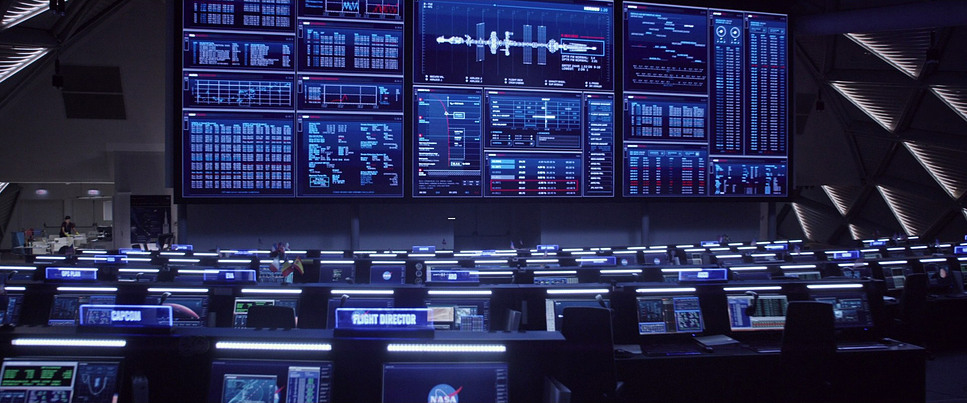
Blocking further emphasizes this. On Mars, Watney is almost always blocked in the center of a void. Inside, he is constantly moving, interacting with his environment. In contrast, the Earth-based scenes at NASA feature complex group blocking people standing in clusters, looking at screens, debating. The visual language creates a binary: Solo struggle vs. Collective effort.
Color Grading Approach
Now, let’s talk about the grade. The color for The Martian was handled by the legendary Stephen Nakamura at Company 3, a longtime collaborator of Ridley Scott.
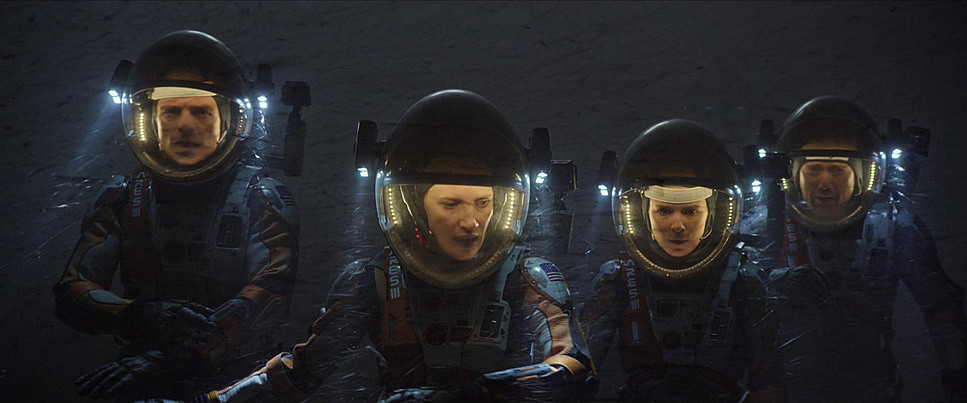
The challenge here was obvious: Mars is orange. If you wash the whole screen in orange, the audience gets visual fatigue, and skin tones look terrible. Nakamura’s work here is sophisticated. He maintains the hue separation. The Martian landscapes are a saturated, rusty orange, but the shadows often dip into a cooler, deep brown or violet, preventing the image from looking flat.
Most importantly, the skin tones remain relatively naturalistic, even in exterior shots. They didn’t just slap a sepia filter on the lens; they carefully keyed the skin to ensure Matt Damon’s performance wasn’t lost in the red dust.
There is also a classic “Ridley Scott” duality in the palette:
- Mars: Warm, Orange, Red, hostile but bright.
- NASA/Space: Cool blues, teals, and sterile whites.
This color contrast creates an immediate subconscious geographic marker for the audience. We instantly know where we are based on the color temperature of the frame.
Technical Aspects & Tools
The Martian: Technical Specs
| Genre | Adventure, Drama, Science Fiction |
|---|---|
| Director | Ridley Scott |
| Cinematographer | Dariusz Wolski |
| Production Designer | Arthur Max |
| Costume Designer | Janty Yates |
| Editor | Pietro Scalia |
| Colorist | Stephen Nakamura |
| Time Period | Future |
| Color | Warm, Saturated, Orange |
| Aspect Ratio | 2.39 |
| Format | Digital |
| Lighting | Side light |
| Story Location | Mars |
| Camera | RED Epic Dragon |
| Lens | Zeiss Ultra Prime, Angenieux Optimo Zooms |
The film was shot primarily on RED Epic Dragon cameras at 6K resolution. This high-resolution capture was essential, not just for the detail, but for the flexibility it gave in post-production for reframing and stabilization—especially helpful when integrating the live-action footage with the extensive VFX work.
Speaking of VFX, the integration of the Wadi Rum location plates with the CGI Martian atmosphere (handled by MPC and The Senate) is seamless. The sky replacements adding that thin, butterscotch-colored haze are what sell the location.
Because the film relied so heavily on 3D rigs and complex VFX, the workflow would have been incredibly robust, likely involving a heavy reliance on a calibrated DI (Digital Intermediate) pipeline to ensure the practical sets matched the digital extensions perfectly.
- Also read: DEADPOOL (2016) – CINEMATOGRAPHY ANALYSIS
- Also read: GUARDIANS OF THE GALAXY (2014) – CINEMATOGRAPHY ANALYSIS
Browse Our Cinematography Analysis Glossary
Explore directors, cinematographers, cameras, lenses, lighting styles, genres, and the visual techniques that shape iconic films.
Explore Glossary →