he Great Escape isn’t just an academic exercise; it’s a look into the bedrock of visual storytelling. The Great Escape is more than just an iconic war film; it is a masterclass in how cinematography can elevate narrative and dictate the emotional rhythm of a story. What John Sturges, Daniel Fapp, and the crew accomplished in 1963 still resonates, and seeing it through the lens of the recent 4K restoration forces you to appreciate the craft even more. Roger Ebert once said this film “should seem new, every time you see it,” and honestly, with each viewing, I find myself discovering new layers in its visual language.
About the Cinematographer
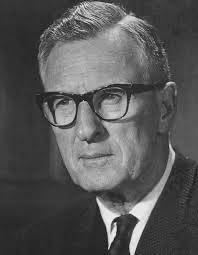
The man behind the lens was Daniel L. Fapp, ASC, a seasoned cinematographer known for bringing a robust, almost documentary-like authenticity to his subjects without sacrificing scale. For The Great Escape, Fapp faced a unique challenge: making a large ensemble cast feel intimate while simultaneously conveying the vast, oppressive nature of a prisoner-of-war camp. His approach here feels less about stylistic flourishes and more about a disciplined, observational eye. He captures the harsh realities of the camp with a practicality that serves the collective story rather than highlighting individual ego.
Inspiration Behind the Cinematography
The core inspiration for the look stems directly from the narrative’s inherent conflict: the stubborn human desire for freedom against overwhelming odds. Sturges viewed this film less as a war story and more as a “curative downer” a testament to perseverance rather than victory. The visual style balances moments of rousing optimism with a stark, dusty reality. You see wide, encompassing shots emphasizing the collective struggle, contrasted with glimpses of individual defiance. It acts as a visual metaphor for their unified purpose: a group of men fighting to maintain their sanity under the constant threat of retribution.
Camera Movements
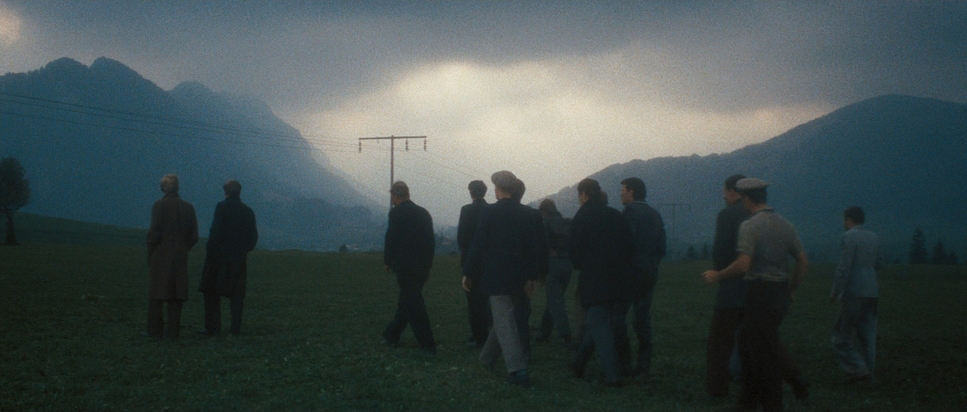
One of the most striking aspects of The Great Escape is Sturges’s deliberate refusal to use intense close-ups. By avoiding tight framing, Fapp’s camera forces the audience to observe the group dynamic rather than getting lost in individual emotion. This isn’t just a stylistic quirk; it is a profound statement on camaraderie in this camp, no one suffers or succeeds in isolation.
Camera movements are consequently precise and motivated. Instead of quick cuts or jarring handheld work, we see deliberate dollies and pans that reveal the sprawling camp or track the men as they dig, forge, and exist. When a character moves, the camera follows with a steady, almost detached grace. This sustained perspective allows us to feel like embedded observers. For instance, in the “hooch-making scene” for American Independence Day, the camera is fluid, capturing the jovial atmosphere across a broader plane. We see multiple reactions simultaneously, which perfectly sets up the sudden horror of the tunnel’s discovery without relying on rapid-fire editing.
Compositional Choices
Following the mandate to avoid close-ups, the compositional choices are heavily geared towards framing the ensemble. We are often presented with deep-focus shots that keep the main characters and their environment equally sharp. Fapp wasn’t just composing for faces, but for the spatial relationships between men and their surroundings the barracks, the wire, and the open parade ground.
This creates a visual hierarchy without needing heavy-handed direction. Consider the scene where Blithe (Donald Pleasance) is told he can’t participate in the escape. The blocking tells the whole story: Bartlett and Blithe stand opposite each other, then Blithe sits, defeated, while Hendley (James Garner) observes from a bunk before rising to interject. Fapp holds a medium-wide shot here, allowing us to see not just the expressions but the body language and positioning within the cramped barracks. The horizontal lines of the bunks and the vertical bars of the windows create subtle depth cues, acting as a constant, subliminal reinforcement that these men are trapped.
Lighting Style
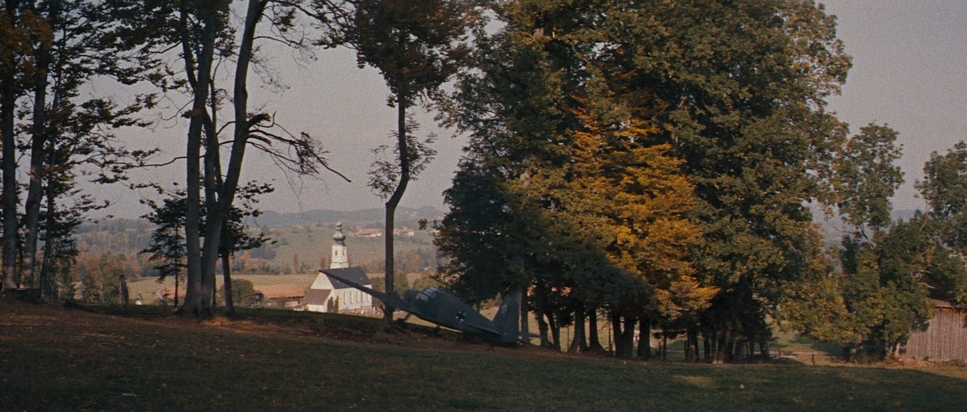
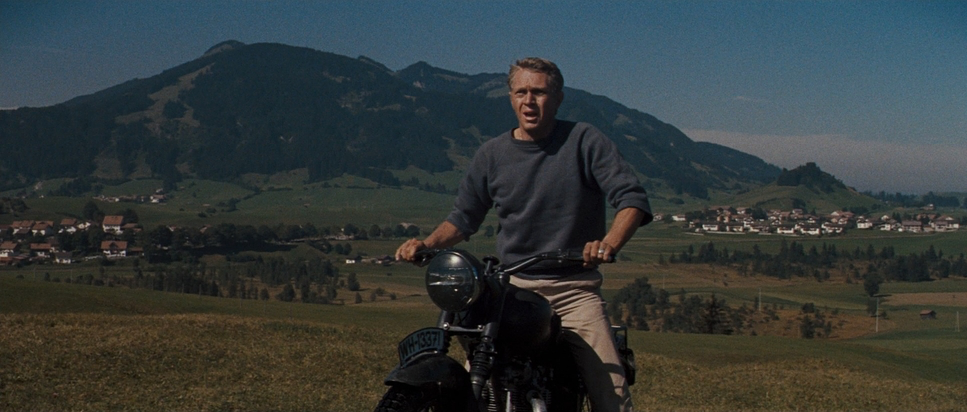
The lighting feels largely naturalistic, adhering to the authenticity required for a historical drama, but with a specific tonal quality. For the exteriors shot in the German countryside (near Munich and Füssen), Fapp employed a broad, high-key approach that feels intentionally desaturated. The sunlight isn’t warm and inviting; it’s harsh and exposing. The camp is visually stripped of vibrant color, leaving a palette of dusty browns and greens that emphasizes the drudgery of containment. Shadows during the day are sharp and revealing there is nowhere to hide.
However, the tone shifts when we move to the tunnels. Here, the lighting becomes motivated and dramatic. The flickering lamplight provides a stark contrast to the bleached-out daylight, creating deep shadows that emphasize claustrophobia. But as a colorist, what I find interesting is that the tunnels aren’t bathed in a hopeless, crushed black. There is always a glimmer a sense of purposeful work. It aligns with the film’s theme of “unrelenting optimism.” The darkness is punctuated by the determined gleam in a miner’s eye (drawing on Charles Bronson’s real-life coal mining experience). It’s a nuanced approach that ensures even in the dark, the human spirit is never fully extinguished.
Lensing and Blocking
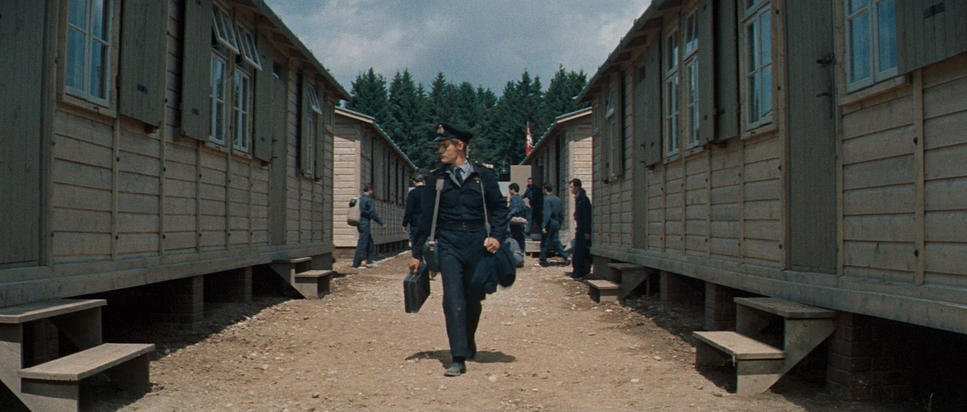
Given the preference for wide shots, Fapp’s lensing choices were critical. He likely relied on wider anamorphic lenses to keep multiple characters in the frame while maintaining the epic aspect ratio. This allows for complex blocking where interactions unfold across the screen, rather than in isolation.
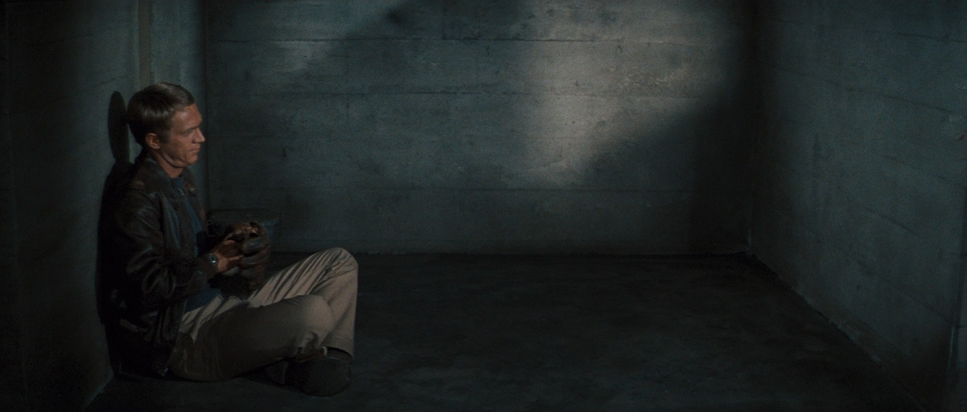
The blocking often dictates the power dynamics. Take the argument between Hendley and Bartlett regarding Blithe. Hendley starts as a passive observer but rises from his bunk to confront Bartlett. This shift in the vertical plane, captured in a wide shot, visually demonstrates his assertion of authority. It’s not about zooming in on a face for emphasis; it’s about physical movement within a defined space. Similarly, Steve McQueen’s Hiltz is often framed in the cooler to emphasize his solitary defiance, using the cell walls as compositional elements. The choice of wider glass also works beautifully for the external action, like the motorcycle chase, allowing the sweep of the landscape to contribute to the visual narrative of the pursuit.
Color Grading Approach
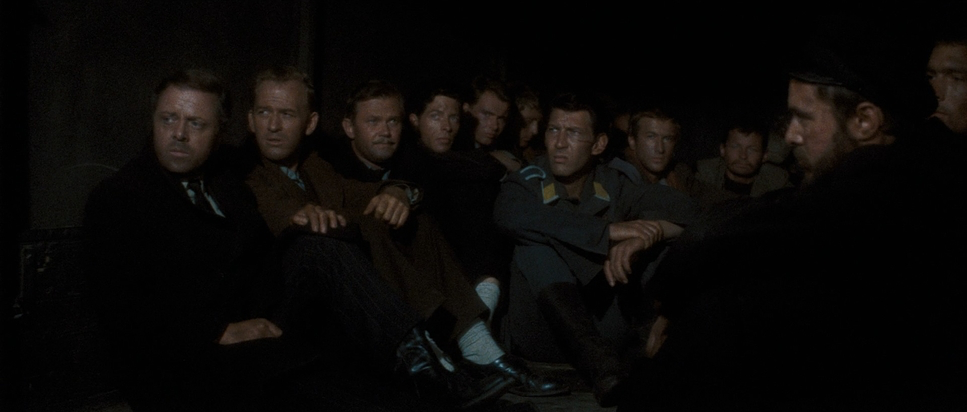
Restoring a film from 1963 is a delicate balancing act. The Criterion 4K restoration mentions “improved color timing,” but for a professional colorist, “natural” on a vintage print means something specific. It doesn’t mean modernizing the look; it means honoring the original Eastmancolor negative sensibilities.
My approach to analyzing this grade focuses on how it preserves the film’s “soul” the grain structure and the density. The restoration apparently utilized personal prints owned by Martin Scorsese and Quentin Tarantino as references. This is a massive detail. It suggests the goal was to replicate the specific theatrical experience of the 60s, not to sanitize it. The palette is appropriately desaturated skin tones are authentic but not overly vibrant, and the military uniforms have that correct, drab separation.
Crucially, the highlight roll-off in the bright exterior shots maintains that distinct filmic quality. The bright skies and sun-drenched fields gently clip rather than losing detail abruptly. Tonal sculpting here is about preserving the grain which is “intact and appropriate” and shaping the contrast to maintain depth without crushing the blacks. It’s about letting the light and shadow speak for themselves while ensuring the color palette supports the emotional shift from triumph to tragedy without feeling forced or digitally manipulated.
Technical Aspects & Tools
The Great Escape
Technical Specifications| Genre | Adventure, Crime, Prison, Drama, Epic, History, Political, Thriller, Military, War, World War II, Action |
|---|---|
| Director | John Sturges |
| Cinematographer | Daniel L. Fapp |
| Production Designer | Fernando Carrere |
| Costume Designer | Bert Henrikson |
| Editor | Ferris Webster |
| Time Period | 1940s |
| Color | Desaturated |
| Aspect Ratio | 2.35 – Anamorphic |
| Lighting | Hard light |
| Lighting Type | Daylight, Sunny |
| Story Location | Europe > Germany |
| Filming Location | Germany > Bavaria |
| Camera | Panavision Cameras |
| Lens | Panavision Auto Panatar, Panavision Lenses |
Shot in Panavision on 35mm film, the production utilized the standard large-scale format of its time. This format inherently provided a richness and texture that digital acquisition still strives to emulate. The optical characteristics of the Panavision lenses the flare, the fall-off, the bokeh all contribute to the film’s distinctive, anamorphic look.
The journey to the 4K Blu-ray is a testament to preservation technology. Scanning the original negatives at high resolution captures every nuance of the film grain. The improvements in clarity noted in reviews are direct benefits of this process. The “softness here and there” is simply an honest reflection of the source material optics in the 60s weren’t clinically sharp like modern lenses. Importantly, the restoration didn’t scrub the grain away (a common mistake known as DNR), but preserved it as an integral part of the image texture. The blend of location shooting and studio work at Bavaria Studio required meticulous matching by the technical crew, a feat that stands up remarkably well even at 4K resolution.
- Also read: THE ELEPHANT MAN (1980) – CINEMATOGRAPHY ANALYSIS
- Also read: THE ELEPHANT MAN (1980) – CINEMATOGRAPHY ANALYSIS
Browse Our Cinematography Analysis Glossary
Explore directors, cinematographers, cameras, lenses, lighting styles, genres, and the visual techniques that shape iconic films.
Explore Glossary →