Rush is essentially a character study draped in the spectacle of 1970s Formula One. The rivalry between James Hunt and Niki Lauda is the engine here. Ron Howard and screenwriter Peter Morgan navigated the line between historical fact and dramatic necessity, maintaining an authenticity that Lauda himself championed, even if they amplified the personal animosity for the screen. It balances the gritty realism of the sport with the heightened drama of a memory, and the visual approach had to bridge that gap.
About the Cinematographer
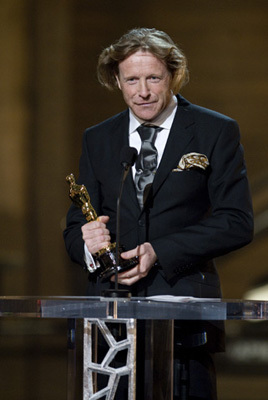
The man behind the look was Anthony Dod Mantle, a DP synonymous with a raw, kinetic aesthetic. He isn’t known for polished, classical beauty; he’s known for the visceral energy of films like Slumdog Millionaire and Antichrist. Bringing him onto a Ron Howard production was a brilliant, disruptive choice. Mantle understands how to make digital sensors feel organic. He brought an edge a documentary-like immediacy that elevated the film beyond a standard period piece. It’s a fusion of a seasoned storyteller (Howard) and a visually adventurous cinematographer (Mantle) that prevents the film from feeling like a dusty museum exhibit.
Inspiration Behind the Cinematography
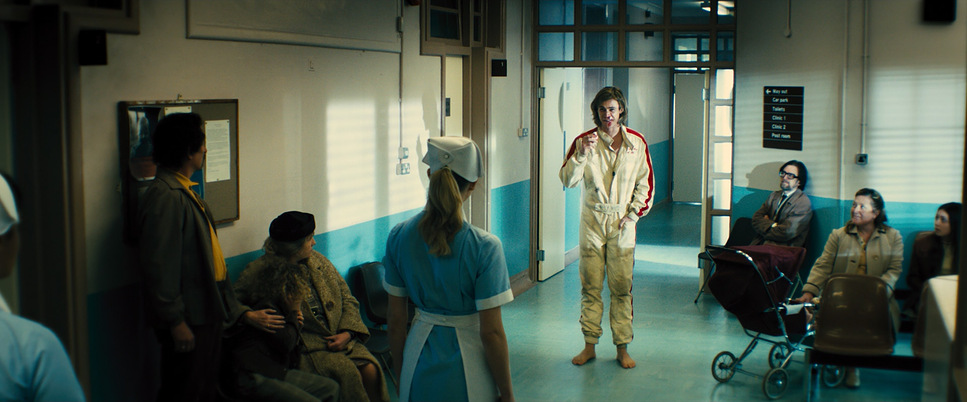
The inspiration clearly stems from the era itself the high-contrast, grainy photojournalism of the 1970s Formula One circuit. You can feel the influence of newsreels and the very real danger that defined the sport. The film starkly notes, “if you make a mistake, you die,” and that anxiety is baked into the visual decisions.
The duality of the characters Hunt the wild card, Lauda the calculator serves as the visual anchor. We often see Hunt in warmer, chaotic environments, while Lauda exists in a cooler, controlled visual sphere. The filmmakers knew this rivalry was the story, so the visuals articulate it constantly. The movie touches on the reality that “driving seemed to be probably 10% of actually what happened… the rest of it was mainly shagging and political stories.” The cinematography captures that specific texture: a raw, unpredictable world where glamour and death were neighbors.
Camera Movements
The camera movement in Rush is about controlled chaos. Mantle employed a diverse palette to convey speed. We see a lot of dynamic handheld work, giving the scenes a vérité feel that places you inside the event rather than observing it from a distance.
The whip pans are particularly effective during overtakes, blurring the world to make the velocity feel tangible. Car-mounted cameras are essential here, but it’s the variety of mounting points that stands out aggressive front-facing POVs and tight shots on tires gripping the asphalt. There is a valid critique, noted in the Inside Evo review, that despite the camera tricks, the cars don’t always look like they are doing true 200mph speeds. However, Mantle compensates for this with a rhythmic edit, constantly shifting between the subjective claustrophobia of the driver and objective, sweeping wide shots of the track.
Compositional Choices
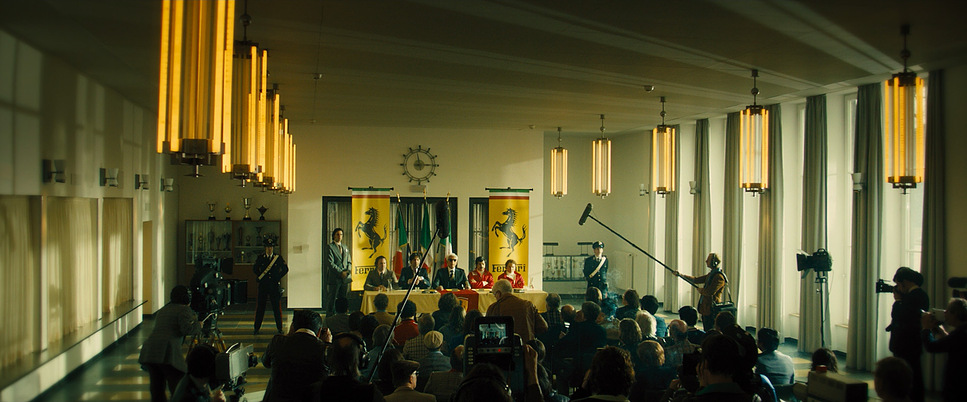
The composition creates a tension between intimacy and spectacle. During the racing sequences, Mantle often uses wide-angle lenses remarkably close to the action. This emphasizes the asphalt and the tire spray, using distortion to heighten the sense of power.
Conversely, for the character moments, the framing tightens. Close-ups on Hunt’s expressive face or Lauda’s analytical gaze communicate their internal states. There is a great use of depth cues, layering foreground elements like barriers or mechanics to make the frame feel deep and busy. When Lauda is recovering in the hospital, the framing isolates him, using negative space to emphasize his pain and determination. The way they frame the drivers within their cockpits sometimes just showing their eyes reminds us that they are both gladiators and prisoners of their machines.
Lighting Style
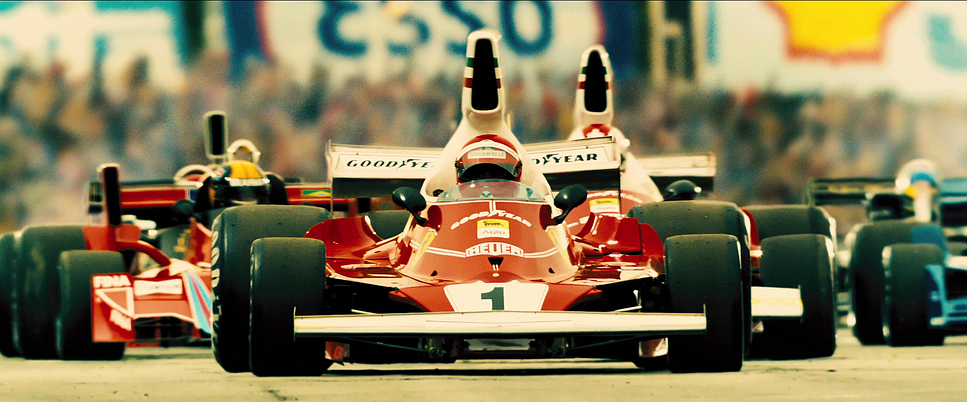
The lighting is a dynamic force here. For the race sequences, the lighting is often hard and naturalistic, embracing the harsh sunlight and reflective surfaces of the cars. It feels authentically daylight-driven. However, they aren’t afraid to let shadows fall harshly on faces inside helmets to build tension.
Where the lighting truly works is in the contrast between the two men. Hunt’s world is lit with practical sources warm tungsten in bars and parties giving him a glowing, effortless charm. Lauda is frequently presented in cooler, starker light, reflecting his methodical nature.
The hospital sequence following Lauda’s accident is the most profound example. It shifts to a high-contrast style, almost unflattering. His burns are revealed in harsh light, emphasizing the physical texture of his pain. As he recovers, the light softens slightly, signaling his resilience. It’s a narrative arc told entirely through the quality of light.
Lensing and Blocking
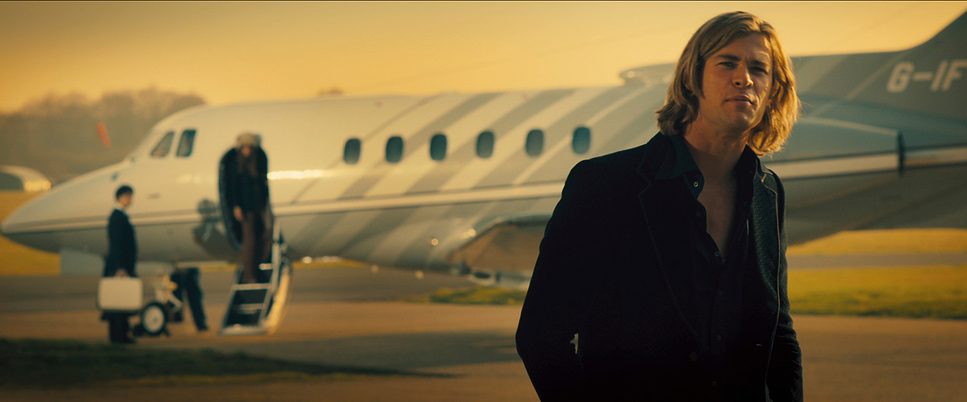
Technically, Rush takes an interesting route. While many period films reach for anamorphic glass to induce nostalgia, Mantle largely shot Rush on Zeiss Master Primes modern, sharp, spherical lenses. He then cropped the image to the 2.40:1 aspect ratio. This choice avoided the heavy distortions and flares of anamorphic, keeping the image grounded and raw. The “vintage” feel comes from the lighting and grade, not the optical aberrations of the glass.
Blocking plays a huge role in establishing dominance. Hunt often occupies open spaces, his movements expansive, commanding the room. Lauda, especially early on, is positioned more deliberately, observing from the periphery. In the scene where Hunt confronts Lauda after his return, the distance between them and their tentative physical gestures underscore the emotional weight of the reunion. It balances the physical presence of Chris Hemsworth against Daniel Brühl’s more wiry frame without letting one overpower the other.
Color Grading Approach
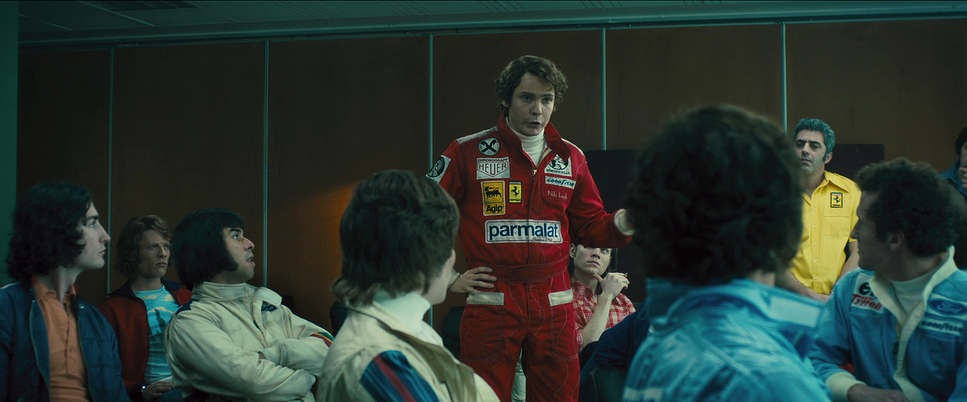
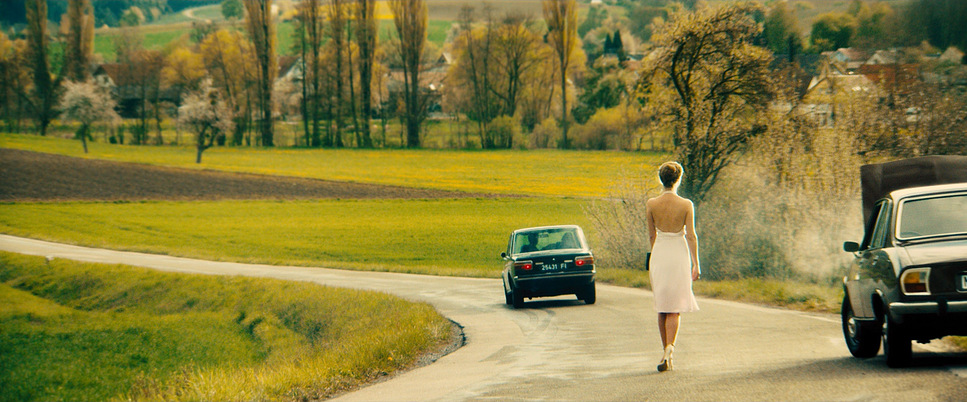
As a colorist, this is where Rush really shines. The grading is central to the storytelling, establishing a warm, desaturated, almost sun-bleached 1970s aesthetic.
The contrast shaping is excellent. Race scenes feature vibrant reds (Ferrari) and golds that pop against muted track backgrounds, but the saturation is mapped carefully to density. The Ferrari red is deep and rich, not a digital, neon orange. The hue separation is distinct; the whites on the McLaren cars carry a slight creamy warmth rather than a sterile digital white.
The tonal sculpting around faces is meticulous. In the hospital scenes, the grade emphasizes the contours of Lauda’s disfigurement, giving it a tactile quality. The highlight roll-off is handled beautifully the “knees” of the highlights are soft, mimicking the response of print film rather than the harsh clipping of digital video. They maintained detail in the blacks rather than crushing them, preserving a wide dynamic range that feels organic.
Technical Aspects & Tools
Rush (2013) – Technical Specifications
| Genre | Action, Drama |
| Director | Ron Howard |
| Cinematographer | Anthony Dod Mantle |
| Production Designer | Mark Digby |
| Costume Designer | Julian Day |
| Editor | Daniel P. Hanley |
| Time Period | 1970s |
| Color Palette | Mixed, Saturated, Red, Cyan |
| Aspect Ratio | 2.39 (Spherical) |
| Format | Digital |
| Lighting Style | Hard light |
| Lighting Type | Daylight, Overcast |
| Story Location | Earth > Europe |
| Filming Location | Earth > Europe |
| Camera | ARRI ALEXA Classic / Plus |
| Lens | Zeiss Master Primes |
From a technical standpoint, Rush utilizes the ARRI ALEXA system to great effect. The Alexa’s dynamic range was crucial for handling the extreme contrast of bright outdoor tracks and dark cockpits simultaneously.
While they used various tricks to sell the speed (like overcranking for slow motion), the discipline in the image capture is what holds it together. By using spherical lenses (the Master Primes), they kept the resolution high and the geometry clean, allowing the post-production team to push the grade further without the image falling apart. The rigging for the car sequences allowed cameras to be placed in virtually every position, immersing us in the “Green Hell” of the Nürburgring. The ability to film on the real track further anchored the authenticity.
- Also read: FORD V FERRARI (2019) – CINEMATOGRAPHY ANALYSIS
- Also read: THREE BILLBOARDS OUTSIDE EBBING, MISSOURI (2017) – CINEMATOGRAPHY ANALYSIS
Browse Our Cinematography Analysis Glossary
Explore directors, cinematographers, cameras, lenses, lighting styles, genres, and the visual techniques that shape iconic films.
Explore Glossary →