Million Dollar Baby resonates with me deeply not just for its powerful performances, but for the sheer discipline of its visual craft. Clint Eastwood, acting as director, producer, and composer, stamped his singular vision on this picture. It is a masterclass in how subtle, often understated cinematography can serve a raw, emotionally complex narrative.
On a first watch, it might appear to be a traditional boxing movie a spiritual cousin to Rocky. But it quickly pivots, becoming something far unique and introspective. This shift, from a familiar underdog narrative to a profound exploration of pain and choice, is mirrored in the cinematography. It’s a film that demands attention not with flashy camera work, but with a quiet, observational power that allows its characters to breathe.
About the Cinematographer

The visual language of Million Dollar Baby is defined by the collaboration between Eastwood and his long-time cinematographer, Tom Stern. Having shot nearly all of Eastwood’s films since Blood Work, Stern has forged a distinct aesthetic with the director. His approach here is stark, naturalistic, and intentionally de-glamorized, favoring practical light and a “less-is-more” philosophy. Stern understands that the most powerful image isn’t always the most elaborately lit, but the one that feels most honest. It’s a testament to how a consistent artistic relationship can produce a signature look where the visuals never compete with the story.
Inspiration Behind the Cinematography
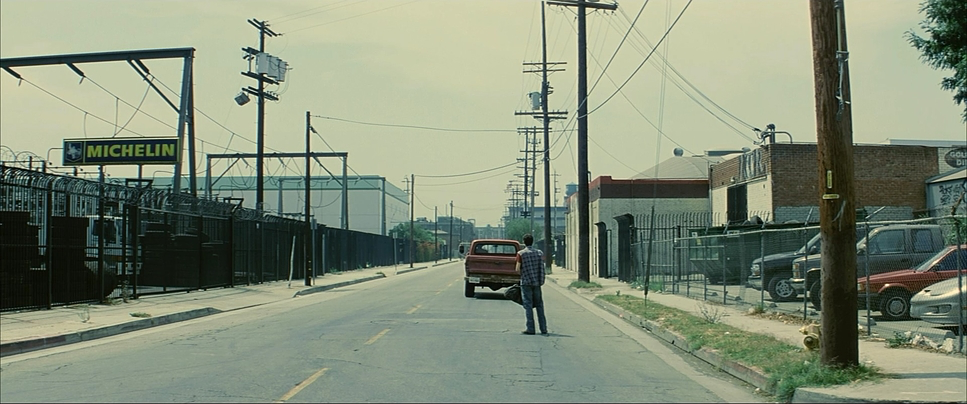
The visual inspiration stems from the film’s thematic core: the internal struggles of the characters and the brutal world of boxing. Morgan Freeman’s character, Scrap, narrates how boxing is an “unnatural” sport, and this tension forms the bedrock of the visual style.
The aesthetic leans heavily into realism, almost documentarian in its observation of the gym, the fights, and the quiet moments between Frankie and Maggie. The gym scenes possess a distinct dark, grimy quality that instantly signals this isn’t a world of pristine, aspirational glory. It’s a place of sweat and faded dreams. The cinematography doesn’t just show us the action; it makes us feel the weight of Frankie’s estrangement and Maggie’s relentless climb. It’s an empathetic lens, connecting us to the raw, unspoken emotions beneath the surface.
Camera Movements
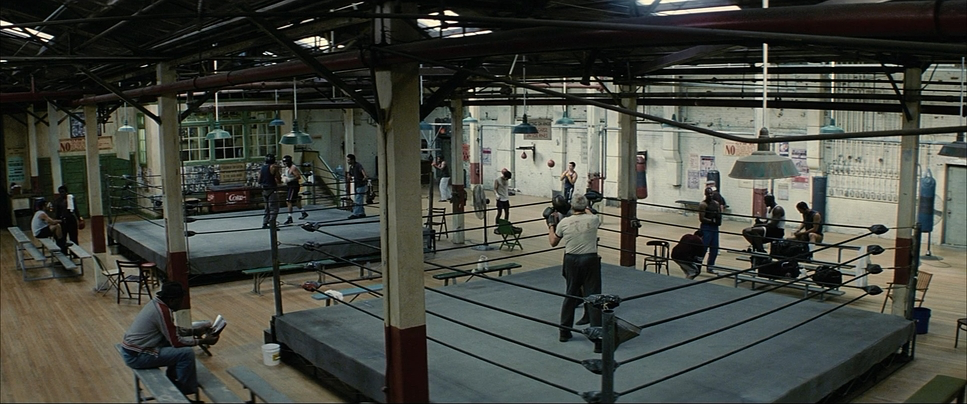
Eastwood and Stern employ camera movements with beautiful economy. There are no gratuitous moves here. Instead, the camera operates with quiet precision, often holding static frames that allow the drama to unfold within the composition. This stillness forces the audience to engage with the subtext rather than being distracted by visual gymnastics.
When the camera does move, it is strictly motivated by character. In the boxing sequences, we see a more dynamic, handheld approach, placing us right in the action to feel the impact of every punch. Yet, even here, there is restraint. A slow dolly might underscore a moment of dawning realization, or a subtle pan might reveal a character’s isolation. These movements act as visual punctuation. The camera becomes an invisible observer, letting the story breathe without imposing itself.
Compositional Choices
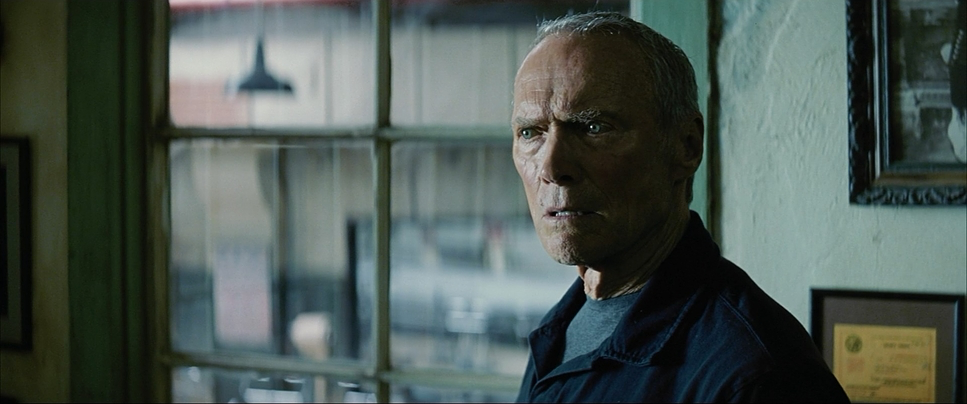
Composition in Million Dollar Baby is masterful in its simplicity. Stern frequently uses wide shots to establish the grittiness of the gym or the starkness of Maggie’s rural upbringing, contrasting the expansive emptiness with the intense focus of her ambition. Close-ups are reserved for moments of intense emotion, allowing us to peer into the inner lives of Frankie, Maggie, and Scrap.
I particularly appreciate the use of negative space. Characters are often framed small or isolated within their environments, reinforcing their underdog status. Frankie, with his stoic exterior, is frequently framed alone, his gruffness softened by visual isolation that hints at his unspoken pain. We often see characters “half encumbered by shadow” especially Frankie which visually reinforces his guarded nature. The compositions are active participants in the storytelling, revealing and concealing with equal intent.
Lighting Style
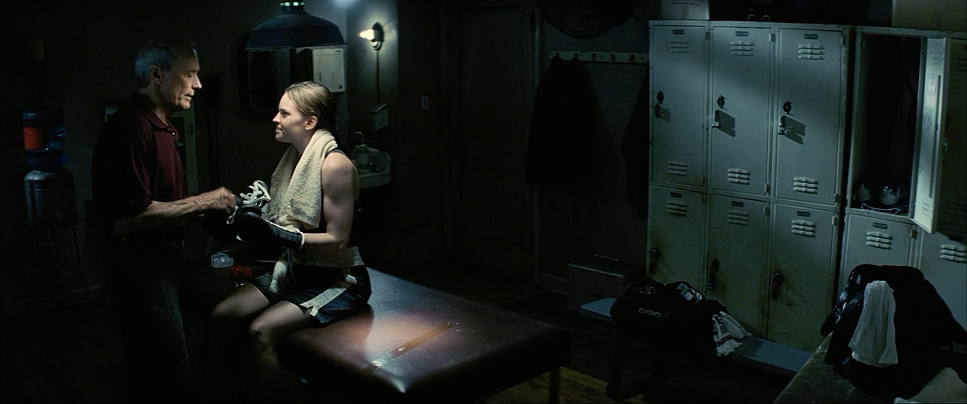
The lighting is a study in motivated naturalism and high-contrast drama. The “noir” feel of the gym scenes is a deliberate choice, utilizing hard top-lighting to create pools of exposure and deep, enveloping shadows. This isn’t about making everything visible; it’s about crafting a specific mood.
The shadows are an active element of the narrative. They obscure, create mystery, and emphasize internal states. When Frankie grapples with his faith or his impossible choices in the final act, the lighting plunges him into deep chiaroscuro, his face half-hidden. Even in the boxing ring usually a place of harsh, even illumination—Stern maintains pockets of shadow, making the fights feel less like a spectacle and more like a visceral confrontation. This grounds the film in a stark reality where light is scarce, forcing the characters to confront what lies in the darkness.
Lensing and Blocking
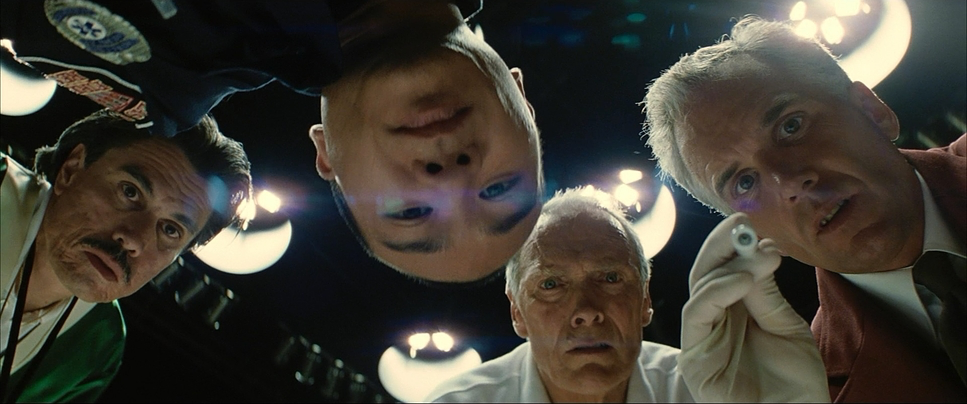
Contrary to the “documentary” feel that might suggest spherical lenses, Stern actually shot Million Dollar Baby using Panavision C Series anamorphic lenses. This choice is fascinating. Rather than using anamorphic for its blockbuster flair or lens flares, Stern utilizes the 2.39:1 aspect ratio to emphasize isolation.
The wide anamorphic frame allows Eastwood to place characters in vast negative space. We see the scale of the boxing arena swallowing Maggie, or the distance between Frankie and Scrap even when they share a room. The shallow depth of field inherent to these lenses focuses our attention strictly on the performance, letting the background fall into a textured blur.
Blocking is equally deliberate. In the gym, Frankie and Scrap often occupy distinct parts of the frame, their friendship played out across a physical distance. As Maggie enters their lives, the blocking shifts; she physically inserts herself into their space until the three are framed together, signifying a surrogate family unit. When the narrative shifts to the hospital, the camera angles change viewing Maggie from high angles to emphasize vulnerability, or low angles to highlight Frankie’s helplessness.
Color Grading Approach
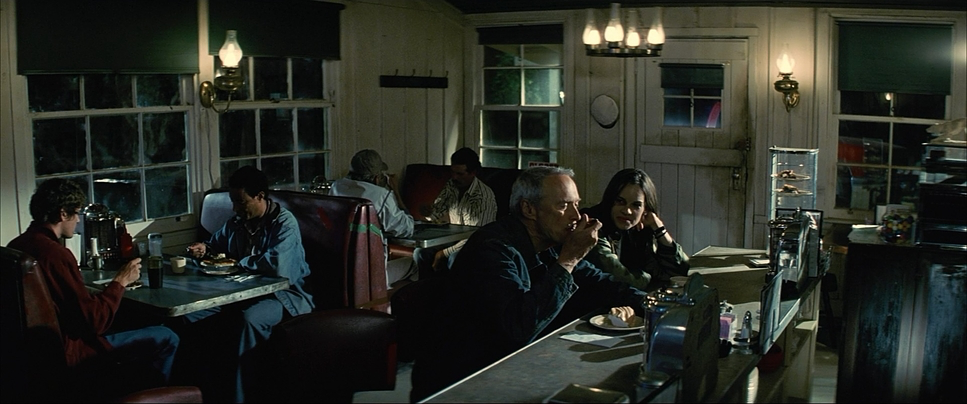
From a colorist’s perspective, the grading in this film is bold and uncompromising. The palette is dominated by desaturated blues, greens, and browns a “lifeless” teal palette that is absolutely fundamental to the film’s emotional logic.
This isn’t a film that was accidentally desaturated. The muted, almost monochrome look mirrors the hard lives of the characters. The cool tones, often with a subtle teal push in the shadows and mid-tones, strip away any romanticized view of the “American dream.” It emphasizes the grit and the unforgiving nature of their existence.
The contrast shaping is crucial. The film employs a low-key, high-contrast look with deep blacks and stark highlights. This tonal sculpting accentuates the shadows, reinforcing the theme of characters living in the dark. The highlight roll-off is smooth, avoiding harsh clipping, which contributes to a believable, filmic texture. By desaturating the hues, the film achieves a timeless, almost print-film sensibility. The lack of vibrant color isn’t a flaw; it’s a choice to immerse us in a world where warmth is rare, making the few moments of connection feel even more resonant.
Technical Aspects & Tools
Million Dollar Baby — Technical Specifications
| Genre | Drama, Action, Family, Sports, Melodrama, Fatherhood |
|---|---|
| Director | Clint Eastwood |
| Cinematographer | Tom Stern |
| Production Designer | Henry Bumstead |
| Costume Designer | Deborah Hopper |
| Editor | Joel Cox |
| Colorist | Kurt Smith |
| Time Period | 2000s |
| Aspect Ratio | 2.39 – Anamorphic |
| Format | Film – 35mm |
| Lighting | Hard light, High contrast, Top light |
| Story Location | California > Los Angeles |
| Filming Location | California > Los Angeles |
| Camera | Panavision Platinum |
| Lens | Panavision C series |
| Film Stock / Resolution | 5246/7246 Vision 250D, 5279/7279 Vision 500T |
Million Dollar Baby was shot on 35mm film, specifically likely using Kodak Vision 2 stocks (5246/5279), which naturally lend themselves to the classic, gritty texture we see on screen. The film stock provides a grain structure and dynamic range that digital sensors of the time couldn’t replicate, especially in the way it handles the fall-off into the deep shadows of the gym.
Utilizing Panavision Platinum cameras and the aforementioned C Series lenses, the team balanced technical reliability with artistic intent. The robust nature of the Panavision system allowed for versatile shooting from static wides to handheld ring work without compromising image quality. The choice of 35mm over digital was essential here; the organic way film renders skin tones and shadows suits the somber, human tone of the picture. It allows the raw, physical reality of the story to shine through the medium itself.
- Also read: TRAINSPOTTING (1996) – CINEMATOGRAPHY ANALYSIS
- Also read: GRAN TORINO (2008) – CINEMATOGRAPHY ANALYSIS
Browse Our Cinematography Analysis Glossary
Explore directors, cinematographers, cameras, lenses, lighting styles, genres, and the visual techniques that shape iconic films.
Explore Glossary →