Few action films have ever landed with such visceral impact or sheer technical brilliance. From the moment the credits rolled, I knew this wasn’t just another action flick; it was a redefinition of the genre. It wasn’t just good; it felt like a correction to the industry proof that action cinema could be high art.
For a craftsperson, Mad Max: Fury Road isn’t just a spectacle; it’s a benchmark for how to convey narrative, emotion, and theme with minimal dialogue and maximum cinematic prowess. It is pure visual grammar, where every frame feels deliberate, designed to immerse you in an insane, unforgiving world.
About the Cinematographer
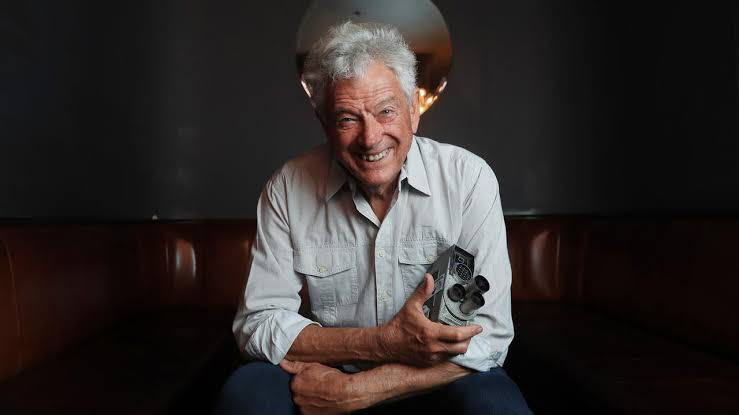
The visual architect behind this epic was John Seale, ASC, ACS. A legend in his own right, Seale had actually retired from feature filmmaking, only to be lured back by George Miller’s irresistible vision. His career spans decades, marked by incredible versatility from the lush, Oscar-winning textures of The English Patient to the frantic energy of Rain Man.
His return for Mad Max: Fury Road was a statement. He brought a lifetime of experience and a fearless willingness to tackle one of the most physically demanding productions in recent memory. Knowing Miller’s history with the franchise, there was clearly a deep trust between director and cinematographer. Seale had to manage a massive logistical beast, coordinating multiple units in the Namibian desert while maintaining a cohesive, polished look that never betrayed the chaotic conditions of the shoot.
Inspiration Behind the Cinematography
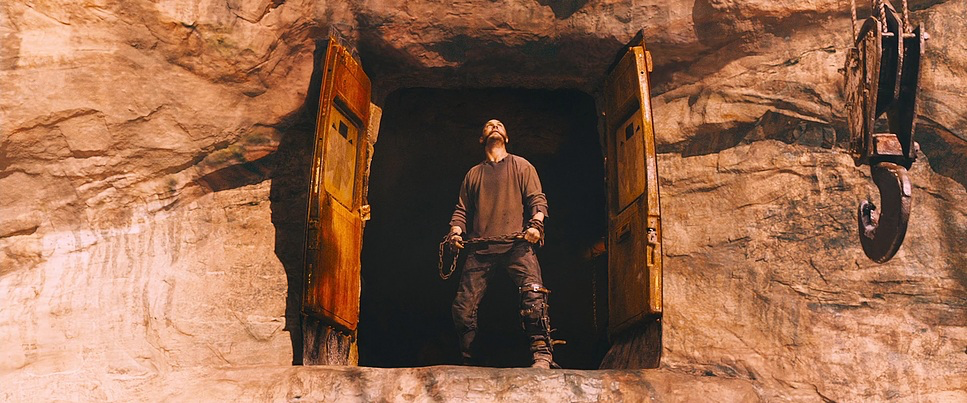
George Miller’s approach to FMad Max: Fury Road was unique, even radical. We often hear about directors who prioritize visuals, but Miller took it to an extreme: the film didn’t even have a traditional screenplay. Instead, it was laid out almost entirely through thousands of storyboards. This tells me immediately that the visual storytelling was the foundation, not an afterthought. Miller was focused on telling a story visually rather than through exposition, and that intent permeates every frame.
The inspiration for the cinematography stems from a desire to craft a “non-stop action thrill ride” that still carried genuine emotional weight. Seale’s task was to ground the over-the-top elements flame-shooting guitars and pole-swinging marauders in a tangible, believable reality. The blend of practical effects and CGI was key here. It’s a sensibility that echoes the best of ’80s action cinema, but supercharged for the 21st century. The desert landscape itself became a character, shaping the light, dictating the color palette, and offering an endless canvas for destruction.
Camera Movements
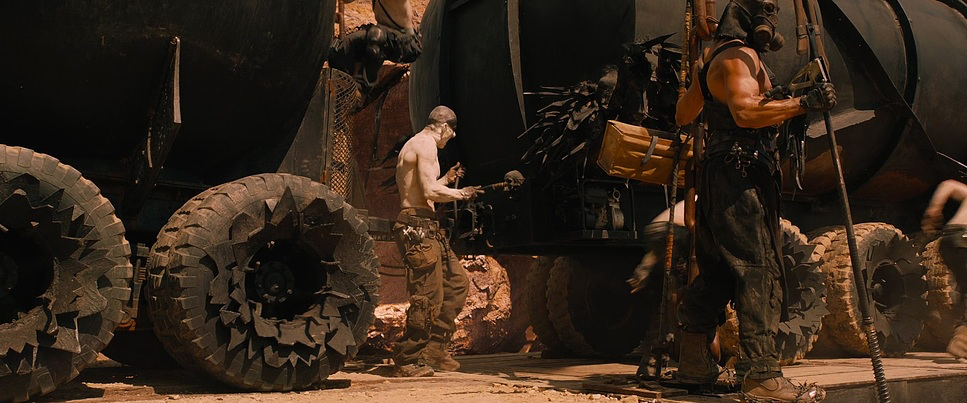
If there’s one thing Mad Max: Fury Road is known for, it’s motion. Relentless, propulsive, almost dizzying motion. Yet, what truly sets it apart is the control within that chaos. A crucial detail that filmmakers appreciate is the lack of “shaky cam.” This is not an absence of energy; it’s a deliberate artistic choice. Instead of handheld jiggle to feign intensity, Seale and Miller opted for incredibly precise, often wide tracking shots that keep the action legible even at breakneck speeds.
The cameras are almost always moving, either tracking alongside the War Rig or pushing in on a character’s determined grimace. But crucially, these movements are almost always motivated. They serve to amplify the momentum of the chase or reveal character through action. Think of the sweeping crane shots that open up the vastness of the desert, immediately establishing the scale of Max’s predicament. The disciplined camera work ensures that every beat of the mania is understood, not just felt.
Compositional Choices
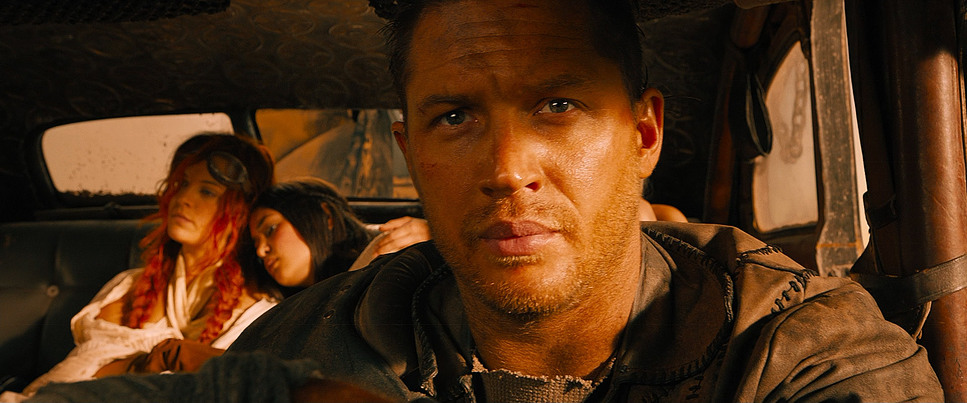
The compositions in Mad Max: Fury Road are a lesson in clarity. While many modern action films resort to tight framing and rapid cuts to mask chaotic staging, Fury Road embraces wide shots (often 2.39:1 spherical) to present its elaborate set pieces. This allows the audience to fully appreciate the complex choreography of vehicles, stunts, and explosions.
One distinct compositional choice is the frequent use of “center framing” or “crosshair framing.” At first glance, you might ask, “Where’s the rule of thirds?” But in a film moving at this velocity, placing key figures and vehicles dead center provides an anchor. It simplifies the scan path for the viewer. When the editor, Margaret Sixel, cuts rapidly between shots, your eye doesn’t have to hunt for the subject it’s already there. It’s not breaking the rules; it’s rewriting them for kinetic storytelling.
Lighting Style
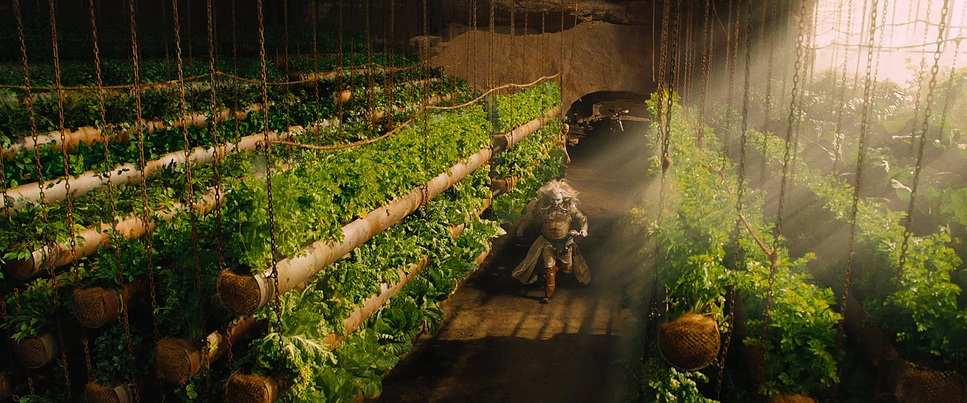
The lighting is as harsh and unforgiving as the apocalyptic setting, utilizing the brutal, unsparing sunlight of the Namibian desert. Seale committed to motivated lighting, often leveraging the sun’s natural position to sculpt the environment. Much of the film was shot during the “golden hour” to capture rich, saturated hues, creating deep, contrasty shadows and brilliant highlights that emphasize the rugged textures of the vehicles and the weathered faces of the characters.
However, the lighting is also highly symbolic. Take the “swamp” sequence. There’s a beautiful moment where Max and Furiosa are bathed in a cool blue light likely a “day for night” treatment while the wives hold a lantern that casts a warm red glow. This isn’t just practical lighting; it’s a visual metaphor. The blue suggests the cold, protective reality Max and Furiosa inhabit, while the warm light symbolizes the fragile hope the women carry. This duality of harsh naturalism and subtle symbolic illumination elevates the lighting from functionality to storytelling.
Lensing and Blocking
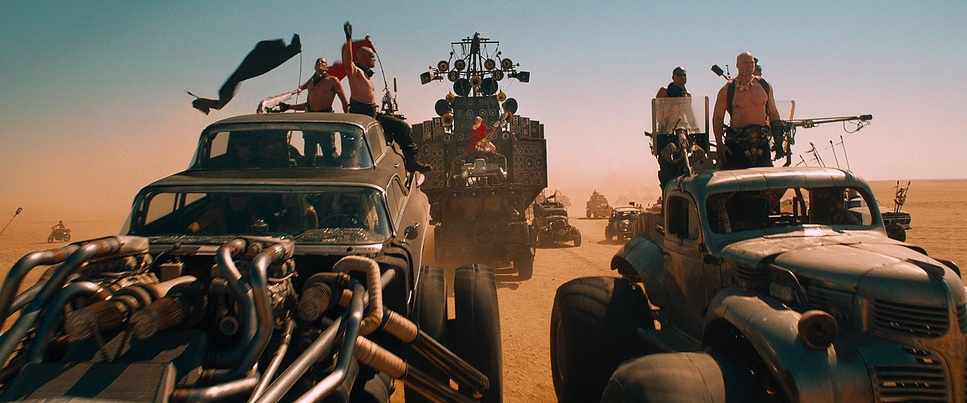
The choices in lensing are directly tied to the need to convey both expansive scale and intimate action. Seale utilized a mix of Angenieux Optimo Zooms and Panavision Primo Primes. He primarily favored wider focal lengths, which emphasize the vastness of the wasteland and provide a greater sense of speed when vehicles hurtle toward the lens.
The blocking is a marvel of coordination. Given the decision to avoid shaky cam, the action wasn’t simply captured; it was meticulously choreographed. Actors and vehicles were positioned precisely within the frame to ensure readability. The camera often tracks laterally with the action, holding characters in the same relative position within the frame. This “well-helmed” approach allowed for incredible feats like the “pole cats” stunts that required perfect spatial awareness to be captured effectively. It’s a testament to the pre-production storyboards that such intricate blocking could be executed so flawlessly.
Color Grading Approach
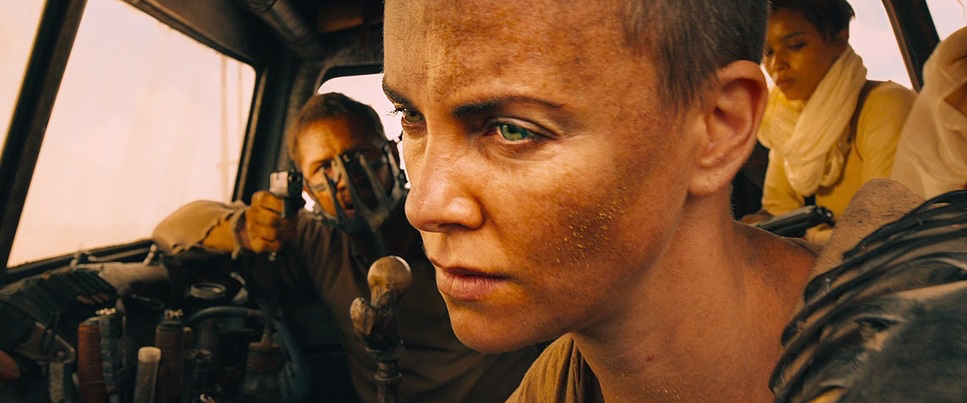
Now, this is where my specific expertise kicks in, because Mad Max: Fury Road is an absolute benchmark in color grading. The film’s colorist, Eric Whipp, helped define an iconic look characterized by a highly stylized, desaturated orange and teal palette. This was a deliberate move away from the “desaturated and muddy” look typical of post-apocalyptic films.
The grade is a sophisticated exercise in hue separation. They aggressively pushed the desert sand and rust into rich, fiery oranges, while pushing the shadows and skies toward teal. As a colorist, I appreciate how this protects skin tones. Even with the saturation cranked up, the separation ensures the characters don’t get lost in the background.
The contrast shaping is also exceptional. Despite the harsh sunlight, Whipp and Seale managed to maintain detail in the extreme highlights (glinting chrome, bright sand) and the deep shadows. Working with 2.8K ARRIRAW files gave them the dynamic range needed to push the image this hard without it falling apart. The highlight roll-off is beautifully managed, lending a filmic density to the digital acquisition. The image has weight; it feels tangible.
Technical Aspects & Tools
| Genre | Action, Adventure, Post-Apocalyptic, Science Fiction, Thriller, Survival, Drama, Dystopian |
| Director | George Miller |
| Cinematographer | John Seale |
| Production Designer | Colin Gibson |
| Costume Designer | Jenny Beavan |
| Editor | Margaret Sixel |
| Colorist | Eric Whipp |
| Time Period | Future |
| Aspect Ratio | 2.39 – Spherical |
| Format | Digital |
| Lighting | Hard light |
| Lighting Type | Daylight, Sunny |
| Story Location | Earth |
| Filming Location | Namibia (Namib Desert) |
| Camera | ARRI ALEXA 4:3 / Plus, ARRI ALEXA M |
| Lens | Angenieux Optimo Zooms, Panavision Primo Primes, Panavision Ultra Speed MKII |
| Film Stock / Resolution | 2.8K / 2.8K ArriRaw |
For a film with such an ambitious scope, the technical choices were crucial. John Seale predominantly utilized ARRI ALEXA Plus and ALEXA M cameras. The Alexa M, with its compact form factor, was particularly vital for squeezing into tight vehicle interiors or mounting on rigs where a full-sized cinema camera wouldn’t fit.
The workflow embraced the best of both worlds: digital acquisition for flexibility in the desert, combined with a deliberate intent to achieve a filmic aesthetic in post. The 2.8K resolution might sound modest by today’s standards, but the quality of the sensor pixels and the 4:3 capture allowed for robust visual effects integration. The extensive pre-visualization acted as a technical blueprint, ensuring that practical effects could be seamlessly integrated with digital enhancements. The sheer scale of the production required a robust infrastructure to manage the footage and bring Miller’s unhinged vision to life.
- Also read: CATCH ME IF YOU CAN (2002) – CINEMATOGRAPHY ANALYSIS
- Also read: V FOR VENDETTA (2005) – CINEMATOGRAPHY ANALYSIS
Browse Our Cinematography Analysis Glossary
Explore directors, cinematographers, cameras, lenses, lighting styles, genres, and the visual techniques that shape iconic films.
Explore Glossary →