It’s a film I first encountered as a teenager, looking for that next Matrix fix. My initial reaction back then was likely similar to many: a bit perplexed by its heavy political weight, mostly wanting more of the stylized action. But over the years, my appreciation for it has grown immensely. It’s truly one of those rare movies that ripens with age, revealing layers not just in its narrative themes of revolution and totalitarianism, but profoundly in its visual language. It’s a film that asks fundamental questions about power, fear, and the enduring strength of an idea, and its cinematography serves these complex ideas with remarkable clarity and precision.
About the Cinematographer
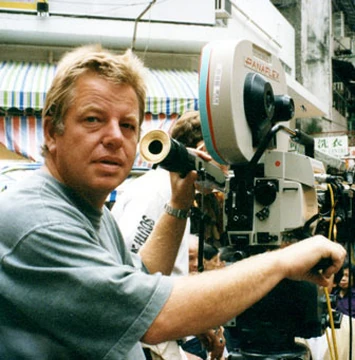
The visual architect behind V for Vendetta was Adrian Biddle, a seasoned cinematographer with a portfolio that included visual heavyweights like The Mummy and Event Horizon. Tragically, Biddle passed away the year of the film’s release, making this one of his final works. While Biddle laid the foundation, the influence of the Wachowskis who produced and wrote the screenplay is palpable. There is a distinct visual signature here, a shared cinematic DNA that resonates with their previous work. Looking back now, the film bears an undeniable visual resemblance to the way they filmed The Matrix trilogy. This isn’t just coincidence; it’s a production reality where a strong creative producer’s vision permeates every frame. This film feels like a seamless blend of Biddle’s technical mastery with the Wachowskis’ distinctive stylistic flair, resulting in a world that is both grimly real and operatically theatrical.
Inspiration Behind the Cinematography
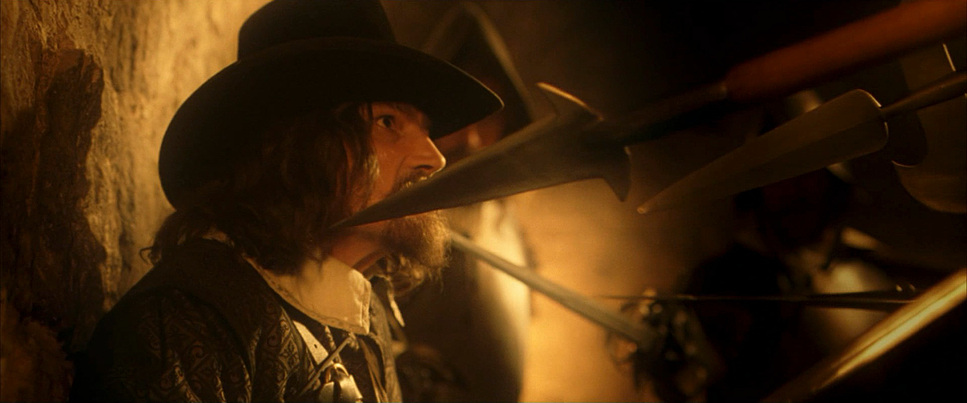
The primary inspiration, beyond Alan Moore’s seminal graphic novel, lies in the film’s core contrast: an oppressive government versus individual rebellion. The narrative, rooted in the Guy Fawkes plot of 1605, directly informs the visual approach. Just as Guy Fawkes sought to blow up Parliament as a symbol of defiance, V aims to dismantle the visual and ideological foundations of the Norsefire regime. The cinematography mirrors this struggle the sterile, controlled, and almost colorless world of Norsefire contrasts sharply with V’s “Shadow Gallery,” a vibrant, chaotic sanctuary of outlawed art and ideas.
The film visually anchors the idea that “people should not be afraid of their governments; governments should be afraid of their people.” This mantra is not just spoken but shown. The oppressive visual aesthetic, characterized by surveillance, cramped spaces, and uniform colors, is disrupted by V’s fluid movements and striking appearances. We are often presented with scenes that force us to question who the real “monster” is, and the cinematography uses techniques like low-key lighting and stark framing to complicate our judgments, even when the narrative attempts to simplify them.
Camera Movements
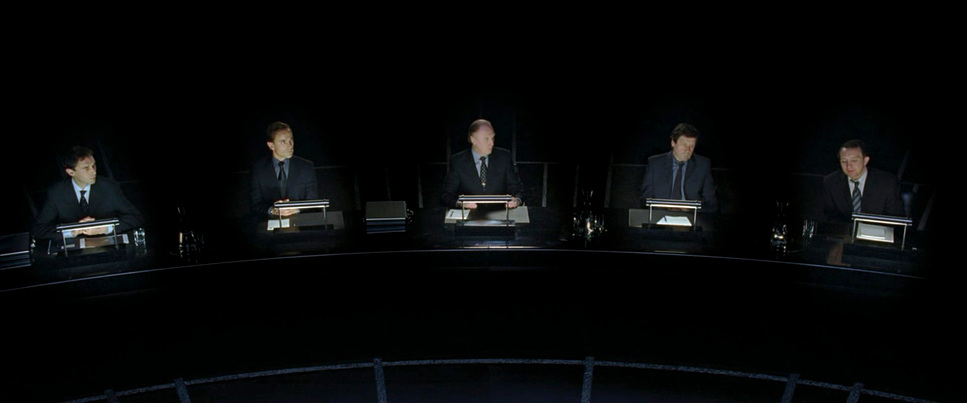
The camera movements in V for Vendetta are a masterclass in serving narrative rhythm. They oscillate between the rigid control of the Norsefire regime and the fluid rebellion embodied by V. When depicting the state, the camera tends to be static, locked down, or moves with an almost clinical, detached precision. Think of the wide, imposing shots of government buildings or the surveillance footage that saturates the screens of Norsefire’s command center. This stillness emphasizes the oppressive weight and the unyielding power structure.
In contrast, V’s movements are often met with dynamic, almost dance-like camera work. His fight sequences are choreographed with a balletic grace, and the camera glides and sweeps to accentuate his speed and mystery. When V first confronts the police to save Evey, the rapid cuts and dynamic angles plunge us into the chaos he creates. Conversely, Evey’s journey is mirrored by the camera’s evolution. Her early scenes are often framed with a sense of confinement, using subtle pans or dollies to highlight her anxiety. As she transforms, becoming “completely free” from fear, the camera grants her more space, wider compositions, and steadier movements, visually signifying her liberation without a single line of dialogue.
Compositional Choices
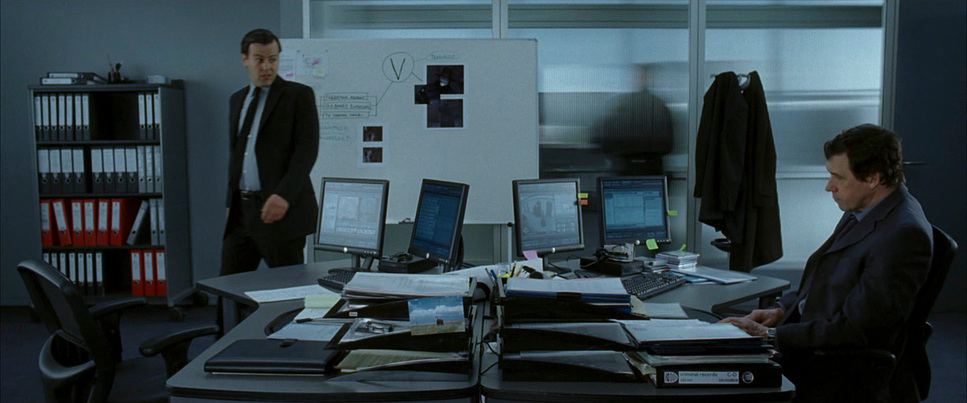
Composition is where V for Vendetta excels in establishing its visual metaphor. The film uses stark, often symmetrical compositions to highlight the totalitarian control and the geometric precision of the Norsefire state. Long, wide shots frequently emphasize the overwhelming scale of the government apparatus and the insignificance of the individual. Buildings like Parliament or the Norsefire headquarters are framed to appear immense and unyielding.
Conversely, intimate close-ups on Evey’s face, or the Guy Fawkes mask, are used to create a sense of personal connection. V’s mask, in particular, is a constant compositional focal point; its unchanging expression forces the audience to project emotions onto it, reinforcing the idea of V as a symbol rather than just a man. The film masterfully employs depth cues to separate characters and ideas. We often see Evey isolated in the frame, surrounded by oppressive architecture. Later, in the Shadow Gallery, the frame becomes richer, filled with V’s forbidden art, creating a sense of visual density and intellectual freedom.
Lighting Style
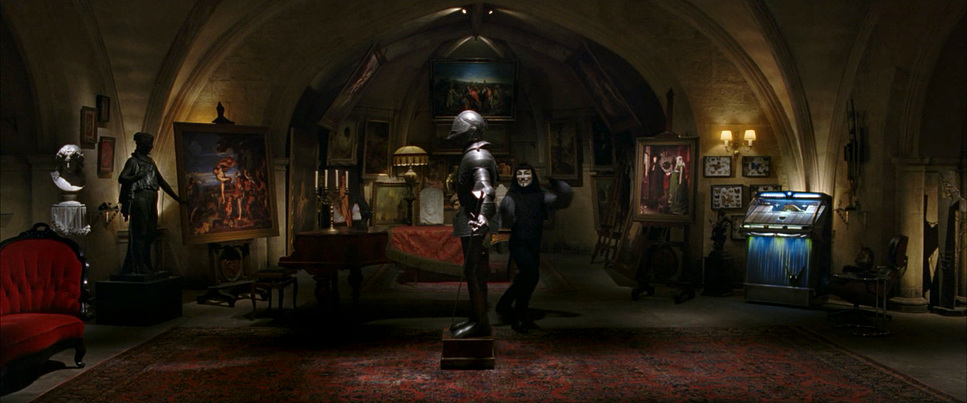
The lighting in V for Vendetta acts as a potent storytelling tool, crafting an atmosphere that oscillates between stark oppression and defiant warmth. It leans heavily into a high-contrast, neo-noir aesthetic, particularly in the film’s early stages depicting London under Norsefire rule. The exterior scenes are often bathed in a cool, desaturated light, emphasizing a perpetually overcast existence. Interiors, especially those of the government, are characterized by sterile, harsh fluorescent lighting that flattens features motivated lighting that reflects the cold, calculating nature of the regime.
When V appears, the lighting shifts. He is frequently introduced from shadow or silhouetted, making his presence mysterious. His Shadow Gallery is lit with a warmer, softer glow. Here, the lighting is more stylized, with practical lamps providing rich, textured light that sculpts faces, giving them a humanity missing elsewhere. Think of the warm, amber tones that embrace Evey as she begins her transformation there. Later, during Evey’s “imprisonment,” the lighting becomes brutal and unforgiving, with stark single sources raking across her face to emphasize torment. The transition to freedom is often marked by a burst of light a deliberate visual release.
Lensing and Blocking
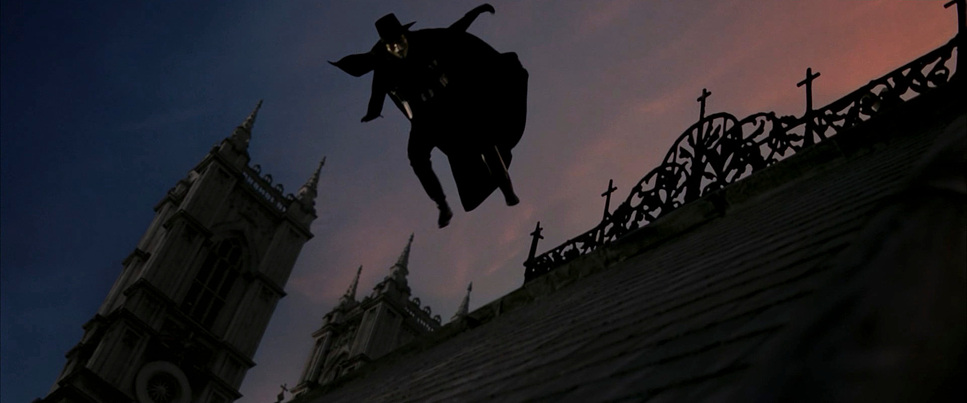
To achieve the film’s specific look, Biddle favored a classical approach using Cooke S4/i prime lenses. These lenses are famous for the “Cooke Look” sharp but with a sympathetic rendering of skin tones and a smooth focus roll-off. This choice was crucial; it helped humanize characters like Evey even when the lighting was at its most oppressive. Wide lenses are used to convey the vastness of the urban landscape, making individuals feel small, while longer lenses are deployed for moments of intimacy or surveillance, compressing space and enhancing the feeling of being watched.
Blocking is particularly effective here in demonstrating power dynamics. V, even when sharing a frame with others, is often positioned in a way that gives him a commanding presence centered, slightly elevated, or occupying a larger portion of the frame. When V and Evey are together early on, the blocking visually underscores their asymmetrical relationship: V as the mentor, Evey as the vulnerable mentee. As Evey gains agency, the blocking shifts; she takes up more physical space and meets V’s gaze directly. The final scene on the train is masterfully blocked to highlight the passing of responsibility, with the masks of the populace forming a powerful, anonymous collective.
Color Grading Approach
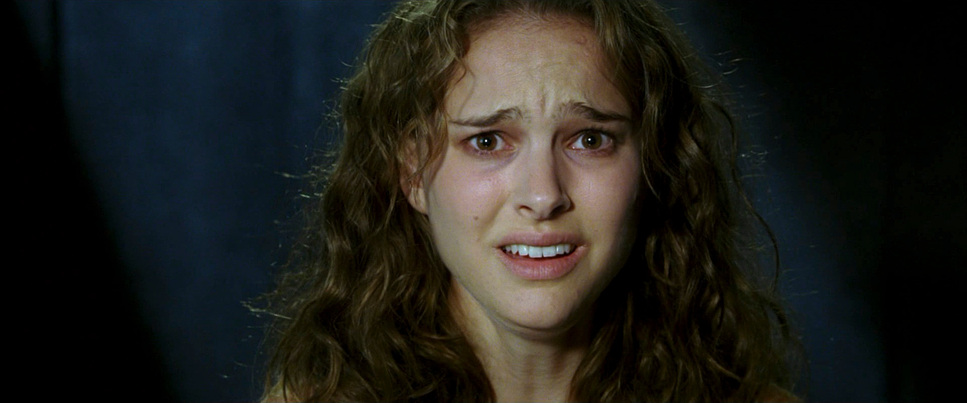
From a colorist’s perspective, the grade in V for Vendetta is deceptively simple but incredibly effective. The overall palette is desaturated, giving the world a cold, sterile, almost dystopian feel. This isn’t just a stylistic choice; it communicates the emotional suppression of a society stifled by fear.
However, within this muted canvas, specific hues are carefully isolated. Red is the dominant symbolic color: the Norsefire party’s flag, V’s roses, the blood of his victims. This strategic isolation acts as a visual alarm. The color grading ensures these reds pop, creating a powerful focal point that signals danger and rebellion.
The tonal sculpting is equally masterful. Shadows are deep and rich, holding information but contributing to the mood, while highlights are carefully managed. There is a subtle print-film sensibility here likely aided by the film stock that avoids the clinical sharpness of modern digital formatting. As Evey undergoes her transformation, the grade subtly shifts not a drastic change, but a gradual infusion of slightly warmer skin tones and richer mid-tones. This hue separation guides the audience’s emotional journey without us even consciously realizing it.
Technical Aspects & Tools
| V for Vendetta: Technical Specifications | |
|---|---|
| Genre | Action, Fantasy, Thriller, Satire, Political, Dystopian, Conspiracy, Science-Fiction |
| Director | James McTeigue |
| Cinematographer | Adrian Biddle |
| Production Designer | Owen Paterson |
| Costume Designer | Sammy Sheldon |
| Editor | Martin Walsh |
| Colorist | Adam Glasman |
| Time Period | Renaissance: 1400-1700 |
| Aspect Ratio | 2.39 – Super 35 |
| Format | Film – 35mm |
| Lighting | Hard light, High contrast, Underlight |
| Lighting Type | Firelight |
| Story Location | … London > Palace of Westminster |
| Filming Location | … Potsdam > Studio Babelsberg |
| Camera | Arricam LT, Arricam ST |
| Lens | Cooke S4/ i |
| Film Stock / Resolution | 5205/7205 Vision 2 250D, 5218/7218 Vision 2 500T, 5289/7289 Vision 800T |
Instead of the digitally clean look common in many modern dystopias, V for Vendetta leans into the organic texture of 35mm film. The production utilized Arricam ST and LT bodies, workhorses of that era. The choice of film stock was specific: Kodak Vision 2 500T (5218) for the interiors and night scenes, which loves shadow detail, and Vision 2 250D (5205) for day exteriors. This combination provides a grain structure and dynamic range that anchors the film in a tactile reality.
The use of practical effects, especially for V’s explosions and the meticulously choreographed fight sequences, grounds the film’s more fantastical elements. In post-production, careful attention was paid to contrast shaping—ensuring that the deep blacks conveyed the starkness of the world without crushing information. The dynamic range decisions were critical in allowing both the oppressive shadows and the defiant bursts of light to coexist within the frame. It’s a workflow that prioritized texture over clinical perfection, grounding the graphic novel’s heightened reality in something that feels gritty and authentic.
- Also read: PIRATES OF THE CARIBBEAN: THE CURSE OF THE BLACK PEARL – CINEMATOGRAPHY ANALYSIS
- Also read: SENNA (2010) – CINEMATOGRAPHY ANALYSIS
Browse Our Cinematography Analysis Glossary
Explore directors, cinematographers, cameras, lenses, lighting styles, genres, and the visual techniques that shape iconic films.
Explore Glossary →