I spend a lot of time in a dark room dissecting the visual language of cinema. It’s a craft that combines intuition with meticulous technical execution, aiming to guide the viewer’s eye and shape their emotional response without them quite realizing why. Stanley Kubrick’s Full Metal Jacket (1987) is a masterclass in this. Even decades later, it resonates in deeply unsettling ways. Running Color Culture, I’m constantly thinking about how every frame serves the story, and Full Metal Jacket offers a particularly rich canvas for exploring how visual choices reinforce profound thematic ideas specifically, the brutal erosion of individuality.
The film isn’t a typical war film; it’s something more elemental. As one analysis aptly puts it, you could swap out the war itself, and the core ideas the loss of self, the dehumanization, the transformation into a “killing machine” would remain. This isn’t a narrative about heroism, but about the psychic cost of being reduced to a cog in a military system. It’s a journey into psychological horror, not just physical combat. For me, that’s where the cinematography truly shines, acting as the silent, unblinking witness to a profound spiritual stripping.
About the Cinematographer
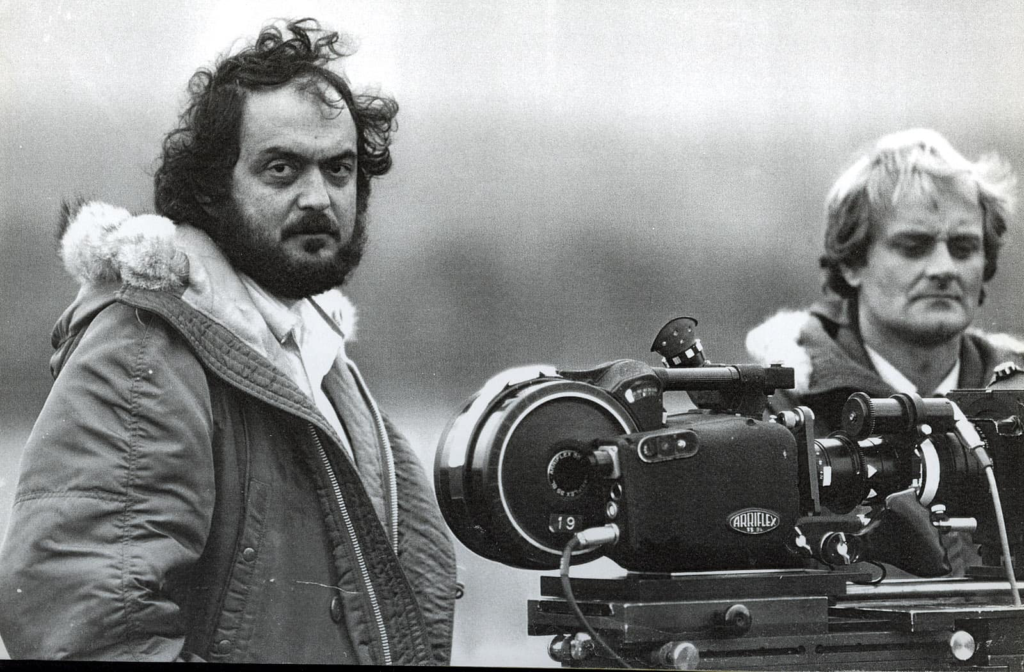
The visual architect behind Full Metal Jacket was Douglas Milsome, though he took over after the initial work was started by Andrew Laszlo. Kubrick’s collaborations were always intense and demanding, and this was no exception. Milsome had previously worked with Kubrick as a focus puller and camera operator on Barry Lyndon, so he understood the director’s exacting standards and singular vision.
Kubrick, as is well documented, meticulously planned every shot, often operating the camera himself. This wasn’t a set where the cinematographer was left to their own devices; it was a direct extension of Kubrick’s specific gaze. Milsome’s role was to execute that vision with technical mastery, translating Kubrick’s surgical approach into tangible images. Milsome pulled off the impossible here: he maintained a cohesive, seamless look that bears the undeniable imprint of Kubrick’s unique aesthetic, despite the behind-the-scenes changes.
Inspiration Behind the Cinematography
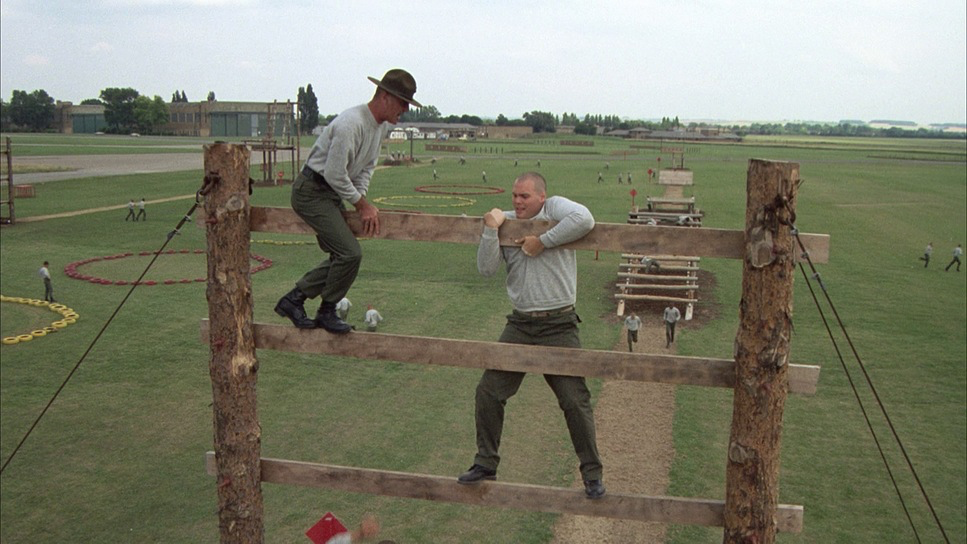
Kubrick’s stylistic inspirations were rarely overt homages; he distilled influences into something uniquely his own. For Full Metal Jacket, the core inspiration was a stark, clinical realism, coupled with deep psychological penetration. The film needed to feel authentic, yet also hyper-real, magnifying the absurdity and horror.
The visual language underscores the film’s central theme: the destruction of the individual. From the opening scene, where recruits receive buzz cuts a literal stripping away of identity the camera work emphasizes uniformity over personality. It’s an uncomfortable, voyeuristic experience to watch this sequence unfold without cuts. The implication sinks in immediately: “They are no longer people. They are now inventory.” This deliberate discomfort is a Kubrickian hallmark. The visual design created environments that felt oppressive and inescapable, whether it was the claustrophobic barracks of Parris Island or the desolate streets of Huế. There’s a conscious decision to avoid typical “hero shots,” opting instead for compositions that highlight insignificance and brutality.
Camera Movements
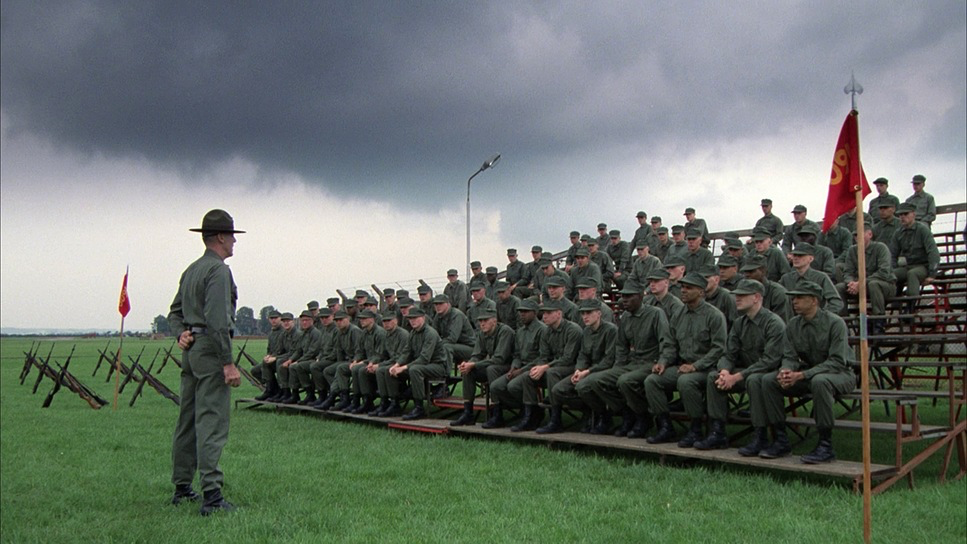
Kubrick’s camera movements in Full Metal Jacket are deliberate, precise, and often slow, serving to emphasize the feeling of inevitability. He avoided gratuitous flourishes; every pan, tilt, or tracking shot had a clear purpose.
During the Parris Island sequence, we see tracking shots that follow the recruits in formation, emphasizing their collective identity rather than individual faces. These movements are steady, almost robotic, mirroring the dehumanizing training. The long shots of soldiers marching, their forms dissolving into a single, synchronized mass, aren’t just a stylistic choice—they are the visual manifestation of their transformation into cogs in the machine. The camera rarely gets intimately close to show individual emotional reactions in these moments, maintaining a cold observational distance.
When the camera does move to emphasize an individual, it feels like a spotlight shining on a specimen. In scenes with Hartman, the camera often pushes in slowly or tracks alongside, emphasizing his overwhelming presence. In the Vietnam section, handheld camera work becomes more prevalent during combat. While never chaotic like some modern war films, this slight increase in kinetic energy contrasts with the rigid control of Parris Island, putting us closer to Joker’s fragmented reality. However, even in battle, Kubrick maintains a controlled chaos. He doesn’t cut away quickly; he allows us to “sit with it,” using longer takes to sustain the tension. The feeling is not one of being amidst the action, but observing its toll.
Compositional Choices
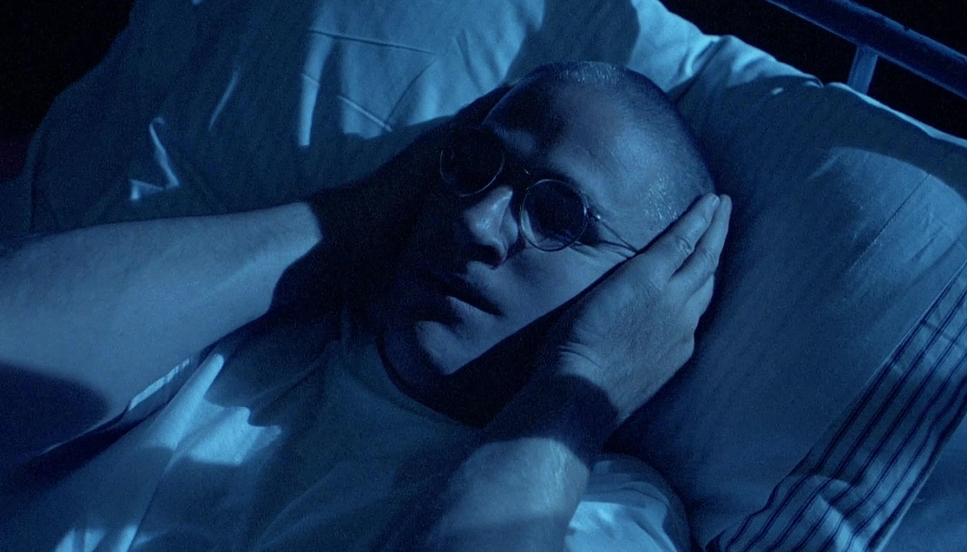
Kubrick’s compositions are legendary for their precision, and Full Metal Jacket is the prime example. He employs symmetrical framing and one-point perspective to create a sense of rigid order and entrapment. The barracks scenes are famous for this, with rows of bunks stretching into the distance, converging lines drawing the eye deep into the frame. This emphasizes the overwhelming conformity; the individual is swallowed by the institution.
He frequently uses wide-angle lenses to capture entire environments, placing characters within vast spaces. This has a dual effect: it makes the characters appear small against the backdrop of institutional power, and it creates depth cues that highlight the starkness of their surroundings.
Crucially, Kubrick is known for deliberately breaking the 180-degree rule (often called “crossing the line”). This is a choice to disorient the viewer, making them feel subconsciously uneasy. By placing the camera on the “wrong” side of the axis in a scene, he prevents the audience from settling into comfortable spatial patterns. It creates a jarring, subconscious unease that perfectly aligns with the film’s thematic core of psychological disturbance. It’s not about making pretty pictures; it’s about making you feel something is wrong.
Lighting Style
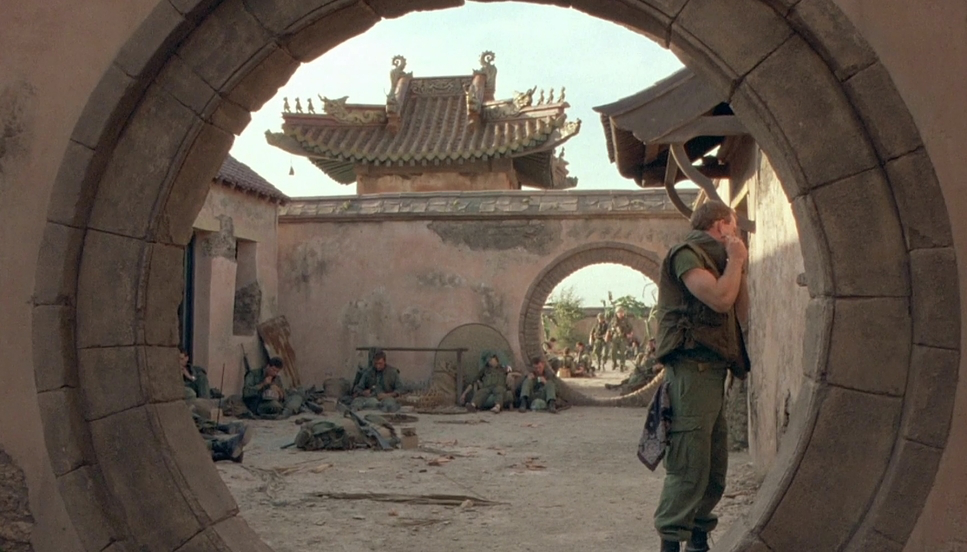
The lighting in Full Metal Jacket is largely motivated, aiming for a naturalistic look that enhances the grim reality. On Parris Island, the lighting is harsh, functional, and devoid of warmth, mirroring the unforgiving training environment. Think of the stark overhead fluorescent lights in the barracks or the raw sunlight on the parade ground. This flat, almost clinical illumination strips away any sense of romance, exposing every flaw.
The Vietnam sequences are where the production context becomes fascinating. The film was famously shot not in Southeast Asia, but in England (specifically the Beckton Gas Works). The lighting team had to work with the diffuse, soft daylight of the UK and make it feel like the tropics. Interestingly, this contributed to the film’s unique look—it lacks the high-contrast, golden “Hollywood” sun often seen in Vietnam movies. Instead, we get a grimy, overcast, diffused light that makes the war-torn city feel even more purgatorial.
Night scenes rely on practical lights like burning fires or muzzle flashes, casting deep shadows. This creates a dynamic, bleak visual texture. The lighting rarely serves to beautify; instead, it underscores the grit, the danger, and the moral murkiness of the situation.
Lensing and Blocking
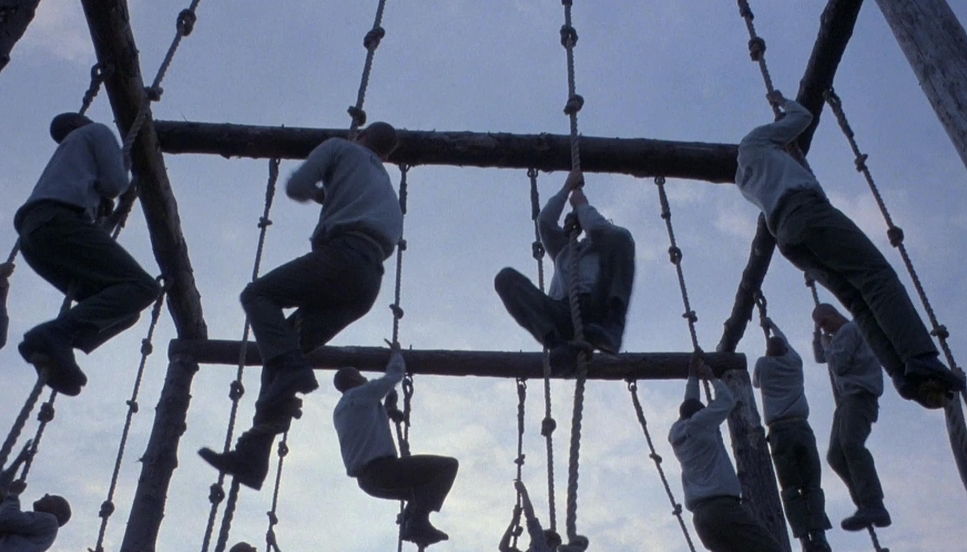
Kubrick’s choices in lensing and blocking were meticulously choreographed to convey character dynamics. He was a master of using specific lenses to control perspective and emotional impact.
In the Parris Island section, wider lenses are frequently employed, even in close-ups. This creates a slightly distorted, grotesque perspective on faces, particularly during Hartman’s tirades. It emphasizes his cartoonish dominance while making the recruits appear trapped by his proximity. This lens behavior isn’t about realism; it’s about subjective experience—the feeling of being overwhelmed. The blocking is highly regimented, reinforcing the military hierarchy. Hartman commands the center, with recruits arranged subserviently around him.
In Vietnam, we see more medium shots that allow us to engage with Joker’s internal struggle. The blocking becomes less rigid, more organic to the chaotic nature of combat, yet still carefully composed. The infamous sniper sequence relies on precise blocking to build suspense, positioning soldiers strategically within the ruined landscape. The long-take nature of many scenes allows for complex blocking to unfold in real-time, pulling the audience into the scene without the distraction of frequent cuts.
Color Grading Approach
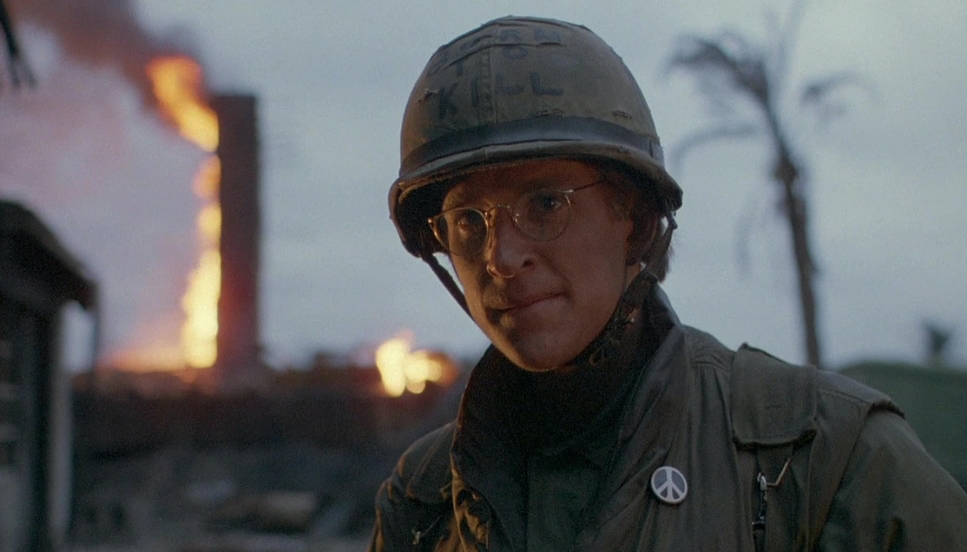
As a colorist, this is where I really pay attention. Full Metal Jacket defines a specific era of print-film aesthetics, but with Kubrick’s specific twist. The overall palette is desaturated, gritty, and leans heavily into cool, muted tones, especially in the Parris Island section. We aren’t seeing “blue” so much as a sickly, industrial cyan that evokes the feeling of concrete and fluorescent hum.
The contrast shaping is bold but distinctively “film.” Shadows are deep, but they aren’t crushed into digital zeroes; they are lifted, milky, and full of grain. The highlight roll-off is incredibly smooth; the film stock handles the bright windows and explosions without blowing out harshly, retaining detail in the whites. This gives the image a robust, tactile quality that digital often struggles to replicate.
In Vietnam, the palette shifts subtly. It remains desaturated, but a warmer, earthier tone emerges from the dust and brick dust of the Beckton set. Reds from explosions or blood pop with brutal intensity against the otherwise subdued background, creating stark hue separation. While modern digital tools allow for precise tonal sculpting, the original look was achieved through careful choices in production design (painting the palm trees and buildings) and chemical processing. The goal wasn’t beauty, but impact. The film’s specific color temperature choices contribute heavily to the enduring feeling of discomfort.
Technical Aspects & Tools
| Genre | Drama, War, Military, Vietnam War, History |
|---|---|
| Director | Stanley Kubrick |
| Cinematographer | Douglas Milsome |
| Production Designer | Anton Furst |
| Costume Designer | Keith Denny |
| Editor | Martin Hunter |
| Time Period | 1960s |
| Color | Desaturated, Black and White |
| Aspect Ratio | 1.78 – Spherical |
| Format | Film – 35mm |
| Filming Location | … United Kingdom > England |
| Camera | Arriflex BL |
| Lens | Zeiss Super Speed |
Kubrick was known for his innovative use of technology, but here the focus was on maximizing existing tools. The film was shot on 35mm film, providing the inherent grain and organic texture that define its aesthetic.
Kubrick favored Arriflex cameras (specifically the BL models) for their reliability. His lens choices likely included high-speed Zeiss primes, offering optical clarity. While not overly reliant on shallow depth of field, Kubrick often preferred deep focus, ensuring that multiple planes of action remained sharp. This deep focus is a key component of his style; he refuses to let the audience escape by blurring out background horrors. Everything is sharp, everything is visible, and everything is inescapable.
The post-production involved painstaking attention to detail in the lab to achieve the correct print-film density. Today, we have control over every pixel in a DI suite, but Kubrick achieved his vision through sheer will and uncompromising precision with the photochemical tools of his era.
- Also read: INDIANA JONES AND THE LAST CRUSADE (1989) – CINEMATOGRAPHY ANALYSIS
- Also read: PRISONERS (2013) – CINEMATOGRAPHY ANALYSIS
Browse Our Cinematography Analysis Glossary
Explore directors, cinematographers, cameras, lenses, lighting styles, genres, and the visual techniques that shape iconic films.
Explore Glossary →