Usually, when someone tells you the best thing they’ve seen lately is an HBO movie about an autistic woman designing cattle chutes, you don’t immediately think “cinematic masterpiece.” But Temple Grandin (2010) is exactly that. It’s a masterclass in how to translate a completely unique internal world onto the screen without it feeling like a gimmick.
It earned seven Emmys and massive critical acclaim, but for me, the real victory isn’t the trophies it’s the empathy. The film doesn’t just ask us to watch Temple; it forces us to see through her. This is a massive technical challenge. How do you depict a mind that functions, as Temple says, “like an internet searching in Google for pictures”? In the color suite, I always say our job is to sculpt emotion with light. Here, the cinematography takes that a step further, attempting to articulate the very mechanics of a human brain.
Ivan Strasburg and the Art of the Lean Production

While Mick Jackson’s direction and Claire Danes’ performance are usually the headlines, the visual backbone here belongs to DP Ivan Strasburg. Strasburg comes from a documentary and TV background which, let’s be real, usually means he knows how to make magic happen with zero time and a tight budget.
What I love about his work here is that it never feels like a “TV movie.” He treats the camera as an interpreter, not just a recording device. You can feel the collaboration between the camera and the character; it’s a visual language that feels grounded in reality but is deeply imaginative when it needs to be. Even with the constraints of a 2010 broadcast budget, Strasburg maximized every frame, proving that visual ambition isn’t about how much money you have, but how well you understand the story you’re telling.
Visualizing a Mind that Thinks in Pictures

The “North Star” for this film’s look was obviously Temple’s own brain. She’s famous for saying her mind works in rapid-fire images: “There’s a scene in the movie where all these shoes come off at rapid succession. That’s exactly how I think.” As a filmmaker, that’s a direct order for how to shoot.
The team leaned into this by using rapid-fire montage, superimpositions, and literal visual overlays. Now, I’ll be honest some of those “artsy” overlays and slow-mo moments feel a little bit like 2010-era digital effects. One reviewer even said they “reeked of a lower budget.” But I disagree. I think they’re brilliant because their intent is pure: empathy. They push the stylistic boundaries to put us inside her sensory processing. It’s not just exposition; it’s about making her anxiety and her genius tangible to the rest of us.
Stillness, Chaos, and the Motivated Frame

The camera movement in this film is surprisingly disciplined. It mirrors Temple’s own relationship with the world methodical, precise, and sometimes overwhelmed by external stimuli. When the camera moves, it’s always motivated.
You’ll see these long, steady, eye-level shots where we just sit with her. It gives the audience space to absorb her unfiltered reactions. But the second her sensory issues are triggered, the camera work shifts. It becomes more dynamic, occasionally handheld, creating that sense of “rushing” comprehension or unease. There’s also a beautiful documentary-like quality to the ranch scenes. The movement is fluid and unobtrusive, allowing the gritty reality of the cattle industry to breathe. It’s a delicate dance between the subjective (how she feels) and the objective (what she’s doing).
Framing the Outsider: Geometry as Emotion
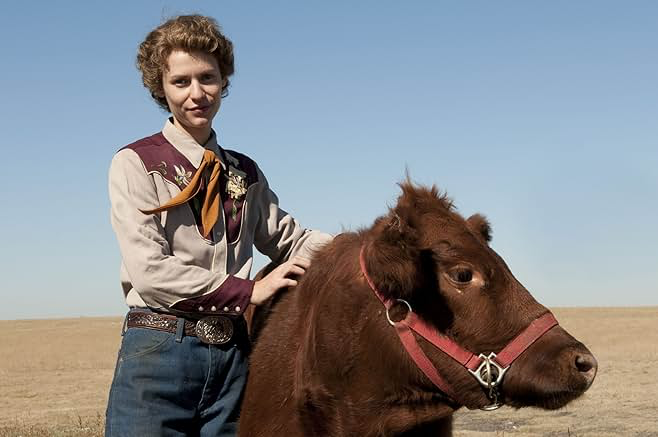
Compositionally, this film uses space to tell us exactly where Temple stands in society. Early on, she’s often framed against busy, chaotic backgrounds or tucked into the corner of the frame. It creates this subtle visual tension she’s the outsider looking in. The negative space around her often feels massive, which, to me, perfectly captures that feeling of sensory overload.
But look at what happens when she’s in a squeeze chute or with the cattle. The compositions change. She becomes the center of the frame. She finds her peace. The recurring use of POV shots seeing the world in fragments before they click together is a genius way of translating “picture thinking” into cinematography. We see her move from being isolated in the frame to becoming a purposeful, empowered presence in a “man’s world,” and that arc is handled mostly through where the camera is placed.
Finding Truth in Raw, Motivated Light

This is where the film feels truly “filmic” to me. The lighting is motivated and naturalistic, which is the only right choice for a biopic like this. You don’t see high-key, “glamour” lighting here. Instead, Strasburg leans into available light and practicals that make the environments feel lived-in.
The early domestic scenes have a softer, slightly diffused quality very much of its era. But once we hit the ranches and slaughterhouses? The light gets harsh. Fluorescent tubes, biting sunlight on dusty fields, industrial textures. It underscores her journey from a sheltered life to the brutal reality of her industry. Even when things get “dramatic,” the lighting stays organic. It never screams for attention, which is a testament to Strasburg’s restraint. It just supports the mood and lets the performance lead.
The Social Bubble and the Long Lens
Lensing and blocking are used here to define Temple’s “personal bubble.” I noticed a really thoughtful mix of focal lengths. We get the wide, objective establishing shots where Temple looks small and overwhelmed, but then we’ll jump into a tight medium with beautiful bokeh that isolates her when she’s deep in thought.
The long lenses are particularly effective in the ranch scenes. They compress the space, making the background feel like it’s pressing in on her, which adds to that sense of determination or entrapment. And the blocking? It’s brilliant. Temple is almost always positioned slightly apart from people. Her movements are angular and deliberate, contrasting with the fluid, social movements of the people around her. But when she’s with animals, she mimics their rhythm. She moves with them. It’s a subtle way of showing us where she truly belongs.
The Grade: Sculpting Texture Without Clichés
As a colorist, this is what I was watching most closely. For a 2010 TV movie, the grade is incredibly sophisticated. It avoids the “digital” look of the time and opts for something warmer and more organic almost like a film print.
I imagine the colorist spent a lot of time on “selective” saturation. The palette is mostly earth tones and natural blues very American West but they’ll pop the green of a pasture or the specific red of a shirt to guide your eye. There’s no “teal and orange” cliché here. The highlight roll-off is handled with real care; you don’t see those brittle, clipped whites that plague early digital broadcast work. There’s a richness in the shadows and a texture to the mid-tones that gives the film depth. When she’s overloaded, the colors might get a bit more intense, but for the most part, the grade is stable and confident. It lets the story shine without shouting “look at me.”
2010 Tech and the “Artsy” Budget Trap
Technically, Temple Grandin is a bit of a time capsule. By 2010, HD cinema cameras like the ARRI D-21 or the early Reds were becoming the standard. The fact that critics were annoyed this wasn’t a theatrical release tells you everything about the image quality. They had great control over exposure and a solid post-production workflow.
While that “artsy” slow-motion and overlay stuff might feel a bit dated now, I think the filmmakers used their tools efficiently. They didn’t need huge VFX budgets; their “special effects” were just clever ways of visualizing Temple’s thoughts. The tools they chose gave them enough dynamic range to play with the image in post while keeping it grounded. It’s a great example of how a talented crew can blow past the limitations of “television” by just being smart with the tech they have.
- Also read: RIFIFI (1955) – CINEMATOGRAPHY ANALYSIS
- Also read: 13TH (2016) – CINEMATOGRAPHY ANALYSIS
Browse Our Cinematography Analysis Glossary
Explore directors, cinematographers, cameras, lenses, lighting styles, genres, and the visual techniques that shape iconic films.
Explore Glossary →