Emir Kusturica’s 1998 film Black Cat, White Cat is exactly that. It’s a wild, unclassifiable beast that dances between farce and magical realism without ever losing its step.
From the opening frame, it’s clear this isn’t a typical cinematic experience. It feels like a fever dream grounded in the dust and heat of a Roma community in post-Yugoslavia. People often compare Kusturica’s vibe to Jean-Pierre Jeunet, and you can see why there’s that same blend of the surreal and the gritty. But how do you actually translate “joyous chaos” into a visual language? That’s the puzzle Vilko Filač had to solve.
About the Cinematographer
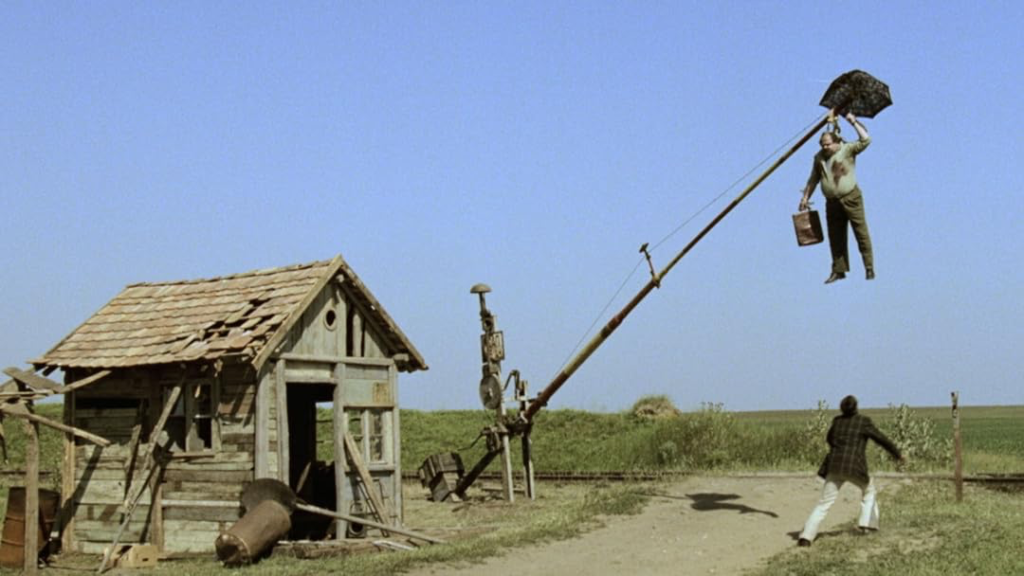
You can’t really separate this look from Vilko Filač. He was Kusturica’s long-time eye, the man behind the lens for Time of the Gypsies and Underground. This wasn’t just a director-DP relationship; it was a shorthand developed over decades.
Filač had this incredible ability to take Kusturica’s loudest, most anarchic ideas and give them a cohesive visual soul. He wasn’t just “capturing” the story. He was breathing life into a world where a pig eating a wrecked car feels just as natural as a man rising from the dead. In Black Cat, White Cat, Filač is at his peak. He provides a stable, expressive foundation for a story that would otherwise fly off the rails.
Inspiration Behind the Cinematography
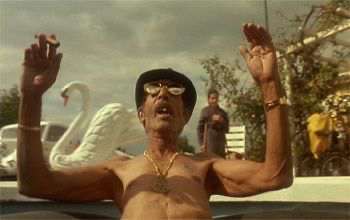
The DNA of the film’s look comes from the setting itself the “Gypsy seaside” along the Danube. It’s a world of vibrant color, constant movement, and deep tradition. Filač’s job was to make the audience feel like they were sitting in the middle of the wedding, not just watching it from a distance.
There’s a “fantasy mixed with reality” energy here that dictates everything. The visuals couldn’t be subtle or quiet. They had to be as operatic as the characters. You can almost see the music in the way the scenes are shot the rhythm and communal spirit are baked into the frames. Filač used the Danube and the ramshackle homes to anchor the madness. Even when the plot goes off the deep end, the sun is still shining and the river is still flowing. That juxtaposition is everything.
Lighting Style
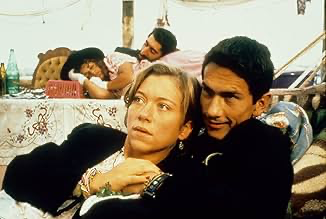
As a colorist, the first thing I notice is how Filač handles that brutal Balkan summer sun. It’s bright, unfiltered, and potentially a nightmare for dynamic range. Yet, he embraces it. The high-contrast sunlight gives the film its “feel-good” energy, casting deep shadows that define the textures of the world.
The interiors feel completely different. They’re lit with motivated, practical sources lamps, windows, the glow of a fire. It’s intimate. He isn’t afraid to let parts of the frame fall into total shadow, which gives the air a sense of age and thickness. In ’98, managing that highlight roll-off on film was a feat. You see it in the sun-drenched exteriors; the whites stay luminous but detailed, transitioning into the mid-tones with an organic softness that we’re constantly trying to replicate in the suite today.
Color Grading Approach
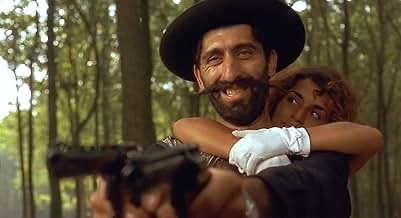
This is where the film really speaks my language. Since this was 1998, we’re talking about film stock and lab timing rather than a digital workspace, but the intent is pure “Color Culture.” The palette is unashamedly warm. It’s a “toasted” image rich, earthy greens from the riverbanks and sun-baked browns in the architecture.
The contrast is firm in the blacks but never feels gritty or harsh. It’s more of a golden, nostalgic cast that makes even the chaotic scenes feel inviting. There’s a beautiful “tonal sculpting” happening here; light and shadow are used to give shape to the clutter. It’s not just a “look” it’s an artistic choice to make every frame feel alive and vibrant.
Lensing and Blocking
Filač mostly sticks to wider focal lengths, and it’s a brilliant move. It keeps the characters connected to their environment. When you have a character like Dadan who’s a total hyperactive lunatic a wide-angle lens emphasizes his erratic energy and the space he’s trying to command.
The blocking is a masterclass in ensemble staging. Kusturica loves a crowded frame, and Filač uses deep focus to keep everyone sharp. Instead of isolating a character with a blurry background, he lets your eye wander. You see the main action in the foreground while three other subplots are happening in the back. It’s dense, fluid, and perfectly reflects the interconnectedness of the community.
Camera Movements
The camera in this film is a character. It’s restless. It’s kinetic. It doesn’t just sit back; it dances through the scenes. There’s a lot of handheld and Steadicam work that makes you feel like you’re right in the thick of the “dodgy situations.”
When Dadan is on screen, the camera mimics his cocaine-fueled energy fast pans, sudden tracking shots, a disorienting rhythm. Then, Filač will hit you with a sweeping crane shot over the Danube that lifts you out of the fray, only to plunge you back into a wedding celebration a second later. It’s exhilarating. The camera isn’t just recording; it’s performing.
Compositional Choices
Filač is a master at organizing chaos. Kusturica’s world is packed with “larger than life” people, and the compositions embrace that abundance. He uses “deep staging” characters interacting across multiple planes to make the world feel lived-in.
You’ll see a lot of natural frames, too doorways and windows that layer the image. He even throws in the occasional Dutch angle during moments of peak absurdity, just to keep you off-kilter. But even at its most “messy,” there’s a balance. He arranges the elements so your eye always knows where to go, even when there are animals, explosions, and dancing happening all at once. It’s like a finely tuned orchestra playing a wild symphony.
Technical Aspects & Tools
Looking at the technical side, this is a 35mm celluloid masterpiece, likely shot on Kodak Vision stocks. That’s where that incredible latitude comes from the ability to hold detail in the bright Balkan sky and the dark corners of a shack simultaneously.
The camera package Arri or Panavision had to be robust to handle those complex crane and Steadicam moves. Back in ’98, there was no “fixing it in post” the way we do now. Filač had to get it right in-camera. The organic grain, the saturated colors, and that gentle highlight fall-off are all hallmarks of a DP who knew exactly how his film would behave in the lab. It’s a testament to a dying discipline.
- Also read: WINTER SLEEP (2014) – CINEMATOGRAPHY ANALYSIS
- Also read: THRONE OF BLOOD (1957) – CINEMATOGRAPHY ANALYSIS
Browse Our Cinematography Analysis Glossary
Explore directors, cinematographers, cameras, lenses, lighting styles, genres, and the visual techniques that shape iconic films.
Explore Glossary →