Kim Ki-Duk’s 2003 masterpiece, Spring, Summer, Fall, Winter… and Spring.This movie isn’t just a film; it’s a living, breathing meditation, and its cinematography is nothing short of transcendent.
It’s one of those rare cinematic experiences that felt less like watching a story unfold and more like being enveloped by a profound, visual poem. I remember watching it after a particularly brutal day the kind where your head feels like a drum and your brain is a tangled mess of to-do lists. Ten minutes in, the world outside my screen just… faded. My headache, no joke, felt lighter. I was transported into the fresh air of that isolated Korean forest. It pulled me into its tranquil rhythm, proving that true visual storytelling needs no translation and no heavy dialogue just pure, unadulterated imagery that speaks directly to the soul.
About the Cinematographer

The visual architect behind this quiet marvel is Begg Dong-Hoon. It’s interesting how some cinematographers become synonymous with a specific director, while others, like Begg, deliver a singular, indelible vision that stands entirely on its own. Spring, Summer, Fall, Winter… and Spring is arguably his most celebrated work, a testament to his ability to capture the spiritual essence of a story through the lens.
His collaboration with Kim Ki-Duk a director famous for his “minimal dialogue” philosophy really puts the cinematographer in the driver’s seat. In a film like this, the visual language isn’t just supporting the narrative; it is the narrative. Every frame carries the weight of character development and philosophical inquiry. Begg Dong-Hoon didn’t just photograph a landscape; he photographed a state of being, a journey through life’s seasons where the natural world acts as both a witness and a participant.
Inspiration Behind the Cinematography
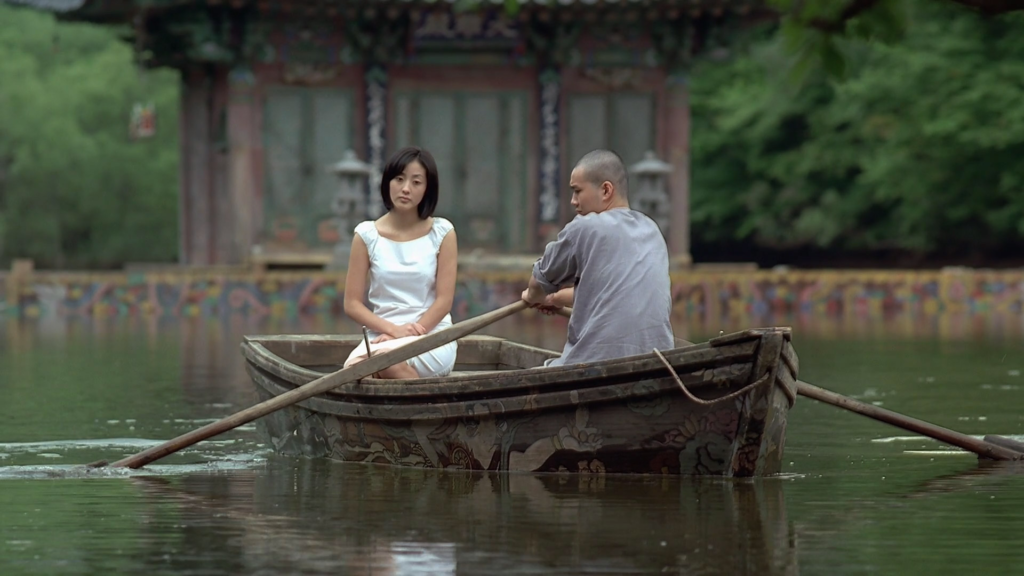
The inspiration here is written right in the title. The story of the monk’s life, segmented by the cyclical passage of seasons, is inextricably tied to the natural world. The floating monastery on Jusanji Pond isn’t just a backdrop; it’s a character that shifts its appearance with the changing light and weather. Kim Ki-Duk clearly wanted to portray the joy, anger, and sorrow of a human life through the lens of nature, and that intention guided every camera placement.
You can feel the roots of Buddhist philosophy in the imagery themes of impermanence and karma are baked into the environment. The 300-year-old tree, the ripples on the water, and the mist that shrouds the pond are visual metaphors for the stages of life. The dedication to “showing, not telling” meant the camera had to become a quiet, reverent observer. It’s a refreshing departure from the dark, office-bound or city-centric movies we see so often; here, the earth itself is the star.
Lighting Style
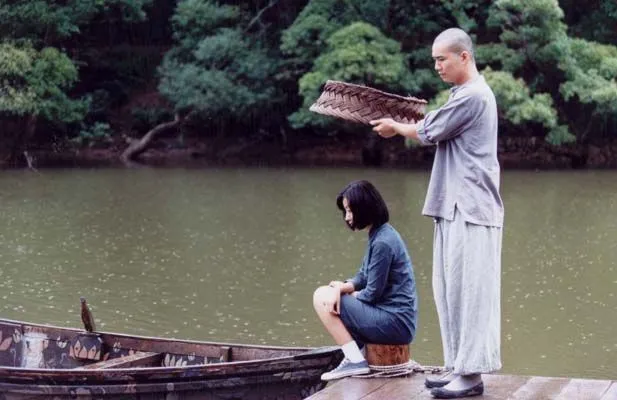
The lighting is overwhelmingly naturalistic, dictated entirely by the time of day and the specific season. As a colorist, I appreciate how Begg Dong-Hoon relied on “motivated” lighting meaning the sun, the moon, and fire do the heavy lifting.
In Spring, the light feels nascent and fresh, with softer highlights that match the innocence of the young monk. Summer brings a harsher, more direct sun that makes the foliage vibrate with life, but also underscores the intensity of the young man’s growing desires. By the time we reach Fall, we’re treated to a golden, diffused warmth that feels deeply melancholic. Winter, conversely, is characterized by a stark, cold light, often filtered through overcast skies or mist, creating a palpable sense of stillness. It’s a masterclass in using available light to evoke emotion rather than just illuminate a set.
Camera Movements
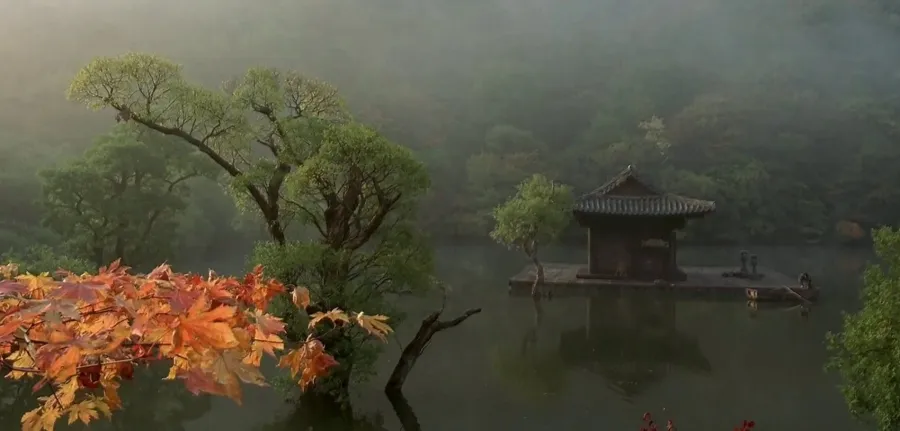
The camera in this film is a patient observer. It rarely draws attention to itself, preferring stillness and slow, deliberate pans that invite us to contemplate the frame rather than just consume it. When the camera does move, it’s often a subtle tracking shot that reveals the vastness of the lake or the isolation of the monastery.
Think about the way the camera traces the light across the water as a new season arrives. These movements aren’t flashy; they mirror the film’s meditative pace. You feel like you’re drifting along with the monastery, experiencing the passage of time viscerally. There’s a distinct sense that the camera is respecting a sacred space, never intruding, only witnessing. It’s about letting the environment speak for itself.
Compositional Choices

Begg Dong-Hoon’s compositions are a lesson in minimalism. He frequently uses wide shots, placing the tiny, floating monastery as a solitary speck against the monumental backdrop of the lake and the steep walls of forest and stone. This immediately establishes a sense of humility and the overwhelming power of nature.
Then, of course, there are the “doors without walls.” These grand, painted wooden doors frame the floating monastery and demarcate the passage of time. They aren’t practical barriers you could easily walk around them yet they are always respected. Symbolically, they serve as thresholds into new spiritual stages. The use of negative space is equally brilliant; the vast expanse of the lake and the empty sky aren’t “empty” at all they are pregnant with meaning, emphasizing the character’s internal struggles.
Lensing and Blocking
I suspect Begg used a combination of wide primes to establish that incredible scale and slightly longer lenses for the more intimate moments. The wide shots allow us to appreciate the layers of the forest, while a medium-telephoto might be used to draw focus to a monk’s hands during a ritual, subtly compressing the background to create a sense of internal reflection.
The blocking is a minimalist art form. With so few characters and such a constrained setting, every movement carries weight. The floating monastery itself dictates the blocking; when your world is a small wooden platform, every step and posture becomes amplified. It reminds me of staging a play on a bare stage the constraint forces a visual discipline that makes the final aesthetic feel incredibly powerful.
Technical Aspects & Tools
Since this was released in 2003, it was almost certainly shot on 35mm film. You can see it in the organic grain and the way the highlights roll off that beautiful, soft transition into the white that digital often struggles to replicate. Whether they used Fuji or Kodak stock, the choice provided a foundation of color depth and latitude that is essential for a film so reliant on the nuances of nature.
Shooting on a floating platform through four seasons must have been a logistical nightmare. Managing moisture, lens fogging in the mist, and stabilizing a camera on water requires meticulous planning. The fact that the film looks so effortless is a testament to the technical precision of the crew. They had to have absolute confidence in their visual grammar because, without dialogue to fall back on, every filter choice and exposure setting had to be perfect.
Color Grading Approach
Now we’re in my wheelhouse. As a colorist, this film is both a dream and a challenge. If I were sitting at the console for this project, my approach would be one of sensitive enhancement rather than overt manipulation.
For the Spring chapters, I’d focus on tonal sculpting aiming for a clean, vibrant feel with gentle contrast to keep the greens looking fresh but natural. Moving into Summer, I’d push the contrast a bit further to allow for deeper shadows, reflecting the heat and passion of that act. I’d be very careful with hue separation here, making sure the skin tones pop against the deep blues of the water without looking “digital.”
In Fall, I’d lean into the warmth. I’d want the oranges and earthy browns to glow with an internal light, perhaps using a slightly lower contrast to give the image a velvety, contemplative texture. Winter is the most dramatic shift. I’d cool the midtones and shadows, pushing subtle cyans and desaturated greens to make the audience feel the chill. I’d be obsessively watching the highlight roll-off in the snow and ice, ensuring they feel “thick” and filmic rather than clipped and harsh. The goal is a sense of timelessness colors that feel connected to the earth.
- Also read: THE HUSTLER (1961) – CINEMATOGRAPHY ANALYSIS
- Also read: FARHA (2021) – CINEMATOGRAPHY ANALYSIS
Browse Our Cinematography Analysis Glossary
Explore directors, cinematographers, cameras, lenses, lighting styles, genres, and the visual techniques that shape iconic films.
Explore Glossary →