Edgar Wright’s Shaun of the Dead (2004), it’s not just for the laughs; it’s a masterclass in how visual choices from a subtle depth cue to a aggressive whip pan coalesce to tell a story. This isn’t just a “horror-comedy.” It’s a field day for anyone obsessed with the alchemy of filmmaking.
About the Cinematographer
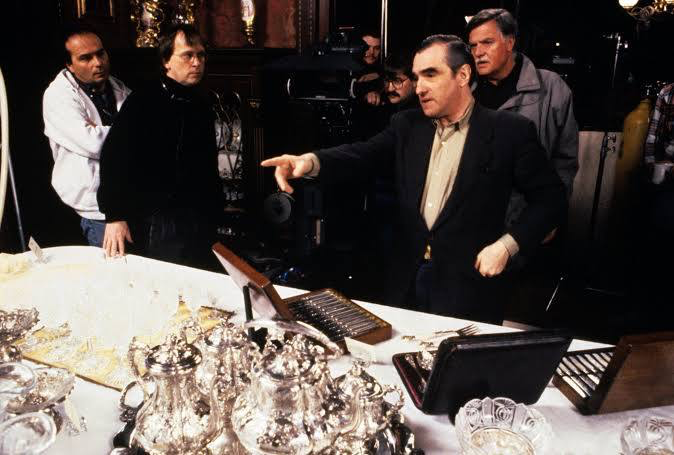
The lens through which we see this apocalypse was held by David Dunlap. If you want to know why the camera feels so rhythmic, look at his resume: he was a camera operator on Goodfellas. Edgar Wright has often geeked out about Dunlap’s ability to execute a perfect swish pan, a skill likely honed under Scorsese. For a film as meticulously choreographed as this, you need a DP who understands that timing is everything. The collaboration between Wright’s frenetic energy and Dunlap’s technical precision is what gives the film its distinctive, almost musical visual pulse.
Color Grading Approach
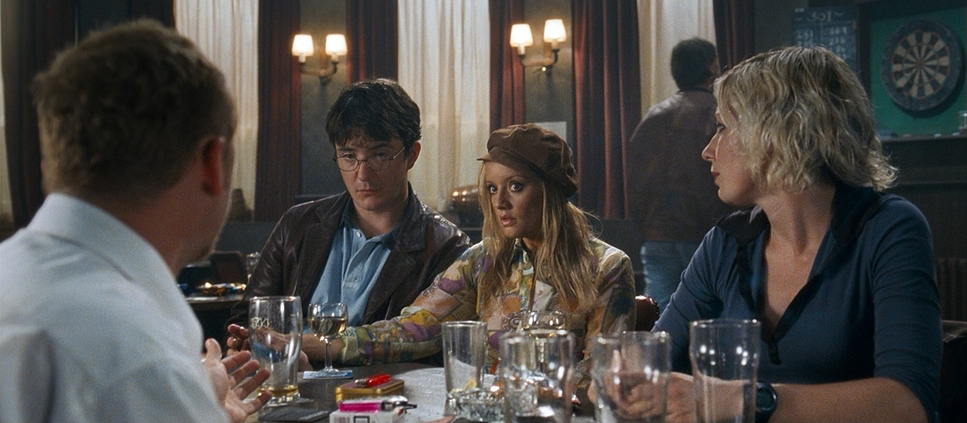
I’m jumping straight to the grade because, for me, this is where the atmosphere is truly born. Shaun of the Dead doesn’t lean into the hyper-saturated look you see in modern comedies. Instead, it favors a slightly desaturated, almost “grimy” palette that captures the mundane reality of North London. We’re talking browns, muted greys, and washed-out greens.
As a colorist, I love the contrast shaping here. In the early acts, the dynamic range feels compressed it’s flat, uninspired, and small, just like Shaun’s life. But as the stakes rise in the Winchester, the shadows get richer. We see deeper blacks and more separation, adding a layer of dread. What’s really impressive is the highlight roll-off. Since it was shot on 35mm film, you get that organic, filmic texture that digital still struggles to mimic perfectly. It’s not just “looking good” it’s about making the violence feel grounded. When the red blood finally pops against that drab, London-grey canvas, it hits harder because of the restraint shown in the rest of the palette.
Inspiration Behind the Cinematography
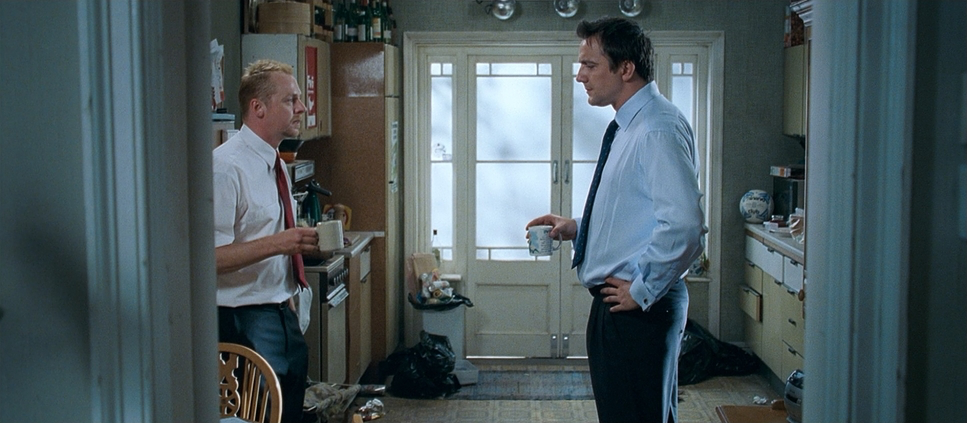
Wright and Pegg weren’t just parodying George A. Romero; they were honoring him. The title is a nod to Dawn of the Dead, but the cinematography takes its cues from the idea of “ordinary people in extraordinary crises.”
The visual conceit that kills me is how everyone is framed to look like a zombie before the outbreak. That’s not just a writing trope; it’s achieved through blocking and a grey, monotonous palette that flattens everyone’s individuality. Wright famously said he wanted the “Citizen Kane of zombie films.” It’s a lofty goal, but when you look at how layered the storytelling is within a single frame, you realize he wasn’t kidding.
Camera Movements
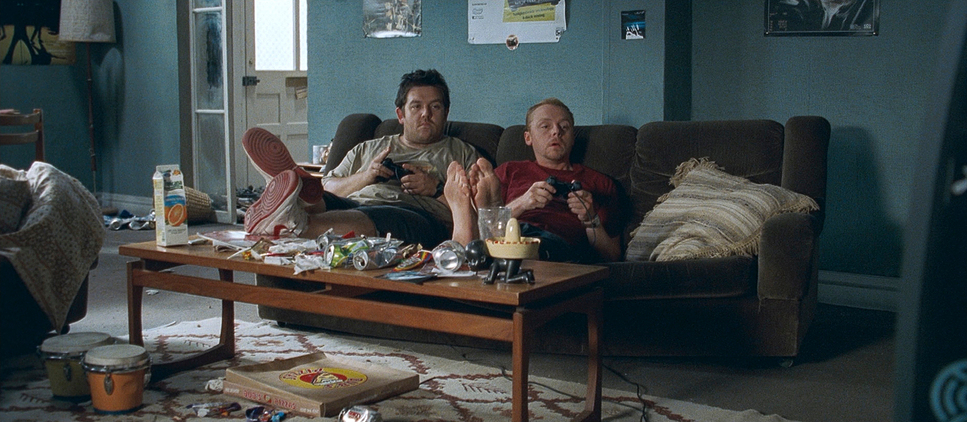
This film is a benchmark for Wright’s signature style. We see a fascinating tug-of-war between long, flowing takes and rapid-fire, rhythmic editing. Wright reportedly edited with a “metronome running” in his head, and you can feel that beat in every shot.
Take the iconic “shoe leather” scene where Shaun walks to the convenience store, totally oblivious to the blood on the fridge door and the chaos in the background. Dunlap reportedly thought the shot would be cut, but Wright kept it, packing it with visual gags. By using a steady, gliding motion (likely a Steadicam or dolly), the camera mimics Shaun’s state of denial. The world is ending, but the camera stays as oblivious as he is. Then, of course, there are the swish pans. Some might say they’re overdone, but I’d argue they’re the film’s heartbeat. They inject a shot of adrenaline into every transition, turning a simple character movement into a punchline.
Lensing and Blocking
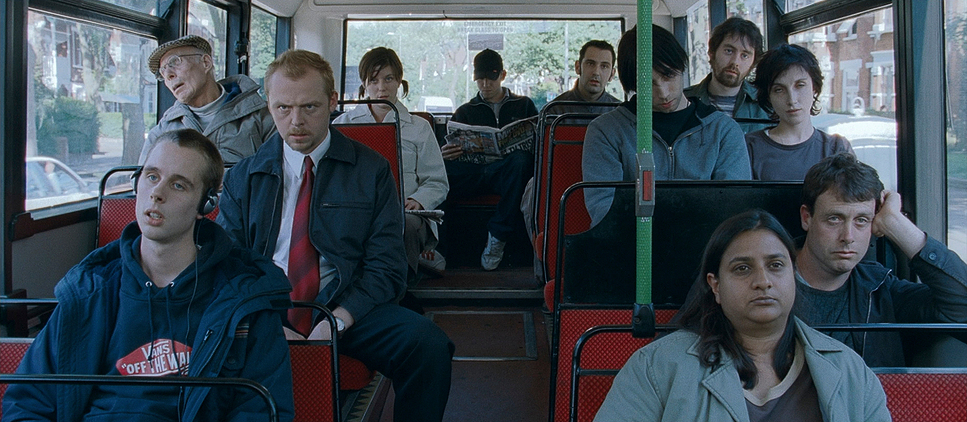
Technically, the film was shot on Arriflex cameras using Cooke S4 lenses. Even though the aspect ratio is a wide 2.35:1, they used spherical glass to get that sharp, clean look.
The blocking is where the comedy really lives. Take the “Kill Phil” sequence it’s a parody of Kill Bill, but the way the actors are arranged in that tight space is like a “ballet of ineptitude.” Wider lenses are used for the group dynamics, allowing us to see every character’s reaction simultaneously, which is crucial for the comedy. When things get heavy like Philip’s or Barbara’s death the camera moves in tight. That shift from a wide, detached perspective to an intimate close-up is how Wright modulates the emotional weight of the scene without the audience even realizing it.
Compositional Choices
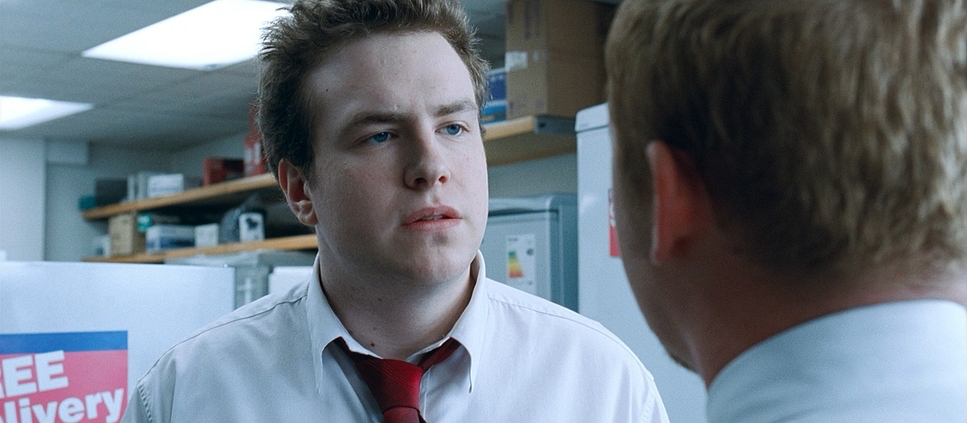
Composition here is never an accident. Wright loves symmetry, especially in the mundane settings like the grocery store or the pub, to show how “stuck” these characters are. But once the zombies arrive, that symmetry breaks. We get Dutch angles and more dynamic, fractured framing to convey unease.
One of my favorite bits is the “TV montage” where news clips are cut together to form a sentence. It’s a brilliant bit of compositional collage. It’s fast, it’s fragmented, and it perfectly mirrors the way information actually travels during a crisis. As a filmmaker, I appreciate how the negative space is used in the early scenes—lifeless characters slumped in the background to foreshadow the literal “dead” who are about to take over the city.
Lighting Style
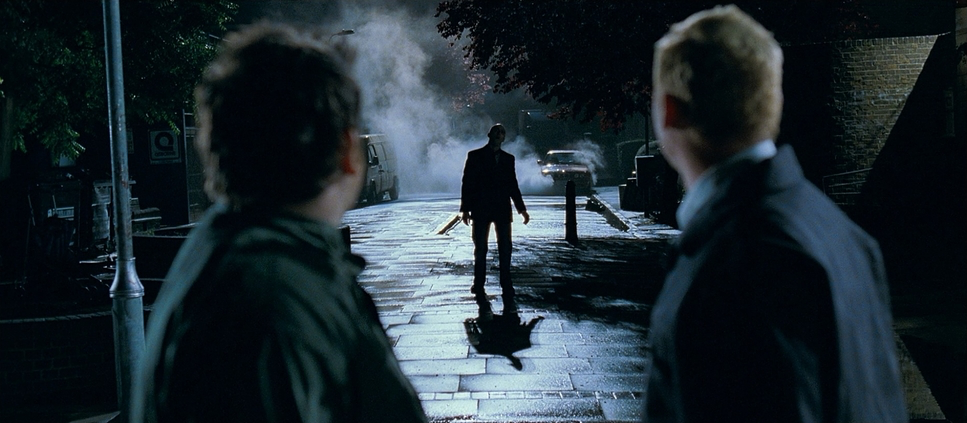
The lighting is surprisingly naturalistic for a genre film. It doesn’t rely on theatrical “horror” lighting with green gels and heavy fog. Instead, Dunlap uses motivated sources streetlights, emergency flares, and the dim practicals of a pub at night.
In the Winchester, the lighting becomes utilitarian and claustrophobic. It relies on ambient pools of light that leave the corners of the room in deep shadow. I’ve always appreciated this “understated” approach. By keeping the lighting grounded in reality, the few moments where it does become dramatic like the soft, melancholic glow during the emotional beats feel earned rather than forced.
Technical Aspects & Tools
Shaun of the Dead (2004)
Technical Specifications & Credits
| Genre | Comedy, Horror |
| Director | Edgar Wright |
| Cinematographer | David M. Dunlap |
| Production Designer | Marcus Rowland |
| Costume Designer | Annie Hardinge |
| Editor | Chris Dickens |
| Colorist | Max Horton |
| Time Period | 2000s |
| Aspect Ratio | 2.35 – Anamorphic |
| Format | Film – 35mm |
| Story Location | England > London |
| Filming Location | England > London |
| Camera | Arriflex 435, Arri 535 / 535B, Arri 235 |
| Lens | Cooke S4/ i |
Shooting on 35mm in 2004 gave this film a “gate weave” and a subtle grain that grounds the absurd premise. But the real MVP here is the editing by Chris Dickens. The precision required to time camera movements to sound effects and dialogue is insane. The Queen “Don’t Stop Me Now” sequence is the gold standard for this. Every bash of a pool cue is synced to the beat. This kind of “visual music” requires a level of planning between the DP and the editor that most productions just don’t have the patience for. It’s a reminder that great cinematography isn’t just about a pretty shot; it’s about how that shot fits into the puzzle of the edit.
- Also read: NIGHTCRAWLER (2014) – CINEMATOGRAPHY ANALYSIS
- Also read: THE NOTEBOOK (2004) – CINEMATOGRAPHY ANALYSIS
Browse Our Cinematography Analysis Glossary
Explore directors, cinematographers, cameras, lenses, lighting styles, genres, and the visual techniques that shape iconic films.
Explore Glossary →